Everlink
Digital payments still have a middleman problem.
Even when the coins themselves sit on a public ledger, the "switch" - the piece of software that routes a payment from Alice to Bob - usually belongs to a company.
That company could (theoretically) change the fees, freeze an account, or go offline.
Payment channels were supposed to help by moving small payments off-chain, but they create a different problem: someone still has to keep a payments hub online.
Everlink
Everlink’s answer is not a better human operator. It is no operator.
The project is an Interledger connector implemented as a HotPocket smart contract on Evernode. Several hosts run the same program, agree every few seconds, and share one Xahau account that needs a majority of their keys to sign. Peers prepay through payment channels, send ordinary Interledger packets, and the cluster routes the payment, takes a small fee, and settles on-ledger.
 Interledger, Or "ILP"
And one of the most incredible innovations, is that those fees can then pay the cluster’s own Evernode rent in EVR! 😲
After the account’s master key is turned off, only the cluster’s signer list can move the money.
The Initial Experiment
On September 3rd, a three-host cluster on Evernode mainnet settled a real Xahau payment: "Alice" opened a 5 XAH channel, streamed a claim, and paid "Bob" 1 XAH in about 24 seconds. The cluster co-signed the redemption and the payout, then returned her unused 2 XAH.
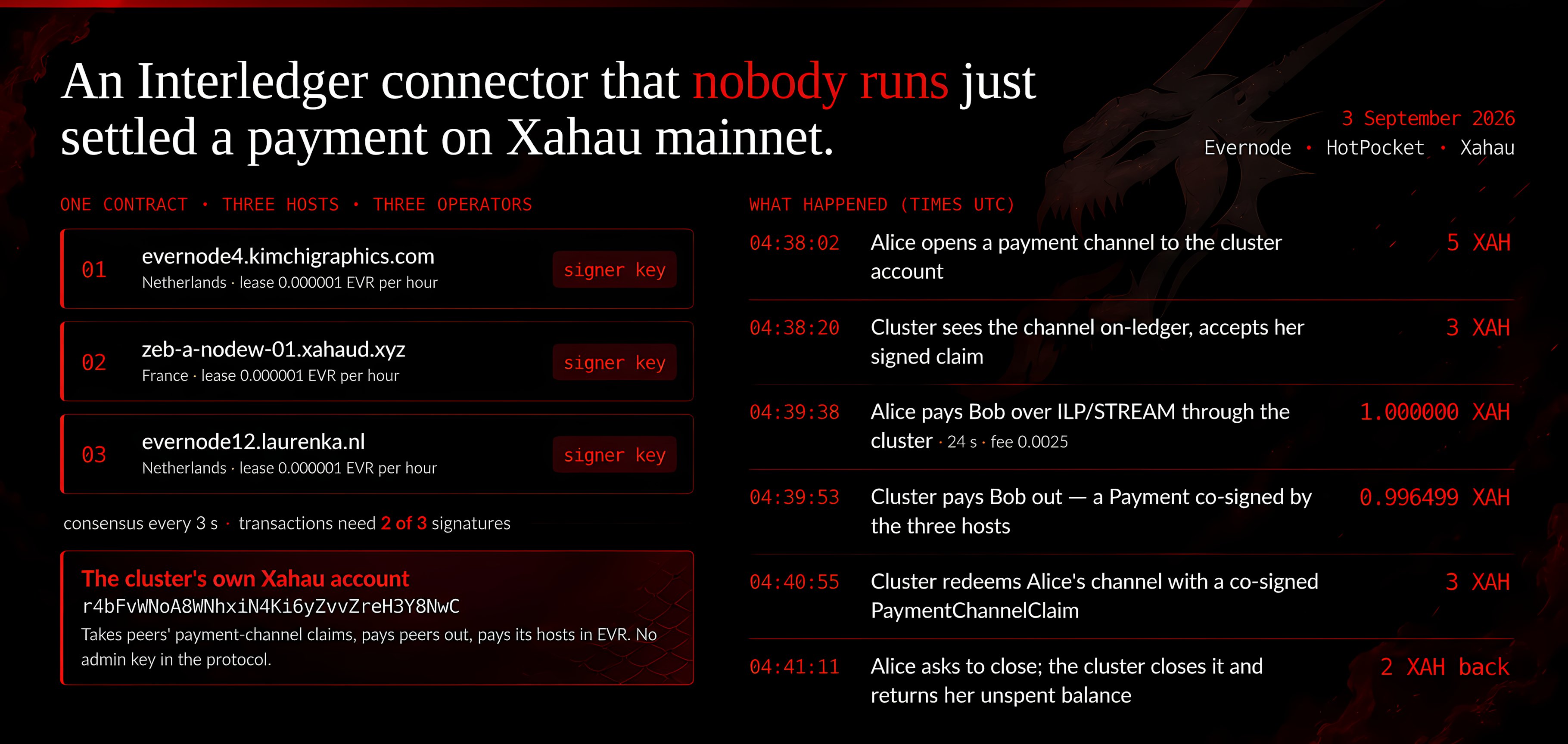 Initial Everlink Experiment
Hosting for the first run cost a near-zero amount; a second cluster later extended its own leases automatically.
Who, What, When
@XRPLNick published the work the same day, calling it “an Interledger connector that nobody runs.”
The code is open-source, and available at GitHub: github.com/XRPLNick/everlink.
What It All Means
In plain language, Everlink shows that financial plumbing can behave like a vending machine instead of a human-run business.
You do not have to trust Nick - or any host - to “keep the books.” Once the master key is disabled, there is no (one) person that can interfere in the process.
A payment switch can take money in, send money out, and pay its own infrastructure bill ... automatically!
Other Hard Problems
Evernode provides decentralized, always-on hosts, leases you can pay in EVR, and a consensus layer so three copies of the program are always verified as the same. That is exactly the job payment-channel designs keep handing to users and "watchtowers".
 Evernode
Everlink does not magically fix every payment-channel limitation.
But it introduces and proves out a possible pattern: put the clerk on decentralized hosts so "Alice and Bob" are not the clerk.
If that works for an Interledger hub, the same pattern may be useful for other “someone has to stay awake” problems around channels, settlement, and automated infrastructure.
More innovations incoming
This is an early experiment.
But ... it is a reminder of why hosting smart contracts next to a payments ledger is a powerful concept. When software can route value, sign for itself, and renew its own lease, it opens the doors to help solve many other intractable problems for the designers of the new finternet.
Nick, whose 'X' profile describes his focus on 'freedom tech', indicated he's still considering the next logical steps for Everlink ... and he shared a powerful part of his own perspective:
"The best way to predict your future is to create it."
E>
Sources
- Announcement of the mainnet connector: https://x.com/XRPLNick/status/2095390274440790321
- Project README: https://github.com/XRPLNick/everlink/blob/main/README.md
- GitHub repository: https://github.com/XRPLNick/everlink
- Evernode: https://evernode.org/
- Interledger: https://interledger.org/developers/get-started/