Evernode For A Low-Trust World
The 2026 Edelman Trust Barometer, a survey of approximately 34,000 people in 28 countries, found that 7 in 10 are unwilling or hesitant to trust someone with different values or information sources.
 Edelman Survey
National government leaders and major news organizations posted the largest trust losses. The only gains went to people in close circles: neighbors, family, and friends.
Trust is retreating from institutions and moving toward what people can personally verify.
The pattern shows up everywhere. Personal data leaks in breach after breach. Official data is doubted by whoever distrusts the publishing organization. And in finance, customers have learned the hard way what happens when one party holds both the assets and the control:
- FTX. The SEC alleged that Sam Bankman-Fried diverted customer funds to his trading firm, Alameda Research, and used them for venture investments, real estate, and political donations.
- Celsius. In January 2023, a U.S. bankruptcy court ruled that crypto in roughly 600,000 "Earn" accounts belonged to the bankruptcy estate, not the customers. Depositors became unsecured creditors of assets they thought they owned.
Both were crypto companies: centralized intermediaries sitting on top of decentralized rails. Any centralized weak point requiring blind trust in a single operator poses a major risk.
That is one of the largest drivers of decentralization.
Evernode
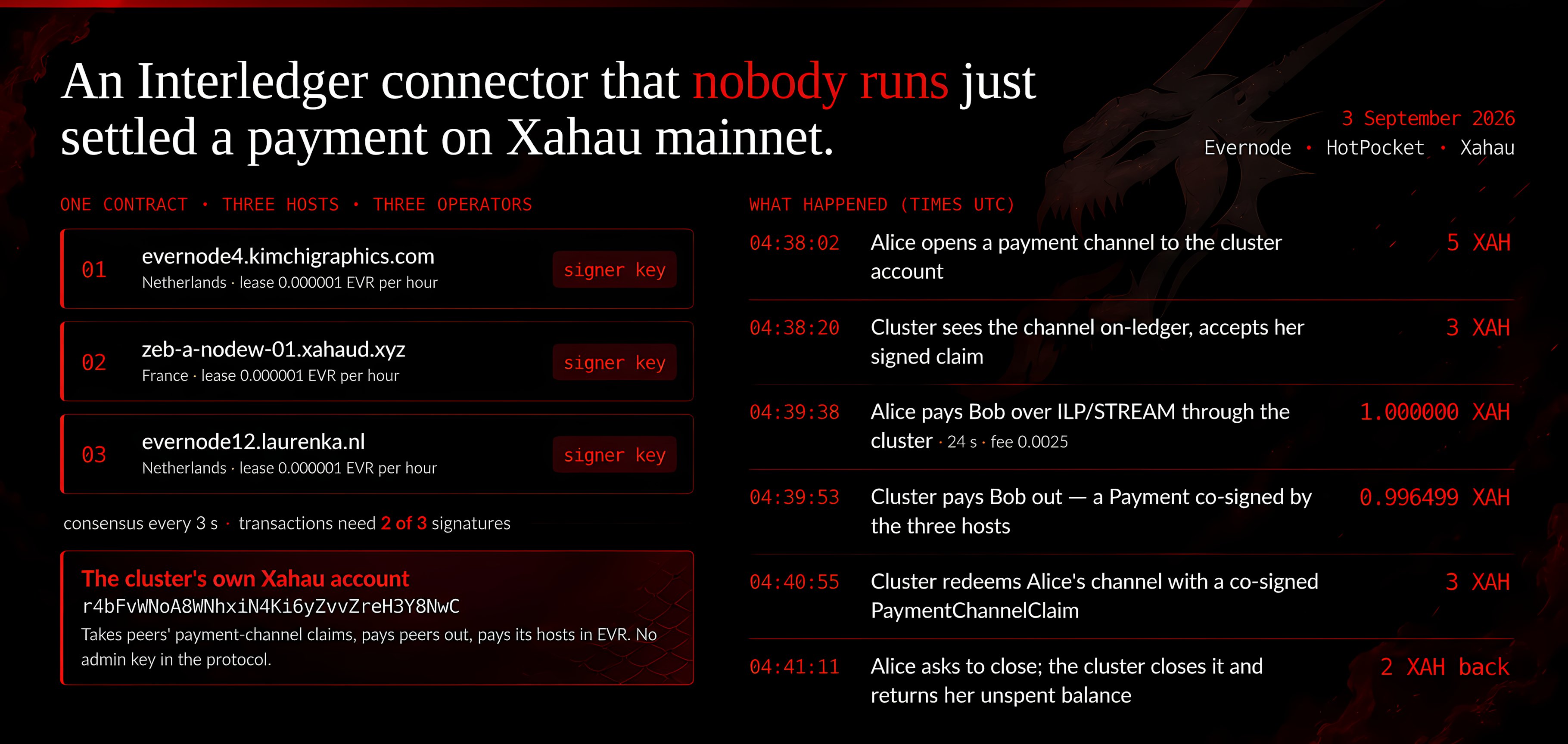
Evernode turns ordinary software into software that no single party controls.
Its dApps run as normal programs, written in almost any language, that can read and write files, call web services, and serve traffic to the open internet. The difference is that each app runs on several independent hosts at once.
The consensus engine, called HotPocket, keeps those copies in-sync: The instances check with each other that they are processing the same inputs and state, and agree on results with no central authority.
Each dApp essentially creates its own small blockchain, an "AppChain," made up of the hosts it runs on.
Three more parts:
- A permissionless host marketplace. Anyone can run the hosting software on a Linux server and lease capacity to dApps ... paid hourly in Evernode's token, Evers (EVR).
- Xahau. Registry, rewards, and governance live in automated accounts called "hooks", on the Xahau Network, an "XRP Ledger with smart contracts", so no company controls who is a host.
- Peer-tested reputation. Every hour, hosts are placed in random groups of up to 64 that test each other's computing power and reachability.
One architectural detail matters a lot: Hosts are identifiable: they register a public email and a domain name, are expected to follow local hosting laws, and can revoke a lease if legally required. That makes Evernode a poor fit for anonymous, anarchist use cases, and a strong fit for something else: accountable decentralization. No single operator can cheat, yet every operator is a known, legally reachable entity.
Institutions, regulators, and cooperatives merge naturally with this architecture.
The Big Idea
Much of what a trad-fi platform is, operationally, is software plus a trusted operator. A clearinghouse, an escrow agent, a land registry, and a stock transfer agent are all "databases", essentially, run by someone that stakeholders must trust.
Today, parties who don't trust each other have two ways to share infrastructure.
- They can appoint a neutral operator, who becomes a possible point of failure.
- Or they can form a consortium with governance, lawyers, and a hosted platform.
Evernode offers a third option: a consortium without an operator.
The application itself becomes the neutral party, replicated across hosts that no single member controls. Institutions provide four kinds of trust: correctly executing rules, keeping secrets, determining truth, and providing recourse.
Evernode is strongest at the first: "correctly executing rules"
Social Trust: A Public-Record Witness Network
The problem: Official information is changed for unclear purposes. Statistical series are revised without notice, reports disappear, web pages are edited, and terms of service transform overnight.
Today's defense is the archive, usually run by a single organization ... which is one point of failure.
In October 2024, the Internet Archive suffered a breach exposing 31 million records alongside repeated denial-of-service attacks, and took services offline while it recovered. Any archive one entity controls can also be sued, pressured, or defunded.
 The Internet Archive
The solution: replace one trusted archivist with many independent witnesses who must agree. Think of the difference between one person's diary and a statement notarized by a dozen witnesses in different countries.
This use case - using Evernode as an archivist solution - showcases the network's strength; witnesses would spread across jurisdictions and unrelated operators. A fascinating version of this archivist idea might mix those hosts with named institutional witnesses, such as university libraries and press-freedom groups, so the record is credible enough to cite.
KJV Forever - Real Example
One of the first projects in this vein is known as "KJV Forever," which seeks to verify & streamline the provenance of the King James Bible, one of the most popular representations of the various canonical texts:
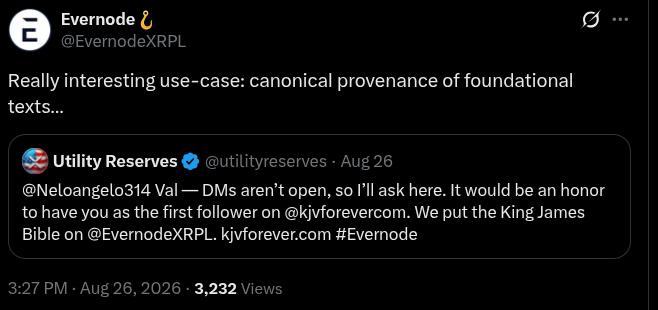 Canonical Provenance Of Foundational Texts
The project description states:
"The text is not kept on one company’s server. It lives inside a HotPocket smart contract on the Evernode network: several independent machines each hold the full text and must agree, byte for byte, on every response you receive."
Finance: Inter-Bank Escrow
"Escrow" means money or assets that are held until agreed conditions are met.
Between banks, it underpins trade finance (pay the exporter when shipping documents arrive), cross-border conditional payments, and securities settlement. Today it runs on correspondent banks, escrow agents, and message reconciliation: expensive middlemen whose main product is neutrality.
Evernode fits this problem like a glove:
- Known parties who don't fully trust each other. A cluster run by identified parties guarantees that no one, including the counterparty, can alter the escrow state alone.
- The parties can be the hosts. Each bank can run its own nodes, alongside neutral tiebreakers such as an auditor or even a regulator.
- Escrow logic is deterministic. "If a document with this fingerprint is signed by these parties before this date, release; otherwise refund" is exactly what replicated consensus handles well. (think of the work being done by Andrei Rosseti here)
- Proven software. Bank workflows parse ISO 20022 messages, handle trade documents, and call sanctions-screening services. Evernode runs the Java, C#, or Python libraries banks already use.
- One chain per deal?! There is no need to onboard the whole industry first: A cluster can theoretically be spun up per transaction or corridor and retired afterward.
The competition: BIS Project Agorá brings together seven central banks and more than 40 institutions, including JPMorgan, HSBC, and UBS. Partior, LSEG's Digital Settlement House, and the Canton Network are all targeting the same banks.
Evernode's most-likely market is everyone those consortia underserve: regional banks, credit unions, emerging-market trade corridors, and bespoke bilateral deals that two mid-sized banks could stand up in weeks.
The obstacles for an Evernode solution are institutional, not technical.
Fiat still moves on trad-fi rails; Partior's own settlement banks, as of September 2026, still square up with each other the traditional way. Settlement finality needs legal recognition, contract upgrades need multi-party sign-off, and banks typically only buy from vendors with irconclad service level agreements (SLAs).
The likely path for this use case is a commercial firm packaging Evernode's engine for mid-tier banks ... like how Digital Asset packages Canton. 🤔
A.I. Trust Issues
An A.I. agent can't open a bank account, sign a contract, or be legally liable. In addition, it can be cloned or discarded for free, so reputation is ephemeral at best.
Therefore, when two companies' agents negotiate, there is a 'trust' question: whose server hosts the deal?
Evernode answers part of this ideally:
- Neutral ground. A negotiation, escrow, or shared record can run on a cluster neither company controls.
- Guardrails outside the model. Spending caps, allowlists, and approval thresholds enforced by consensus and by Xahau hooks can't be "talked around" by a manipulated agent.
- Verified rules and an audit trail. Every state change is agreed-upon by independent hosts and recorded, so disputes have evidence.
 Evernode Is Neutral Ground For A.I. Agents
Evernode does not have an answer for everything, however.
LLMs are non-deterministic, so three nodes asking the same model get three different answers, which breaks consensus. Scott Chamberlain has described the right approach: deterministic rules run inside consensus, while the agent's model calls run in a separate process outside it.
Trad-Fi Incumbents
Mastercard launched Agent Pay in April 2025, built on tokens scoped to individual agents, and Visa responded a day later with Intelligent Commerce. Google's Agent Payments Protocol (AP2) uses cryptographically signed "mandates" as proof of what a user authorized, and supports stablecoins through Coinbase's x402 protocol.
The two models compete:
- The incumbent's model extends trusted intermediaries: card networks vouch for agents and absorb fraud risk, as they do for cards today.
- The DePIN model builds trust-minimized infrastructure: keys, stablecoins, and code-enforced rules, much of it from grassroots crypto projects.
The likely outcome is a hybrid. Evernode's natural role in either world is the deterministic referee: the neutral layer where agents from different owners meet, agree on rules, and settle.
Evernode Was Created For A Low-Trust World
The low-trust transition won't happen overnight.
It will be a slow replacement of "trust me" with "check for yourself." Evernode doesn't make anyone honest, keep every secret, or decide what is true. Instead, it lets people who don't trust each other run the same software, with no one in charge and everyone simultaneously accountable.
Basic examples from this article: A witness network that exposes secret revisions, an escrow banks can trust, and a neutral location where AI agents meet.
The first adopters are building the kind of tools the next decade will need ... ones that enshrine neutrality. If you've been waiting for proof that trust can be engineered rather than depending on one individual or organization, look no further than Evernode.
E>
Sources
- 2026 Edelman Trust Barometer press release: https://www.edelman.com/news-awards/2026-edelman-trust-barometer-society-slides-into-insularity
- Edelman 2026 insights for financial services: https://www.edelmansmithfield.com/2026-Edelman-Trust-Barometer-Key-Insights-for-Financial-Services
- SEC charges against Sam Bankman-Fried (FTX): https://www.sec.gov/newsroom/press-releases/2022-219
- Celsius Earn accounts ruling analysis (O'Melveny): https://www.omm.com/insights/alerts-publications/the-words-matter-bankruptcy-court-finds-clear-terms-of-clickwrap-agreement-made-customer-cryptocurrency-property-of-celsius-bankruptcy-estate/
- Evernode official site: https://evernode.org/
- Evernode platform overview (HotPocket): https://docs.evernode.org/en/latest/platform/overview.html
- Internet Archive 2024 breach report: https://www.infosecurity-magazine.com/news/internet-archive-breach-31m/
- Internet Archive services update, Oct 2024: https://blog.archive.org/2024/10/21/internet-archive-services-update-2024-10-21/
- Provenance of foundational texts: https://x.com/EvernodeXRPL/status/2092725660192240074?s=20
- KJV Forever: https://kjvforever.com/#/about
- BIS Project Agorá prototype report coverage: https://www.ledgerinsights.com/bis-project-agora-prototype-keeps-central-bank-money-under-domestic-control/
- Partior and LSEG settlement bank leg: https://theindustryspread.com/partior-lseg-dish-settlement-bank-leg-q1-2027/
- JPMorgan deposits on Canton Network: https://www.mexc.com/it-IT/news/427281
- Building AI agents on Evernode: https://lexautomagica.com/2026/05/13/adventures-in-ai-consensus-1-bringing-autonomous-economic-agents-to-evernode/
- Mastercard Agent Pay explainer: https://eco.com/support/en/articles/14845483-mastercard-agent-pay-explained
- Visa Intelligent Commerce: https://www.visa.com/en-us/solutions/intelligent-commerce
- Google Agent Payments Protocol (AP2) announcement: https://cloud.google.com/blog/products/ai-machine-learning/announcing-agents-to-payments-ap2-protocol
- Coinbase x402 in AP2: https://www.coinbase.com/developer-platform/discover/launches/google\_x402