Collateral: XRP & XAH
Every loan rests on a contingency: if the borrower can't pay, the lender has something to take. That "something" is collateral, and it underpins nearly every part of finance, from a family's mortgage to a hedge fund's leveraged trading book.
 Collateral For A Mortgage
For most modern financial systems, good collateral has meant a short list of assets: cash, government bonds, blue-chip stocks, real estate. That list is now changing. Over the past year, digital assets have moved from "too risky to touch" to accepted collateral at prime brokers, major exchanges and even the largest U.S. bank.
My view is that this is a structural shift.
Prime Brokers
A prime broker is a one-stop shop that large banks run for professional investors, mainly hedge funds. Instead of using dozens of firms for borrowing, trading, safekeeping and paperwork, a fund parks its assets with a single prime broker that does all of it under one roof.
The prime broker:
- Lends money so the fund can buy more than its own capital allows.
- Lends securities so the fund can sell short.
- Holds the fund's assets in custody and settles its trades.
- Nets everything into one margin account, so long and short positions offset each other ... and as a result, the fund needs less total collateral.
That last point is the heart of the business. A prime broker decides what counts as collateral, how big a discount (a "haircut") each asset gets, and when to issue a margin call. Its test for any asset comes down to three questions:
- Can I value it every day?
- Can I sell it quickly in a crisis?
- Can I legally and physically control it?
Traditionally, only cash, Treasuries and liquid stocks passed easily.
The open question has been whether digital assets could pass, too.
Ripple Prime
In April 2025, Ripple announced its purchase of the prime broker Hidden Road for $1.25 billion - one of the largest deals in crypto history. With it, Ripple became the first crypto company to own and operate an International, multi-asset prime broker.
 Ripple's Purchase Of Hidden Road
The stated goals were to use Ripple's dollar stablecoin, RLUSD, as collateral across Hidden Road's products, and to migrate its post-trade activity onto the XRP Ledger.
Renamed Ripple Prime, the business has since gone further. By March 2026, its CEO was describing institutions posting XRP directly as margin. A fund can pledge XRP, receive dollar credit, and use it to trade CME futures, all without selling tokens.
Ripple Prime now accepts a mix of Treasuries, fiat currencies, gold, BTC, XRP and tokenized money market funds. U.S. clients can cross-margin XRP and RLUSD holdings with OTC swaps and CME futures and options. RLUSD is accepted at a zero haircut, and revenues have reportedly tripled since the acquisition.
Evernorth
Evernorth is a Ripple-backed public company built to hold XRP, often compared to Strategy (formerly MicroStrategy) for BTC. It raised over $1 billion from backers including SBI Holdings, Ripple, Pantera, Kraken and GSR, and now trades on Nasdaq as XRPN.
The key difference from Strategy is that Evernorth runs an active treasury. Rather than simply buying and holding, it will attempt to grow XRP per share through lending, liquidity provisioning and decentralized finance yield.
That makes it a natural participant in exactly the kind of collateral markets Ripple Prime is building.
Ripple's New Bank
On October 26, 2026, on the eve of Ripple's Swell conference in New York, the Office of the Comptroller of the Currency granted final approval for Ripple National Trust Bank.
A national trust bank is not a full-service commercial bank. It safeguards and manages assets for others, but it generally doesn't take ordinary deposits or make loans. Its authority is:
- Managing the segregated reserves backing RLUSD.
- Acting as collateral trustee of those reserves for RLUSD holders.
- Providing fiduciary digital asset custody.
Brad Garlinghouse framed the charter as giving Ripple "an even stronger foundation for RLUSD." That matters for collateral. Remember the prime broker's third question: can I legally and physically control it? Federally supervised reserves and custody make RLUSD easier for other institutions to treat like cash, and they give conservative lenders a regulated, neutral place to hold pledged digital assets.
Synergy
Put the pieces together and a full collateral stack comes into view:
- Ripple Prime lends against XRP, RLUSD and other assets.
- Evernorth holds a large pool of XRP it wants to put to work.
- Ripple National Trust Bank holds the reserves behind RLUSD and can provide federally supervised custody.
The potential fit is easy to see. A large holder like Evernorth could lend XRP to Ripple Prime's clients, the way pension funds lend stocks to Wall Street prime brokers, earning fees that grow its XRP per share. It could also borrow dollars against its XRP. RLUSD, backed by federally-supervised reserves, serves as the cash leg that moves between them.
No such arrangement between these entities has been announced formally, but the architecture is clearly being assembled.
Collateral For Retail
For everyday borrowers, collateral has long meant small, case-by-case loans: a savings account pledged for a credit-builder loan, a car title, gold jewelry at a pawn shop. The common thread is that the lender needs an asset it can value and take quickly.
Crypto is now entering this space. In February 2026, Coinbase added XRP, along with DOGE, ADA and LTC, as eligible collateral for USDC loans of up to $100,000. Coinbase had earlier relaunched Bitcoin-backed loans in the U.S., and decentralized lending protocols let holders pledge tokenized gold to borrow stablecoins.
At the institutional end, JPMorgan now accepts Bitcoin and Ether as collateral for loans to institutional clients. BitGo has launched lending against a mix of assets held in custody. Ripple is clearly not alone.
The trend is broadening.
XRP, XAH, And Others
Why might native tokens of public networks make particularly good collateral?
Because of their properties:
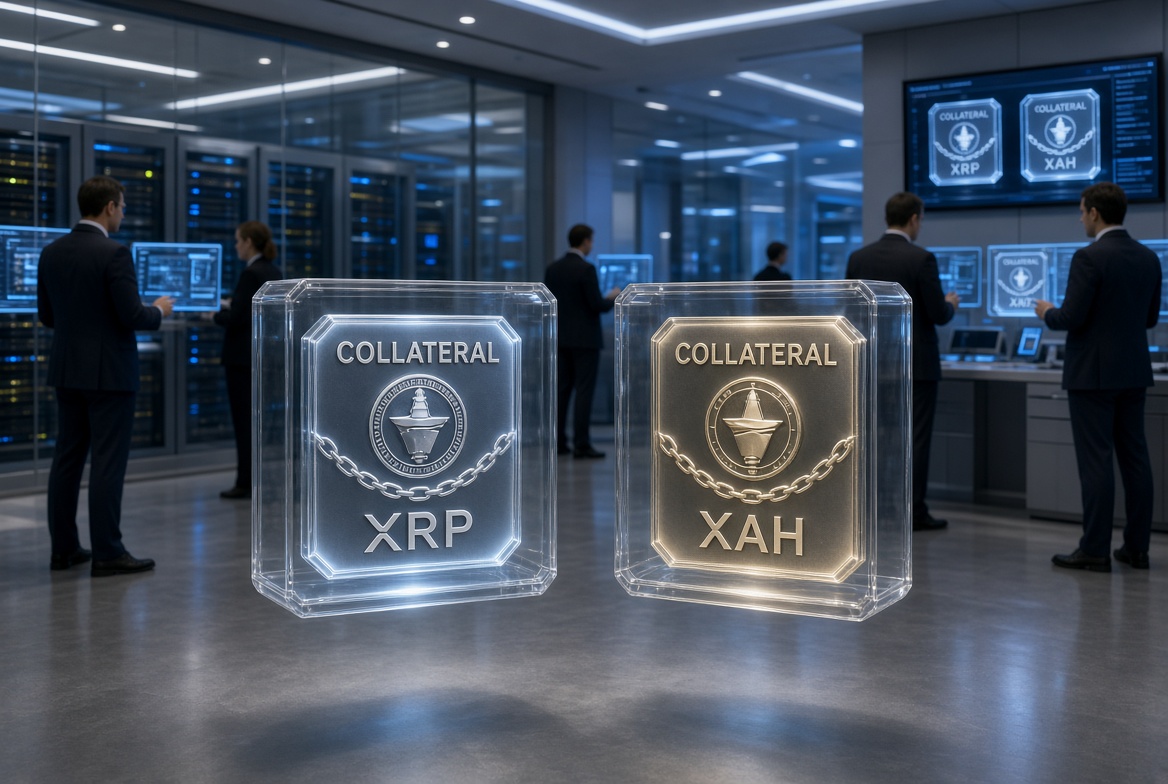
- No counterparty. XRP and XAH are native assets. They aren't anyone's IOU, so there is no issuer that can default.
- Transparency. Holdings and transfers are visible on a public ledger. In 2008, nobody could see where pledged collateral had gone; on a public ledger, that chain can be traced.
- Fast, final settlement. Ledgers like the XRPL settle transactions in seconds, around the clock, including weekends.
- Programmability. Xahau, a network built from the XRP Ledger's codebase by independent developers, adds "hooks," small smart contracts attached to accounts. Logic like this could, in principle, enforce collateral rules automatically.
Speed matters more than it might seem. Margin is sized to cover how much prices could move before a lender can actually get paid. As Ripple Prime's CEO has noted, collateral that moves in seconds shrinks that window, which can reduce how much margin is needed in the first place.
 Native Tokens As Collateral
The honest counterweight is volatility. Lenders still apply steep haircuts to crypto; JPMorgan's reported haircuts on BTC and ETH run 30% to 50%. Crypto doesn't win as collateral by being stable. It wins by being instantly movable, verifiable and free of counterparty risk.
The Finternet
In 2024, the Bank for International Settlements' Agustín Carstens and Infosys co-founder Nandan Nilekani described the "Finternet": a future financial system of interconnected ecosystems, much like the Internet, built on tokenized assets and unified ledgers.
Collateral is where that vision becomes concrete.
A Finternet where assets move instantly but collateral still settles on business-day timelines would be like a sports car stuck in traffic.
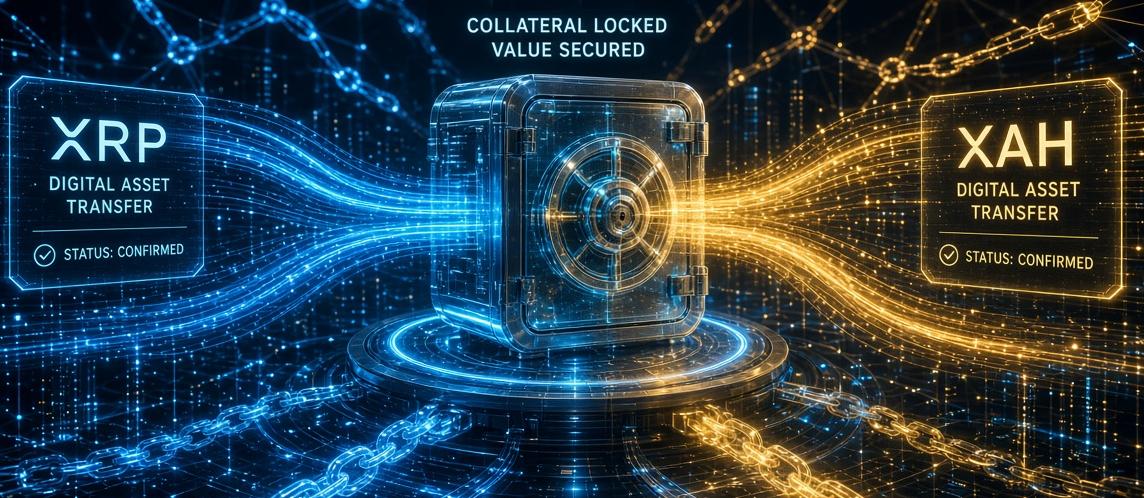 Native Network Tokens As Collateral
Native digital assets, held by trusted custodians and pledged in seconds, are the missing ingredient. Ripple's prime broker, its new trust bank and the growing list of lenders accepting crypto are early pieces of that system. The direction of travel is clear: collateral is going digital, and crypto is becoming part of the foundation.
X | X>
Sources
- Ripple press release on the Hidden Road acquisition: https://ripple.com/ripple-press/ripple-acquires-prime-broker-hidden-road/
- FinTech Futures on the Hidden Road deal: https://www.fintechfutures.com/m-a/ripple-acquires-hidden-road-for-1-25bn-to-expand-institutional-crypto-services
- Ripple Prime CEO on XRP as collateral (Coinpedia): https://cryptonews.net/news/altcoins/32570810/
- Ripple Prime CEO on posting XRP as margin: https://www.mexc.com/it-IT/news/960587
- Markets Media on Ripple Prime growth and RLUSD haircuts: https://www.marketsmedia.com/ripple-prime-prepares-for-wall-street-2-0/
- Blockworks on Evernorth's formation and strategy: https://blockworks.com/news/ripple-evernorth-raise-xrp
- Evernorth SEC filing (Oct 2026): https://www.sec.gov/Archives/edgar/data/0002092592/000119312526419605/d118629dex991.htm
- Ripple press release on OCC trust bank approval: https://ripple.com/ripple-press/ripple-receives-final-occ-approval-to-establish-national-trust-bank/
- Swell 2026 dates (Bitcoinist): https://bitcoinist.com/ripple-makes-major-announcement/amp/
- Coinbase adds XRP as loan collateral: https://www.mexc.com/news/754598
- BitGo portfolio-based lending and Coinbase Bitcoin loans: https://www.mexc.com/news/995630
- JPMorgan accepts BTC and ETH as collateral (The Block): https://www.theblock.co/amp/post/376038/jpmorgan-to-let-institutional-clients-pledge-btc-eth-loan-collateral
- JPMorgan crypto collateral haircuts: https://whale-alert.io/stories/eedb01e3c041e5/JPMorgan-to-accept-Bitcoin-and-Ethereum-as-collateral-for-US-dollar-loans-through-Kinexys-in-2026
- Tokenized gold as DeFi collateral (BTC-Echo): https://www.btc-echo.de/news/tokenisiertes-gold-marktwert-auf-400-milliarden-dollar-227595/
- Xahau network overview: https://xahau.network/docs/resources/whitepaper/
- BIS working paper on the Finternet: https://www.bis.org/publ/work1178.pdf