Xahau: Three Years Old
Close to Halloween of 2023, a group of long-time, independent XRP Ledger builders switched on Xahau: a layer-one blockchain built from the XRP Ledger's proven code base, with one major addition, hooks. Hooks are smart contracts that attach directly to an account and run automatically based on either transactions happening, or the passage of time.
This month, Xahau turns three. 🎂
Year three was not an easy one for crypto. Prices fell, exchanges closed, and capital fled to the safest corners of the market. But on Xahau, year three was the year the application layer grew by leaps and bounds. DeFi, security, messaging, collectibles and developer tooling all shipped.
The High Points
One Xahau
For its first two years, Xahau had almost no DeFi applications. That changed in June 2026, when One Xahau launched.
 One Xahau
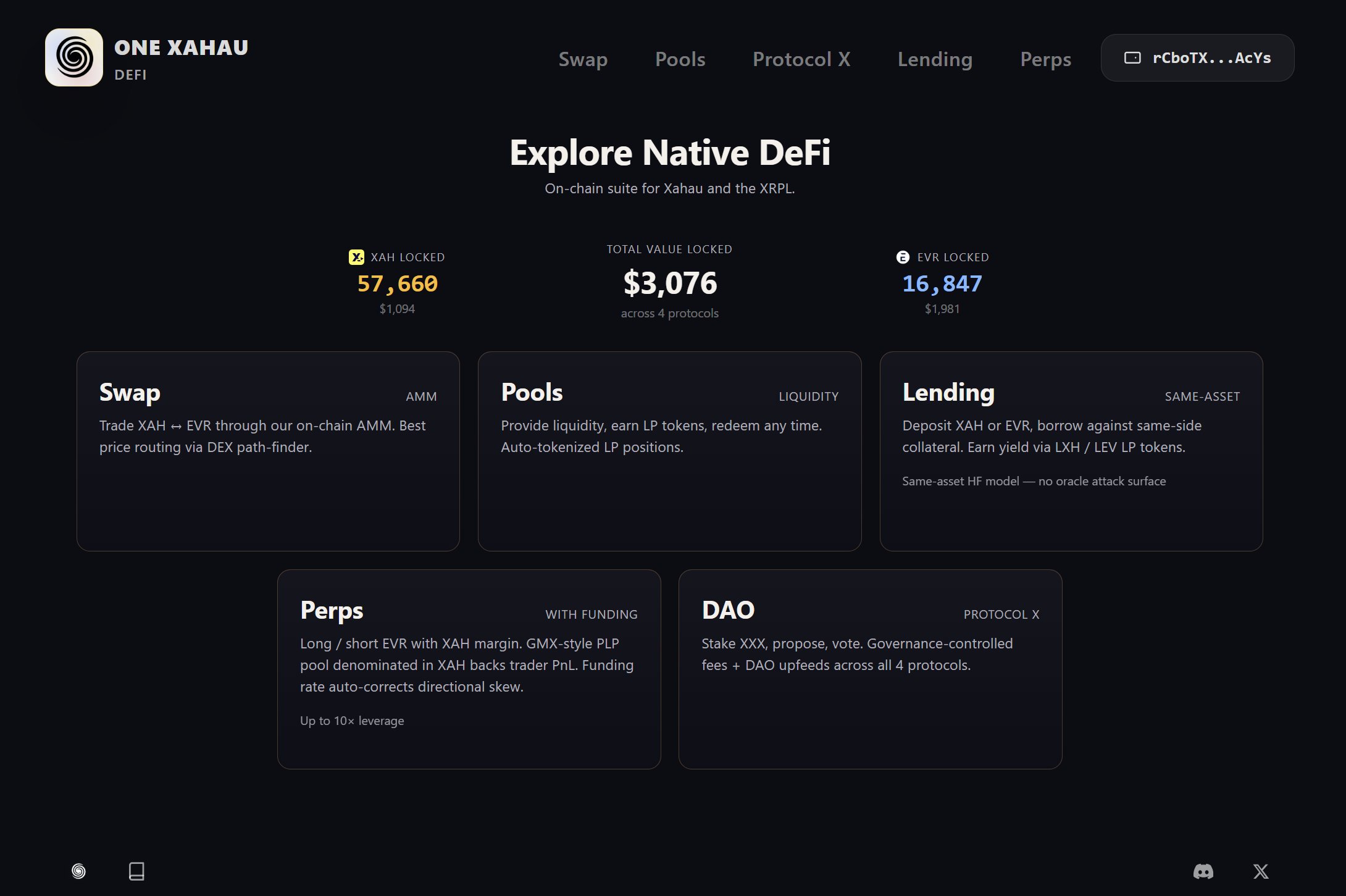
Built by Cbot, One Xahau began life as a token data aggregator and grew into one of the first full DeFi suites on the network. It launched with three products, each powered entirely by Hooks:
- An automated market maker (AMM), where liquidity providers earn fees from swaps, and new token pairs are listed by DAO vote.
- Perpetual contracts, initially offering long and short positions on EVR (Evernode's token) priced in XAH, with funding rates and position caps to protect the pool.
- A collateralized lending pool, where borrowers can take loans up to 50% of their collateral's value, with interest flowing back to liquidity providers.
A share of every fee flows to the One Xahau DAO, governed by on-chain Hooks and an elected council. Votes are cast with the platform's XXX governance token, which is consumed when used.
The significance: sophisticated, multi-product financial applications can run on hooks today, without waiting for native protocol features.
Cbot has also said he plans to open-source the core AMM, lending and perpetuals hooks for other developers to reuse.
Odin's Eyes
In the XRP ecosystem, the response to theft has historically depended on volunteers. These are people trying to help others: explorers that flag scam addresses, independent forensic investigators tracing funds hop-by-hop, and someone persuading an exchange to freeze an account before the money is cashed out.
Odin's Eyes, also built by Cbot and live on Xahau mainnet since July 2026, is an attempt to make that response automatic ... and to pay the people who do the watching.
It works like this:
- A central registry account (the "Eye") records a single status for each address it has evaluated: clean, verified, suspicious, or confirmed malicious.
- Other accounts in the ecosystem install a small companion hook (a "raven") that checks every counterparty against that registry before a transaction clears.
- When an address is blacklisted, the registry broadcasts the decision, and every raven freezes that address on its own account - no manual update required. Ravens also trace who funded a flagged account, so "mule" accounts used to scatter stolen funds inherit the bad status automatically.
- Raven operators earn RVN, a capped-supply reward token, through a small baseline reward for screening traffic, plus larger bounties for confirmed catches.
Odin's Eyes can't reverse a theft, and it only protects the parts of the ecosystem that opt in ... but it introduces something the volunteer model never had: an incentivized, network-wide circuit breaker that can freeze stolen funds before they reach a cash-out point.
There are currently 40 active 'raven' accounts helping to fine-tune the new automated safety net, including the high-profile accounts that belong to the One Xahau Defi group.
Evergram
Most messaging apps ask you to trust a company: its servers, its policies, and its ability to resist legal and commercial pressure. Evergram, created by Brazil-based developer Andrei Rosseti, takes a different approach.
 Evergram: Wallet-Based Authentication
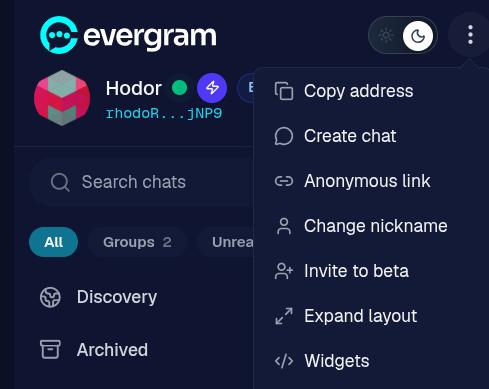
Your identity is your wallet on the XRP Ledger or Xahau, and you log in with a non-custodial wallet such as Xaman. Each chat has its own encryption key, messages are encrypted on the sender's device before they leave it, and - by design - neither Evergram nor its infrastructure can decrypt them. The app itself runs on Evernode, a decentralized hosting network, paid for in EVR, with Xahau Hooks handling user registration and payments for the Pro membership in XAH.
Evergram debuted in January 2026. In August 2026 it shipped Orion, a major release that turned it from a wallet-based chat client into a significantly larger communication stack:
- Public group discovery and shareable invite links, with admin approval and moderated modes.
- Embeddable widgets that let any website offer end-to-end encrypted chat to visitors who don't have a wallet at all - a natural fit for customer support, tip lines and confidential intake forms.
- Slash commands that put payments (
/pay) right in the chat box. - Device and storage configuration, and a suite of more than 400 unit tests.
Evergram also reflects a pattern in Andrei Rosseti's work. It follows Xahau DocProof (2025), a blockchain-based notary, and Origo (late 2025), a single-signer document verification tool - each of them being a step in building identity and trust tools on Xahau.
Xahau Vault
Xahau handles NFTs differently from the XRP Ledger. Its URITokens are deliberately lean: a link and an owner, with features such as royalties, auctions and escrowed trades left to hooks.
While URIs (NFTs) on Xahau certainly existed - and were used by early-adopter developers - there was no smooth way to list or trade them outside of direct peer-to-peer trading via wallet apps.
Xahau Vault, Cbot's third major project of the year, filled that gap. It's a non-custodial NFT and URIToken marketplace: users log in with Xaman, their holdings appear automatically, and they can buy at a listed price or swap peer-to-peer. Trades settle on-chain through Cbot's broker and swap hooks; the marketplace never takes custody of the tokens.
And ... an auction hook just went live this month!
Xahau Vault integrates with its neighbors: collectors can launch One Xahau or message another owner through Evergram directly from the site.
Two related items:
- Native royalties. URITokens have no built-in creator fee today. Cbot Labs has proposed an amendment that would let creators set a permanent royalty at mint time, paid automatically on secondary sales.
- XRP Ledger support. Cbot has said he plans to extend Xahau Vault to the XRPL, possibly with cross-chain functions once the FeatureExport amendment is available.
Xahau Cards
On-chain card collecting was one of crypto's few bright spots in 2026. According to Blockworks Research, collectors spent more than $320 million on on-chain card packs in June 2026 alone - more than five times the prior year. Much of that runs on Solana and Polygon, through platforms backed by physical cards.
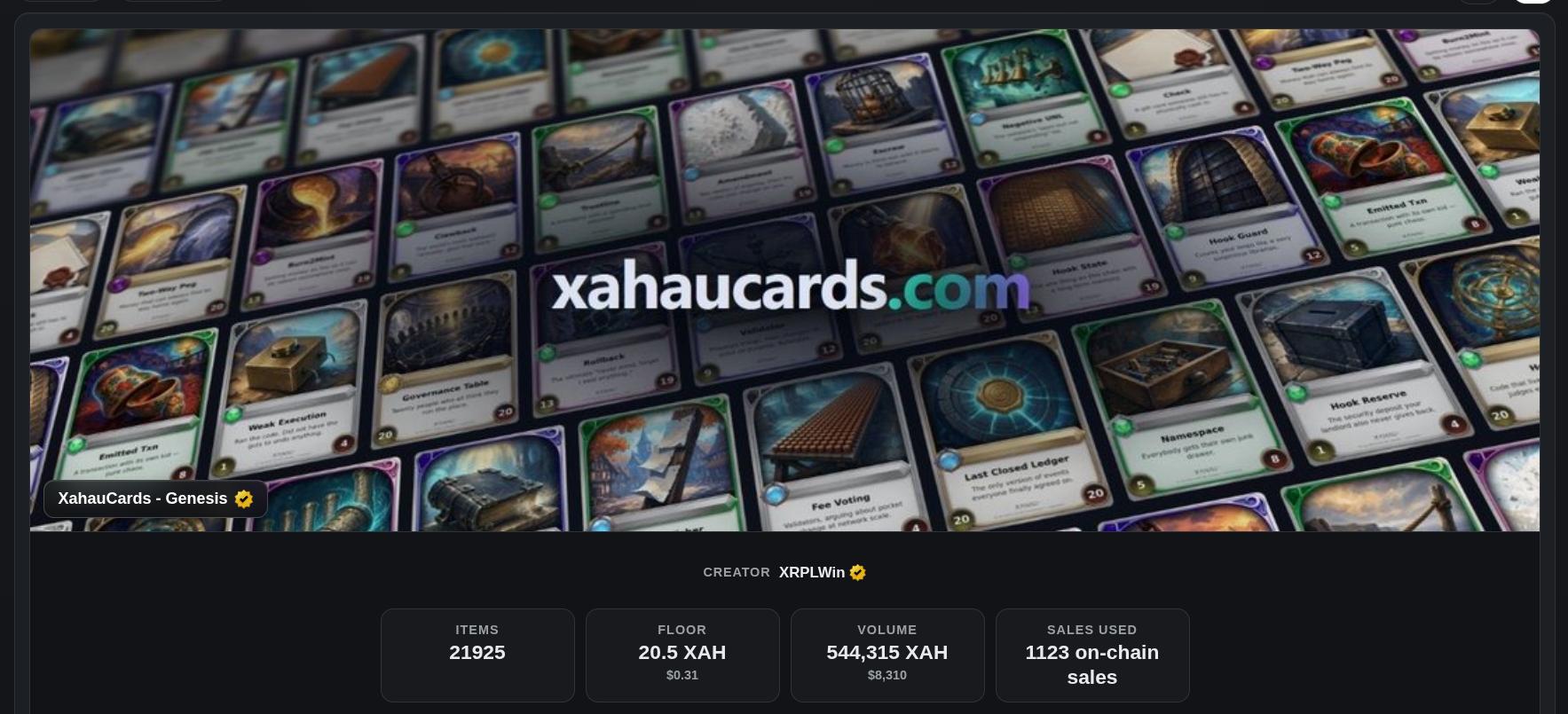
Xahau Cards, created by the developer behind the XRPLWin explorer, takes the digital-native route: the card is the token, minted as a URIToken. Opening a pack costs a small amount of XAH, and the ledger decides first the rarity tier and then the specific card. Non-legendary cards also have their stats rolled, so two copies of the same card can be worth very different amounts.
The minting, shop logic and card data are all run by four hooks, which XRPLWin open-sourced.
Two features stand out:
- Cryptographic autographs. A card owner can ask a whitelisted signer to sign their card. The signature is stored as part of the token itself, permanently altering the card. David Schwartz (JoelKatz) and Richard Holland, the architect of hooks, were among the signers.
- Achievements. Fifty video-game-style collector milestones are tracked automatically on the site.
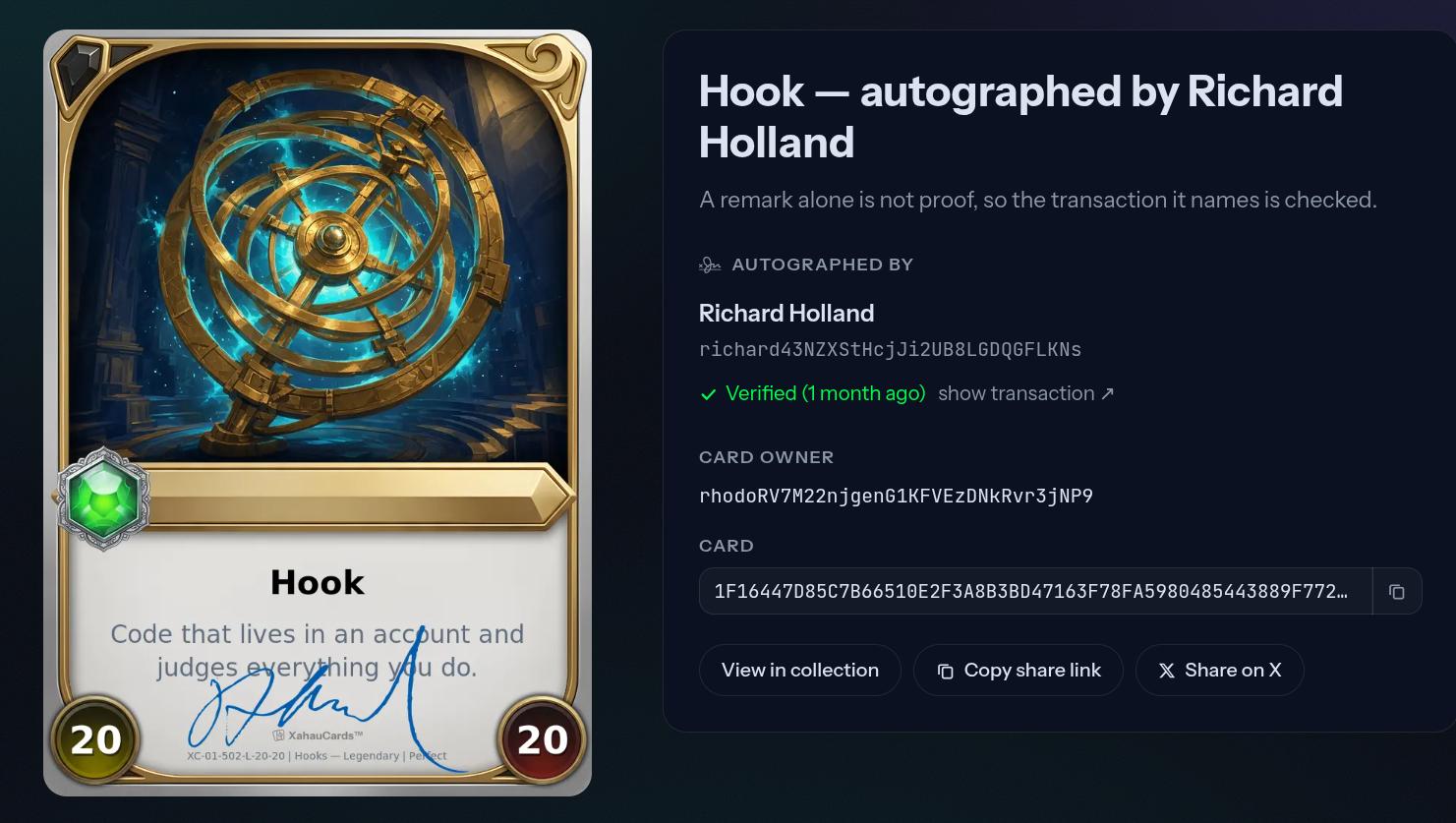 Xahau Cards: Cryptographic Autographs
The results surprised even the creator.
The Genesis set opened on September 18, 2026, and its 5,000-pack public allocation sold out in under three hours. Including a claim promotion for FUZZY NFT holders on the XRP Ledger, 5,098 packs (25,490 cards) were minted. By October 9, the collection had recorded 1,123 sales and roughly 544,000 XAH in volume on Xahau Vault.
XRPLWin has said there will be more sets, and that playable game rules might follow for one or more of the sets.
Upgraded Tools
Year three also brought major improvements for developers building on Xahau. While there are dozens of examples that I re-posted as I read through them on 'X', two of my favorites are:
xahau-mcp and the Kairo Vault toolchain. In June 2026, a community developer known as Hugegreencandle released xahau-mcp, the first Model Context Protocol for Xahau, which gives AI agents a structured way to read the ledger and reason about Hooks. It was the first piece of a three-tool, open-source (MIT-licensed) toolchain under his Kairo Vault effort:
- Flight Simulator runs a transaction's hook code against live ledger state before you sign, so you know whether a hook will accept or reject it.
- xahc helps write, lint, test and package safe C hooks.
- xahc-prover goes beyond testing to formally prove that a hook satisfies safety rules (spend limits, destination locks, no double-spend and more) for every possible transaction - or returns the exact transaction that breaks the rule.
XRPLWin's next-generation explorer. In October 2026, XRPLWin - fresh off the Xahau Cards mint - shipped a complete rebuild of his explorer for both the XRP Ledger and Xahau. The front end, back end and data layer were all rewritten, on a new ClickHouse-based indexer that took roughly two years to build and backfill. Highlights for Xahau users include:
- A live network dashboard (transactions, new accounts, XAH burned, network load) plus amendment, fee, validator and node data.
- Community-described hooks: Hook developers can now name their own hooks, upload an image and publish an ABI (a machine-readable description of how to interact with the hook).
- A filterable transaction index, charts, and an SQL console for analysts.
Together, these tools lower the barrier for building on Xahau ... considerably.
By The Numbers
Three years in, here's where Xahau stands.
XAH supply: 657,000,000
XAH burned over year three: 2,845,000
Activated accounts: 217,321
XRPL DEX Volume: ~ 816,000 XRP (Annual XRP-to-XAH directional DEX pairing on the XRP Ledger only)
Latest rich list (as of late October 2026, only measuring the Xahau network):
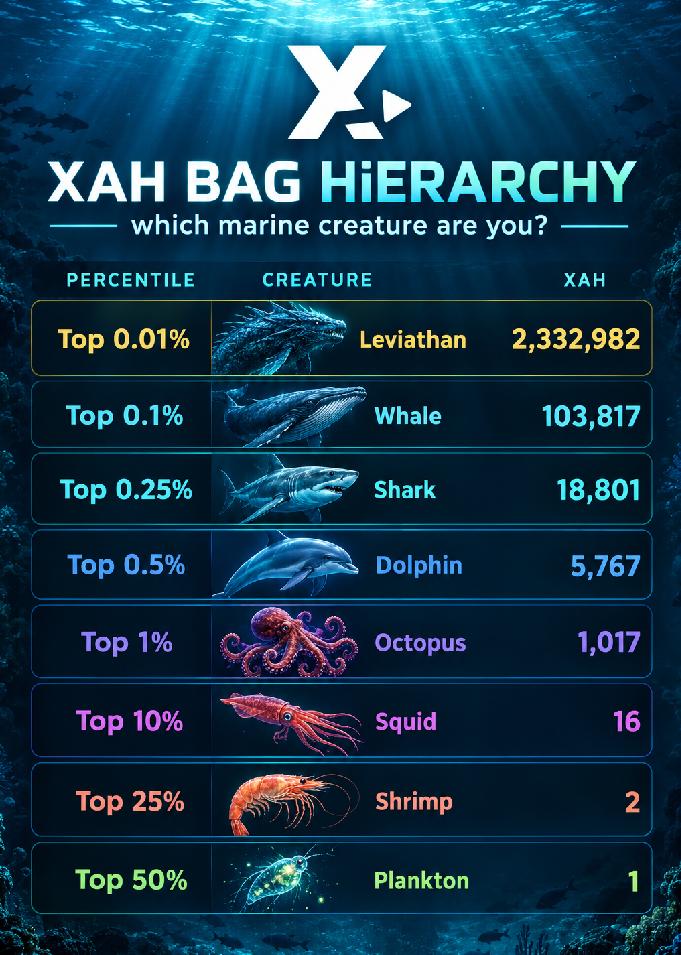 XAH Rich List
XAH price. XAH began 2026 at about $0.032 and, at the time of writing, trades around $0.012 a decline of more than 55% year-to-date. It's a common story among small-cap crypto networks in 2026.
Centralized exchange (CEX) liquidity. Xahau had unusually bad luck here. Two of the three centralized exchanges that supplied its on-ramp liquidity - BitMart and CoinEx - both announced they were shutting down in 2026. That leaves Bitrue as Xahau's CEX on-ramp, serving users in Asia and the other markets it covers.
Decentralized exchange (DEX) liquidity. With the Xahau CEX options adversely hit in 2026, the XRP Ledger's DEX - where XAH trades as an issued token that can be moved to the Xahau network - has become the most important source of liquidity for XAH.
InFTF
The Inclusive Financial Technology Foundation (InFTF), the nonprofit that champions the Xahau network, spent year three mostly behind the scenes: working with entrepreneurs and developers to deploy applications, new tools and educational content.
Its year included several visible milestones:
- Remittances. InFTF's corridor with the Cooperative Bank of Oromia, one of Ethiopia's largest banks, is scaling its EUR → ETB service to the entire country, with a USD → ETB pilot and new bank and remittance partners in East and West Africa on the roadmap.
- Stablecoins. Compliant USD and GBP stablecoins, and regulated currencies from additional countries, are listed as in-progress rollouts, joining the MiCA-compliant euro stablecoin already live on Xahau.
- Agentic payments. InFTF joined the Linux Foundation's x402 Foundation.
- Events. A quarterly community event, Xahau Connect, and an InFTF event bringing enterprise partners and developers together, planned for Q4 2026.
InFTF members also run independent sites that use the network.
One fun example from the last year: gifs.xahau.love, a community GIF archive created by Ekiserrepe, pays 75 XAH for every approved, published GIF - a small but clever way to reward community members for producing on-brand Xahau marketing content.
Crypto Bear Market
Xahau's third year coincided with one of crypto's harshest downturns.
Bitcoin peaked in October 2025 at roughly $126,000, then fell by about half. But for small-cap networks, the bear market started earlier and cut deeper. The market for small caps has been in a downturn since December 2024, losing about 44% of value from the late-2024 peak through the end of 2025. It then lost nearly another 23% in the first half of 2026.
The pain wasn't limited to prices. Nearly 100 crypto projects - exchanges, DeFi services, NFT marketplaces and blockchains - ceased operations in 2026, and well-known exchanges including BitMEX, BitMart and CoinEx announced closures.
XAH was not immune. It fell more than 55% in 2026, and losing two of its three exchange listings removed easy on-ramps for new users.
The Rise Of AI Coding
When Xahau launched, writing a Hook meant writing C, compiling it to WebAssembly and staying within strict execution limits. That was a real barrier for many would-be builders.
In 2026, that barrier is much lower. AI coding tools have become standard: in JetBrains' Developer Ecosystem Survey 2026, which surveyed more than 15,000 professional developers, agent-written code is a substantial share of what many developers ship.
Xahau is benefiting in two ways:
- Writing Hooks is easier. AI assistants can draft C Hooks, explain the Hook API, and help debug — making Hook development accessible to developers, and even non-developers, who would previously have been put off by C. Several of this year's builders are self-taught.
- Checking Hooks is easier, too. The obvious risk of "vibe-coded" smart contracts is bugs that cost real money. That's exactly where the year's new tooling fits: xahau-mcp gives AI agents structured access to the ledger, the Flight Simulator tests a Hook before you sign, and xahc-prover can formally prove that a Hook follows its safety rules.
Coding a new hook is now possible for people that can understand how to properly use AI coding tools.
Clarity & Regulations
Stablecoins are one of Xahau's key target markets. Fast, low-cost settlement, combined with Hooks that can enforce compliance rules at the account level, make the network a natural fit for regulated digital currencies and high-frequency financial use cases.
The stablecoin rules of the road:
- United States: The GENIUS Act, signed in July 2025, created the first federal framework for payment stablecoins and moved into its rulemaking phase this year.
- European Union: MiCA is active, with stablecoin issuers required to be authorized by July 1, 2026.
- Elsewhere: Brazil and Japan, among others, now have dedicated stablecoin rules in force.
For Xahau, this standardization matters. Rules that make a compliant stablecoin's rules predictable also normalize much of what is important for growing an on-chain market: regulated issuers, market makers, liquidity providers, and AMMs. Clear rules don't guarantee that issuers will choose Xahau - but they remove a significant reason for not choosing any new network.
Protocol Upgrades
Xahau describes itself as an "enterprise-grade" Layer-1 where protocol changes are few and deliberate, and most of the work happens in rollouts, integrations and partnerships. Year three followed that pattern.
Roadmap Items
In April 2026, the roadmap (covering Q2 2026 through Q3 2027) listed seven new protocol features. Here's where they stand today, per the roadmap updated October 14, 2026:
| Feature | What it does | Status (Oct 2026) |
|---|---|---|
| PriceOracle | Native on-ledger price feeds for DeFi and Hooks | ✅ Activated |
| IOURewardClaim | Lets projects reward holders of their own tokens, like XAH's balance rewards | ✅ Activated |
| Random Number Generator | Verifiable on-ledger randomness for Hooks and apps | Ready for amendment vote |
| NamedHook | Human-readable names for Hooks, so specific Hooks can be invoked | Ready for amendment vote |
| FeatureExport | An approach for Xahau-XRPL cross-chain logic, so hooks can manage XRPL accounts and assets | In development |
| JSHooks | Write Hooks in JavaScript alongside WebAssembly | In alpha development |
| Audits & optimization | Ongoing security and performance work | Ongoing |
Current Waypoint & Future Items
The updated roadmap now runs from Q4 2026 to Q1 2028 and adds three new protocol features, all marked ready for an amendment vote:
- PWALoader, which lets an account publish a small loader for a web app on the ledger itself, served by participating nodes.
- OnChainManifests, which publishes validators' key information on the ledger, so every node can learn key changes and revocations directly from ledger state.
- HookOn (HookOnV2_1), which lets a Hook respond differently to incoming and outgoing transactions.
The roadmap lists rollouts of major targets: USD and GBP stablecoins, more fiat currencies, a USD → ETB remittance pilot, additional African banking partners, an NGO donation platform, a merchant settlement pilot (Q2–Q3 2027) and an enterprise settlement offering for regulated partners (Q3 2027 onward).
Future High Points
What might year four bring? A few developments are already in motion.
Agentic Payments
For thirty years, the web had an unused status code: HTTP 402, "Payment Required." In 2025, Coinbase revived it as the basis of x402, a standard that lets software — including AI agents — pay for a resource in the middle of an ordinary web request, without a human clicking "confirm." Payments are typically made in stablecoins, and can be as small as fractions of a cent, making true pay-per-use pricing practical for APIs, data feeds and compute.
In July 2026, the Linux Foundation took over governance of the standard through the new x402 Foundation, whose members include Visa, Mastercard, American Express, Stripe, Google, AWS, Coinbase and Ripple. InFTF joined as a nonprofit member, bringing x402 to Xahau.
Xahau's fit here is unusually strong. The hardest problem in letting an AI agent spend money isn't the payment rail; it's the guardrails: "this agent can spend up to $400, only with approved merchants, only this week." On Xahau, those rules can be enforced by a Hook attached to the account itself, checking every transaction before it clears. The Kairo Vault toolchain already includes an x402-xahau component that uses a guardrail Hook as the spending authority.
Real x402 volume is still small and early-stage, and estimates of the eventual market vary enormously. But if agentic payments do take off, Xahau has one of the most natural integration paths of any smart contract network.
Non-Traditional Use Cases
Not every use case on Xahau is a bank corridor. Year three showed that creative applications can bring real activity and new users to the network:
- Memecoins and community tokens, which One Xahau's DAO-listed pools can now give a trading venue.
- URI-based collectibles such as Xahau Cards, whose blockchain-based card packs sold out a 5,000-pack mint in under three hours.
Watch, too, for Xahmoeba - a "pet"-style project still on Xahau's testnet, with a placeholder collection already on Xahau Vault.
The Tip Bot
One of the most anticipated arrivals of year four is the Xahau Tip Bot, a Web 3.0 take on the much-loved XRP Tip Bot, which let people send small amounts of crypto to each other on social media.
Year Four Begins
Three years ago, Xahau was a promise: the XRP Ledger's speed and reliability, plus programmability through Hooks.
Year three tested that promise under hard conditions. Prices fell. Two of three exchange listings disappeared. Capital retreated across all of crypto - Xahau included.
And yet it was also the year the application layer advanced.
 Year Four Begins
Year four begins with a protocol roadmap full of features ready for a vote, regulated stablecoins in the pipeline, and a growing set of tools that make building on Xahau easier than ever. If year three proved that Xahau's builders will keep building in a downturn, year four may show what they can do when the market turns in their favor.
X>
Sources
- One Xahau liquidity pools: https://onexah.io/defi/pools
- One Xahau on X: https://x.com/One_Xahau
- Cbot (One Xahau creator) on X: https://x.com/Cbot_Xrpl
- One Xahau announcement post on X: https://x.com/One_Xahau/status/2060485880834326547?s=20
- Odin's Eyes on X: https://x.com/Odins_Eyes_
- Odin's Eyes registry: https://odinseyes.io/registry
- Evergram web app: https://evergram.app/app
- Andrei Rosseti (Evergram creator) on X: https://x.com/andreirosseti
- Xahau Vault on X: https://x.com/Xahau_Vault
- Xahau Vault "website" as listed in research file (duplicates X profile): https://x.com/Xahau_Vault
- Xahau Cards on X: https://x.com/XahauCards
- Xahau Cards website: https://xahaucards.com/
- "Q & A With The Creator Of xahau-mcp" (xpert.page): https://xpert.page/hodor/blog/q-and-a-with-the-creator-of-xahau-mcp
- XRPLWin Xahau explorer: https://xahauwin.com/
- Bithomp Xahau explorer: https://xahauexplorer.com/
- Xahscan explorer: https://xahscan.com/
- Activated Xahau accounts, all time (Bithomp): https://xahauexplorer.com/activations?period=all
- gifs.xahau.love community GIF archive: https://gifs.xahau.love/
- Ekiserrepe (gifs.xahau.love creator) on X: https://x.com/ekiserrepe
- Xahau official roadmap (Q4 2026 → Q1 2028): https://xahau.network/roadmap/
- Wietse Wind post on possible new features: https://x.com/WietseWind/status/2107756742721589735?s=20
- Xahmoeba on X: https://x.com/xahmoeba
- Xah Tip Bot on X: https://x.com/XahTipBot
- Xahau Vault marketplace: https://xahauvault.com/
- Xahau "About" page (launch date, Launch Alliance, COOP Bank corridor): https://xahau.network/about
- U.Today on Xahau mainnet launch (Oct 2023): https://u.today/xrp-ledger-sidechain-xahau-now-live-in-mainnet
- Pantera Capital on the altcoin bear market (CoinDesk): https://www.coindesk.com/markets/2026/01/23/altcoins-have-been-in-a-bear-market-since-late-2024-pantera-says
- XAH historical prices (CoinLore): https://www.coinlore.com/coin/xahau/historical-data
- BitMart wind-down (Cointelegraph): https://regional-front.cointelegraph.com/news/bitmart-wind-down-exchange-end-trading
- CoinEx shutdown announcement (The Block): https://www.theblock.co/news/business/2026-09-15-coinex-shut-down-414788
- Stablecoin regulation in 2026 — GENIUS Act and MiCA (KuCoin): https://www.kucoin.com/blog/bd-stablecoin-regulation-updates-2026-genius-act-mica-enforcement-global-compliance-trends
- JetBrains Developer Ecosystem Survey 2026 on agent-written code: https://blog.jetbrains.com/research/2026/08/how-much-code-do-developers-really-let-agents-write/
- Measured share of AI-authored production code (Lenz): https://lenz.io/q/percentage-of-code-written-by-ai-2026