EverArcade
On Monday, June 29th, Shawn, the creator of EverArcade, sat down with Scott Chamberlain - co-founder of Evernode - for a two-hour conversation on 'X' Live, introducing the project publicly and fielding live questions from a large audience.
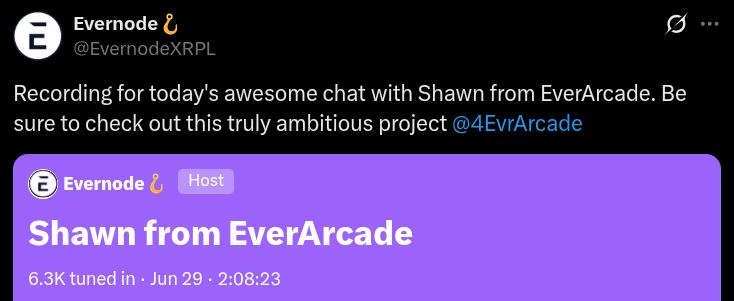 Scott Chamberlain Interviews Shawn Of EverArcade
This article introduces the project through the lens of two problems that have plagued the modern video game industry: creators who don't get paid fairly, and worlds - along with everything built inside them - that can vanish overnight.
The Two Problems
Problem One: Vendor Lock-In - Your World Can Disappear Without Warning
Every digital world today lives or dies by one company's decision to keep paying for servers.
When that decision changes, everything inside the world - characters, items, economies, relationships, years of collective history - goes with it, whether or not anyone asked for that outcome.
This isn't hypothetical.
When NCSoft shut down City of Heroes, players tried to buy the game outright to save it; the offer was refused, and the world stayed dark until a fan-run server was eventually granted an official license years later. Star Wars Galaxies ended with players gathering in-world to watch a scripted apocalypse - a send-off, but a permanent one. PlayStation Home had millions of active inhabitants when Sony shut it down in 2015; popularity wasn't the deciding factor, ongoing investment was. Asheron's Call lasted 17 years before closing in 2017.
 Game Loyalty Lasts Years
More recently, the problem has involved property rights.
Ubisoft delisted The Crew in December 2023 and shut its servers in March 2024, rendering a game more than two million people had paid for - including real-money DLC - permanently unplayable. Ubisoft's legal defense was that buyers had only purchased a revocable license, not the game itself. That decision helped ignite the "Stop Killing Games" movement, now backed by over 1.3 million signatures and an active lawsuit from a French consumer protection group alleging the arrangement amounted to an abusive, misleading contract.
Up until now, Web 3.0 hasn't been much better.
Blockchain gaming's core promise was that NFT-based ownership would let items outlive the game itself. In practice, more than 300 blockchain games have shut down, with roughly 93% of GameFi projects now effectively dead.
Ember Sword raised over $200M and closed anyway. Pirate Nation raised $33M and told players their assets could only be "burned" for speculative certificates once it wound down. When Nyan Heroes shut down, its token dropped 98.5% the same day. The lesson isn't that portability doesn't matter - it's that minting a token pointing at a centralized server was never enough to deliver it.
Problem Two: Creators Are Being Underpaid
The people who actually build games and worlds tend to capture a small share of the revenue they generate.
Valve's Steam takes 30% of most sales, with reduced tiers that mostly help the small number of publishers who cross $10M and $50M - thresholds most indie developers never reach.
In Game Developer Conference's developer survey, only 7% of respondents thought a cut that high was justifiable for a storefront to take. Roblox developers see roughly 25 cents on the dollar reach them through the traditional cash-out pathway, the lowest effective share among major platforms, and Roblox's own developer forum regularly features frustration over shrinking creator margins.
Mobile developers face the same dynamic: Apple and Google have, historically, taken up to 30% on in-app purchases, a rate that has now drawn antitrust rulings against both companies, with courts explicitly questioning whether the fee reflects real cost or simple market dominance.
The Common Thread
These two problems come from the same architectural root: today's platforms bundle hosting, discovery, payments, and identity into one non-negotiable package that only the platform controls.
That bundling is what lets a platform both dictate the price of access and unilaterally decide when a world stops existing. A developer or player never really owns their relationship to the world; they rent it, on terms set entirely by one company ... for as long as that company finds it profitable.
How EverArcade Could Change the Equation
EverArcade's founding thesis is that the fix for both problems is the same: unbundle the world from the company operating it.
If a game world is a portable, verifiable artifact - something closer to a file than a service - rather than a database record locked inside one company's servers, two things follow.
First, the world no longer depends on any single operator's survival; it can be hosted, migrated, and verified by a competitive ecosystem of independent providers, which is the direct technical answer to vendor lock-in.
Second, once hosting, verification, and distribution become separable, competitive markets rather than one bundled platform fee, creators can shop each layer independently instead of accepting whatever cut a single gatekeeper demands - the direct answer to underpayment. In EverArcade's own language, value shifts from controlling the world to providing services around the world, and no single company can hold either the world or its creator hostage.
What EverArcade Actually Is
At its core, EverArcade borrows an idea familiar to crypto fans - the same logic that lets a blockchain reconstruct a correct account balance by replaying every transaction from genesis - and applies it to game worlds instead of currency.
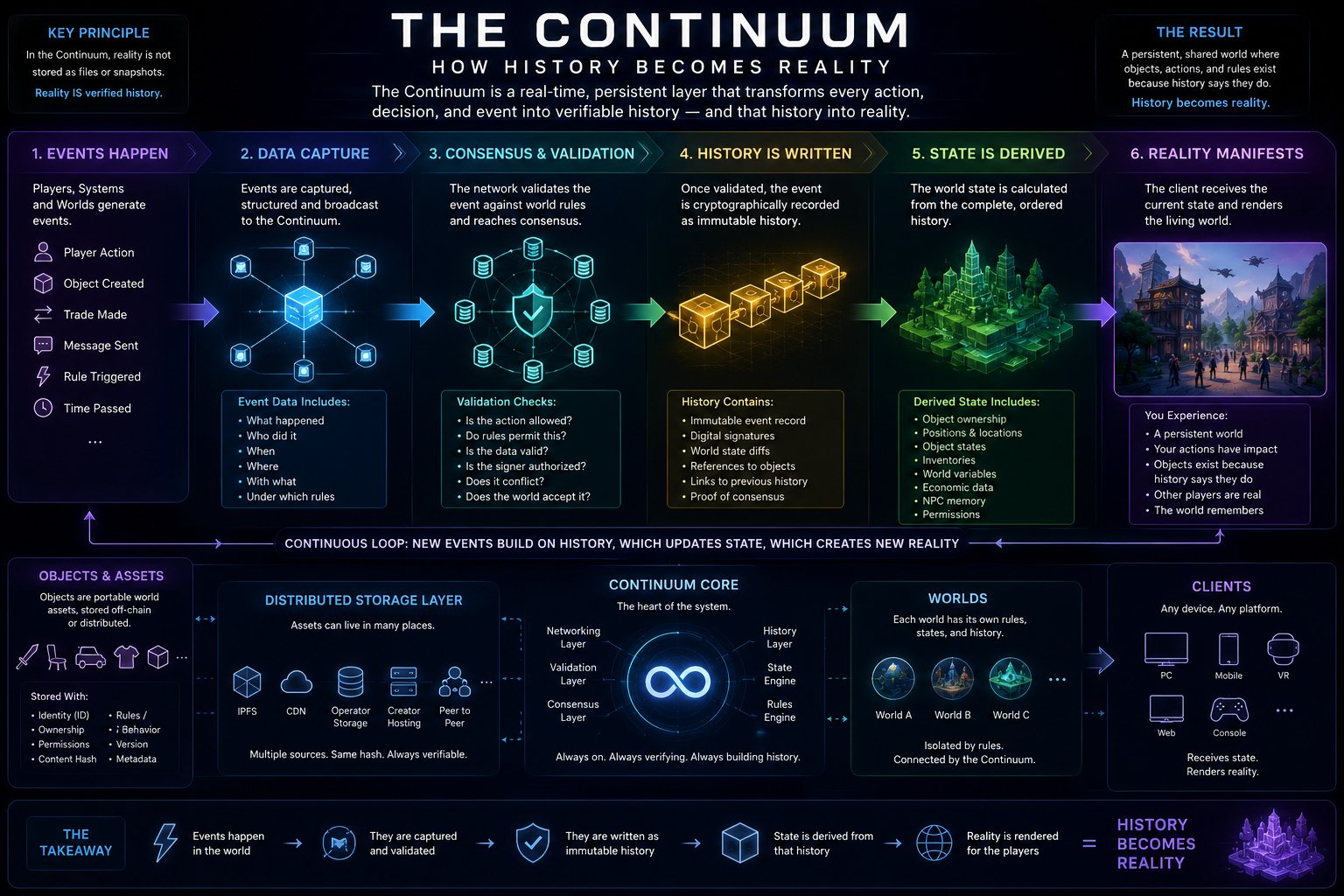 EverArcade Concepts
A world's current state is treated as a derivation of its full history, not a record some corporation can delete.
Core Concepts:
- Deterministic replay - given the same starting state and the same ordered sequence of player actions, any compliant implementation must arrive at exactly the same world state. This is what makes a world portable: anyone, anywhere, can reconstruct it, without needing the original company's cooperation or continued existence.
- Cryptographic commitments - a world periodically publishes compact proofs (state roots, receipt roots, continuity roots, and a "world hash") that let any third party verify a claim about the world's state without trusting the operator's word for it.
- Projection isolation - rendering and presentation are kept strictly separate from the authoritative simulation, so different studios can build different visual experiences.
- Checkpointing and archives - to keep long-running worlds from growing unmanageably large, the live copy of a world periodically checkpoints and pushes older history into separate archive tiers, linked back by cryptographic roots.
Together, these properties are meant to let a world outlive any single studio. Worlds can migrate between hosts, and prove their own authenticity ... the properties that were missing from City of Heroes, The Crew, Stadia, and the NFT games that failed.
Where Evernode Fits In
Evernode is a decentralized hosting network. Instead of one company running all the servers for an application, Evernode lets independent operators ("hosts") lease out computing capacity through a permissionless marketplace, paid in the network's native token, EVR.
Applications run across multiple independent hosts simultaneously using HotPocket, Evernode's consensus engine, which lets a cluster of machines process the same ordered inputs and independently arrive at the same result - without one operator dictating the outcome.
That distinction - determinism versus consensus - is exactly the place Evernode plugs into EverArcade, and it addresses the vendor lock-in problem.
Determinism guarantees that if everyone has the same history, everyone computes the same world. But when actions are arriving from many players at once, something still has to decide whose sequence of events is the real one - that's a consensus problem, and it's what HotPocket solves.
An EverArcade world could technically run on a single server and still be deterministic, replayable, and verifiable - but a single server requires everyone to simply trust that operator to admit actions fairly, order them correctly, and stay online. Evernode's decentralized host network removes that single point of trust, letting multiple independent replicas agree on the authoritative sequence of events without depending on any one company's continued existence.
Getting a live EverArcade world running correctly inside Evernode's HotPocket environment turned out to be a real engineering hurdle - Shawn credited HugeGreenCandle with helping debug and optimize the live mainnet deployment after months of independent work building the deterministic kernel.
Speculating on a Sustainable Business Model
None of this matters commercially unless it can be monetized in a way that's better for both types of stakeholders - the players who don't want their worlds to vanish, and the creators who don't want their revenue captured by a gatekeeper.
Here are the ideas from the EverArcade architectural documents:
- Unbundled service markets, not a single new "platform fee." Instead of one company charging one bundled cut, hosting, verification, migration, and archiving could each become separately priced, competitive markets. Creators pay only for services they actually use; players benefit because no single company can unilaterally end a world it's tired of funding.
- Operators earn through infrastructure, not gatekeeping. Evernode hosts already earn EVR for providing computing capacity; a similar model could let world-hosting operators earn ongoing fees for uptime and reliability, rather than a percentage of every transaction inside the world - shifting the incentive from "extract from creators" to "compete on service quality."
- Verification and archiving as paid trust infrastructure. Independent verifiers and archives could charge for certifying a world's authenticity or preserving its history long-term - a new service category.
- Treasuries and community ownership. Long-lived worlds could hold their own treasuries, funded by a small, transparent, community-governed fee, rather than an opaque cut set unilaterally by a platform.
The caveat is that this remains largely speculative.
EverArcade's architectural documents repeatedly flag funding mechanisms, incentive alignment, and long-term economic sustainability as open questions rather than solved ones. The technical case for portability is further along than the economic case for who ultimately gets paid and how much.
Follow-up With Shawn
I posed three questions to him:
Question: What is your greatest hope for EverArcade?
Answer: My greatest hope for EverArcade is that we help establish the idea that digital worlds can be portable, verifiable, and truly owned by their communities. I don't want meaningful digital places to disappear because a company shuts down a server or changes its business model. I want worlds to become part of our digital heritage - places that can be preserved, migrated, and continue evolving long after their original creators move on.
Question: What was the most challenging problem you faced in the conceptual design of EverArcade?
Answer: The hardest problem was realizing that a digital world can't depend on trusting a server or a company. If a world is going to be portable and independently verifiable, then every change to that world has to be deterministic and replayable. That sounds simple, but it fundamentally changes how you think about game design, networking, persistence, and even ownership. The challenge wasn't building another game platform - it was designing a system where reality itself could be reproduced and verified anywhere.
Question: How soon do you see yourself running a proof-of-concept game on Evernode where players and potential developers can take a look?
Answer: Sooner than many people probably expect. We already have deterministic execution, replay verification, and portable world packaging working. The next step is demonstrating a small multiplayer world running across independent infrastructure on Evernode and proving that the same inputs produce the same reality regardless of where it's hosted. Once people can see that happening live, I think the implications become immediately obvious.
The Continuum
A movie released in 2018, "Ready Player One", imagined a future where an entire generation's social life, economy, and identity lived inside one persistent virtual world - the "Oasis".
But it's worth noticing what that fictional world depicted: the Oasis was one person's creation, and its entire fate hinged on what happened to his company after he was gone.
That's the same fragility EverArcade was meant to address.
EverArcade's version of the Oasis is aptly named "The Continuum" ... because it introduces worlds that can't be deleted by one man or company. It enables creators who can't be shortchanged by uneven power dynamics. Maybe that's the real promise: not just a better game, but a version of the OASIS that doesn't depend on any one person, or company, to keep the lights on.
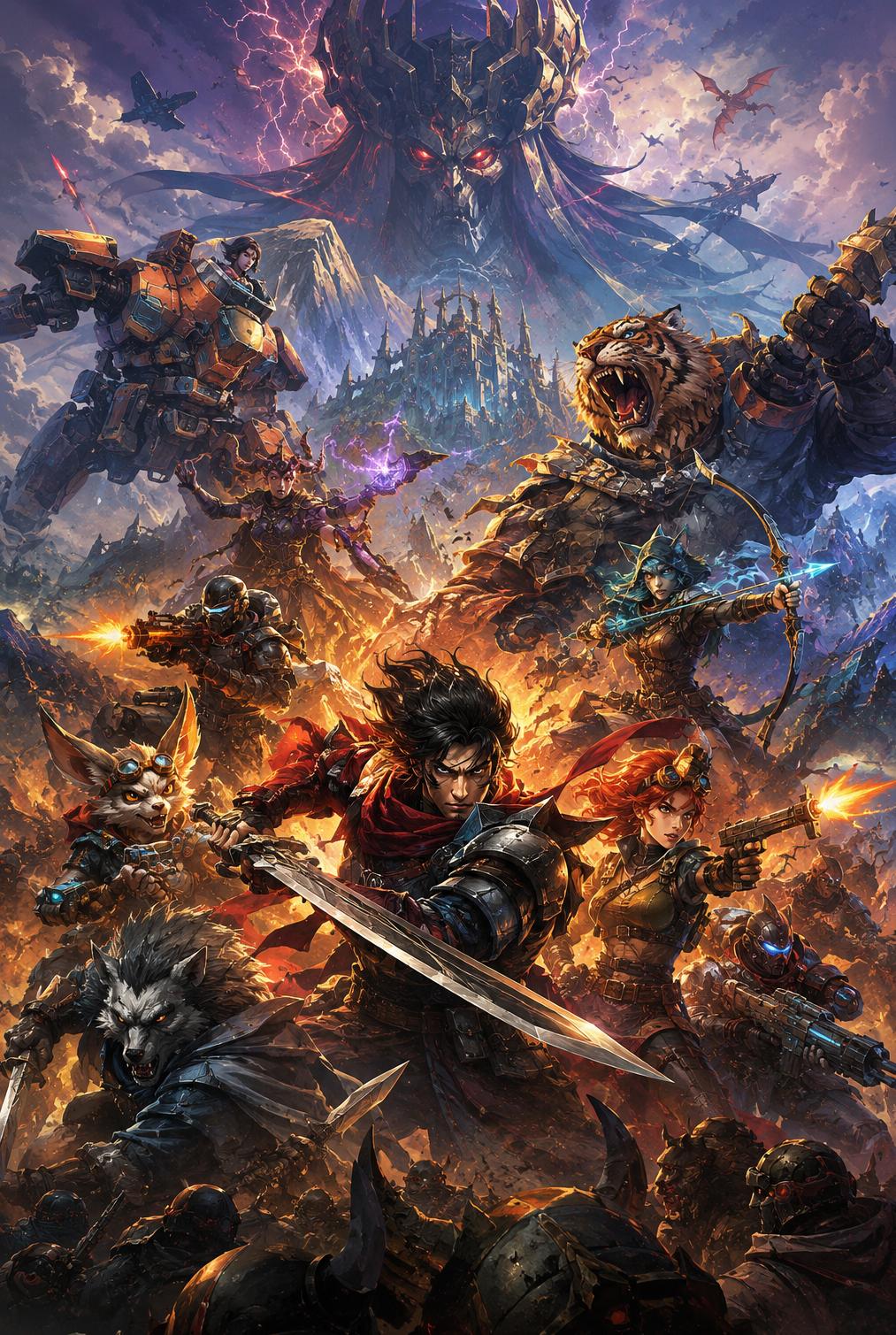 The Continuum
EverArcade might enable what the entire gaming market has been missing; and that fairness might unleash a torrent of creative genius from game designers. E>
Sources
Q&A with Shawn and Scott Chamberlain: https://x.com/EvernodeXRPL/status/2071763199893159968?s=20
Q&A with with Shawn over 'X' DM
EverArcade - official site: https://www.everarcade.xyz/
Architecture & Vision for EverArcade: https://www.everarcade.games/research
Evernode Developer Docs: https://www.evernode.org/developers
Evernode SDK / HotPocket primer (GitHub): https://github.com/EvernodeXRPL/evernode-sdk/blob/main/primer.md
"7 online worlds that ended while people were still playing," GamesRadar+: https://www.gamesradar.com/7-games-shut-down-while-people-were-still-playing/
"20 MMOs We Lost Too Soon: A Gamer's Tribute," Yardbarker: https://www.yardbarker.com/video_games/articles/20_mmos_we_lost_too_soon_a_gamers_tribute/s1_17458_42692751
"French consumer group sues Ubisoft over shutdown of The Crew," Game Developer: https://www.gamedeveloper.com/business/french-consumer-group-sues-ubisoft-over-shutdown-of-the-crew
Stadia Announcement FAQ, Google: https://support.google.com/stadia/answer/12790109?hl=en
"More than 90% of Web3 games failed after $15 billion boom," CoinDesk: https://www.coindesk.com/markets/2026/04/23/more-than-90-of-web3-games-failed-after-usd15-billion-boom-as-gamers-never-showed-up-caladan
"Web3 games have collapsed. How can we get out of the 'cyber graveyard'?," PANews: https://www.panewslab.com/en/articles/1s44x4wi
Roblox Developer Revenue Share Explained (2025–2026), RoLearn: https://rolearn.dev/insights/roblox-developer-revenue-share-2026/
"Valve Steam Antitrust Lawsuit: $6B Cut on Trial [2026]": https://tech-insider.org/valve-steam-antitrust-lawsuit-2026/
"Most game devs don't think Steam earns its 30% revenue cut," PC Gamer: https://www.pcgamer.com/most-game-devs-dont-think-steam-earns-its-30-revenue-cut/
"Apple Must Change Its Tightly Controlled App Store, Judge Rules in Epic Lawsuit," NPR: https://www.npr.org/2021/09/10/1023834758/apple-app-store-epic-games-fortnite-verdict
Ready Player One: https://en.wikipedia.org/wiki/Ready_Player_One_(film)