Masters Of Illusion
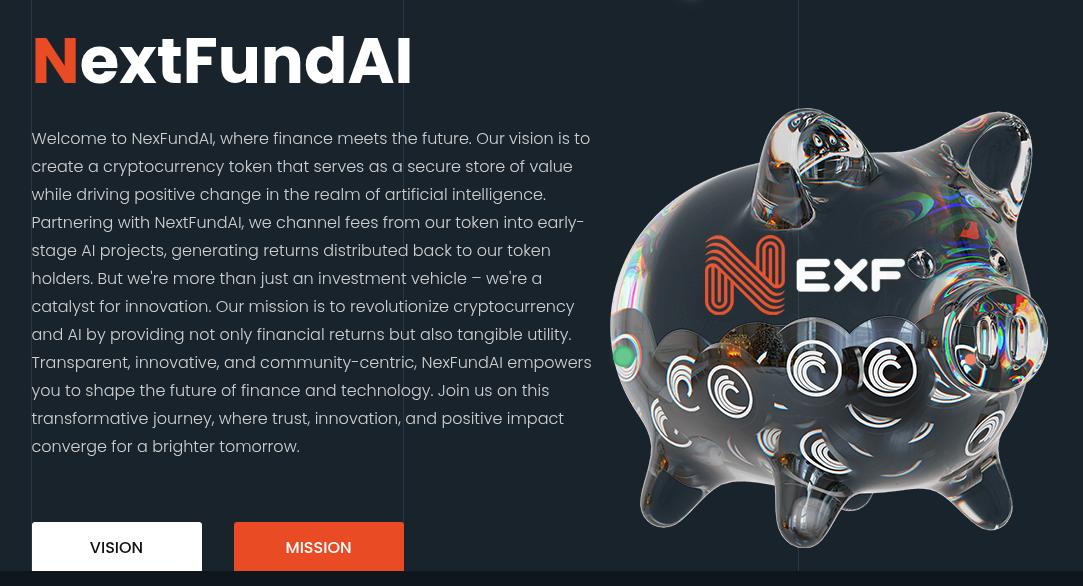
In late 2024, a small crypto asset called NexFundAI started trading on several exchanges.
 Next Fund AI
It had a working website, a pitch about AI-driven finance, and steadily climbing volume. It also had one problem for anyone who tried to buy it: it wasn't real.
NexFundAI was created by the FBI.
The token was the centerpiece of Operation Token Mirrors, an undercover sting run by the FBI and the IRS. Agents built a fake crypto company, minted a token on the Ethereum blockchain, and then went shopping for "market makers" to help it look popular. Several firms took the bait. According to the resulting indictments, firms including Gotbit, ZM Quant, and CLS Global agreed to trade the token against itself - buying and selling in circles with no real change of ownership - to manufacture the appearance of demand.
The investigation ultimately touched more than 60 different cryptocurrencies and led to the seizure of over $25 million. One firm, CLS Global, later pleaded guilty and admitted in court filings that it had agreed to run exactly this kind of sham trading. Blockchain forensics in a related case were almost comically direct: investigators traced 1,209 of 1,221 transactions - 99% - straight back to the wallets of the firm accused of running the scheme.
It's a dramatic story, but it's also a useful lens.
Crypto's reputation for wild price swings and inflated valuations isn't just a story about a new asset class in its early stages. Part of it is a story about markets that, for years, purposefully created the illusion of a busy, liquid market.
What Is Legal Versus Illegal
It's important to be precise here, because two different activities get lumped together under "market manipulation" in casual conversation:
Market-making is legal, and essential.
A market maker continuously quotes both a buy price and a sell price for an asset, ready to trade either side. This is what keeps markets liquid - it's why you can buy or sell a stock, or a major crypto token, in seconds rather than waiting for a matching counterparty. Firms like Jane Street, Citadel Securities, and Wintermute do this at enormous scale, and they are regulated participants in trad-fi markets.
Wash trading is illegal, everywhere it falls under a regulator's jurisdiction.
This is when a firm or individual trades with itself, or with a colluding party, to fabricate volume, with no real risk or change in ownership. Related tactics include spoofing (placing orders you intend to cancel, to fake demand) and painting the tape (coordinated trading to move a reported price). In the U.S., these are forbidden under the Securities Exchange Act and the Commodity Exchange Act, and the SEC and CFTC have pursued cases in both traditional and crypto markets for years.
The line, in short: providing real liquidity is a service. Faking liquidity is fraud.
Where crypto has differed from traditional finance ("trad-fi") isn't the law - it's the strength of the surrounding infrastructure that catches violations:
| Topic | Trad-fi & Securities | Crypto (Mainly CEXes) |
|---|---|---|
| Wash trading legality | Clearly illegal, long-established case law | Illegal wherever securities or commodities law applies - but jurisdiction is often murky |
| Exchange oversight | Regulated entities, required to monitor and report suspicious activity | Historically ranged from tightly regulated to offshore and lightly supervised |
| Enforcement track record | Decades of precedent and consistent case flow | Improving, but younger and more uneven |
| Common outcome | Wash trading exists, but is actively policed | Studies have found large shares of reported volume on some exchanges were fabricated |
The rules themselves are very similar for both markets.
The Early Years
Long before most people had heard of Bitcoin Cash or Bitcoin SV, BTC had an unchallenged monopoly on the 'Bitcoin' name, and was a very small market.
Nobody would recognize it by today's standards. In the early 2010s, price discovery happened largely on forums like Bitcointalk, where a small speculator community compared notes, traded tips, and watched a handful of exchanges - most famously Mt. Gox - handle the bulk of global volume.
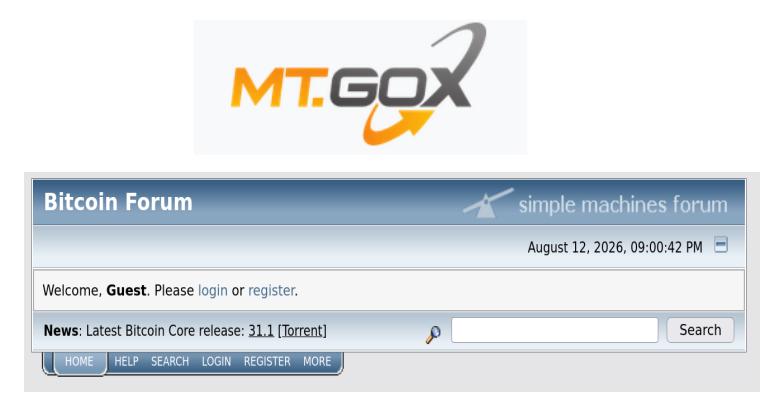 Mt GOX & The Bitcointalk Forum
That combination was a near-perfect recipe for volatility.
Order books were thin, so a single large trade could move the price double digits in minutes. The total market was small enough that early miners and adopters could individually swing it. There were no futures or options markets to let traders hedge or arbitrage prices ... that infrastructure didn't arrive until CME and CBOE launched Bitcoin futures in December 2017. And the dominant exchange ran into trouble: Mt. Gox's 2014 collapse, with roughly 850,000 BTC lost or stolen, wiped out the market's central pricing venue overnight.
Bitcoin's wild early swings were simply what happens when a small, thinly-traded market has no organized liquidity behind it. But that same thinness also made the market unusually easy to manipulate - which set the stage for the next chapter.
The First Stablecoin
As Bitcoin's 2017 run toward $20,000 unfolded, a persistent question followed it: how much of that rally was organic?
Finance professors John Griffin (University of Texas) and Amin Shams (Ohio State) set out to answer it using blockchain forensics, in research eventually published in the peer-reviewed Journal of Finance. Their focus was Tether (USDT), a stablecoin marketed as fully backed 1:1 by U.S. dollars.
Griffin and Shams found that purchases made with newly issued Tether were disproportionately timed after Bitcoin price downturns, and that a small number of high-issuance hours accounted for an outsized share of Bitcoin's gains. Specifically, the 95 hours with the heaviest Tether issuance between March 2017 and March 2018 corresponded to 59% of Bitcoin's compounded returns over that period.
Their interpretation: issuing Tether without full backing acted like printing new money chasing the same supply of Bitcoin ... inflating its price without any real capital entering the market.
 Masters Of Illusion
The pattern wasn't airtight proof on its own - some of it was also consistent with ordinary arbitrage trading. But it lined up with a legal reckoning that followed: in 2021, the New York Attorney General settled with Tether and its affiliated exchange Bitfinex over misrepresentations about reserve backing, including an undisclosed $850 million shortfall.
New Regulations: New Crypto World
New guardrails are now being built. The West is setting the pace, with the EU slightly ahead of the U.S. on the calendar.
| Date | Milestone |
|---|---|
| Jun 2023 | EU's Markets in Crypto-Assets Regulation (MiCA) enters into force |
| Jun 2024 | MiCA stablecoin rules (for asset-referenced and e-money tokens) become applicable |
| Oct 2024 | FBI's Operation Token Mirrors sting begins |
| Dec 2024 | MiCA's full exchange licensing and market-abuse rules take effect |
| Jul 2025 | U.S. GENIUS Act signed into law, mandating audited 1:1 stablecoin reserves |
| Jul 2026 | GENIUS Act implementing rules due from U.S. federal regulators |
| Jan 2027 | GENIUS Act reaches full effect (backstop enforcement date) |
The EU's MiCA framework directly targets market abuse and requires licensed exchanges to actively surveil for it, with full rules already in effect since December 2024 (though some member states have granted existing exchanges transition time into mid-2026). The U.S. GENIUS Act attacks the problem from the stablecoin side: once fully in force, issuers must hold verifiable, audited reserves - closing the exact loophole Griffin and Shams documented, where new tokens could be minted without dollars behind them.
What this won't do is make wash trading vanish.
Stablecoin reserve rules fix the fake money problem; they don't stop two accounts from trading with each other. That still requires active enforcement, and enforcement appetite can shift - the SEC dropped several of its civil wash-trading cases in early 2026 even as separate criminal charges from Operation Token Mirrors continued. This reflects traditional finance: securities laws have banned wash trading since 1934, and regulators still bring cases today. Better rules reduce the problem.
But they don't erase it, in any market.
The Wild West Is Gone
All of this points to a market that is slowly maturing.
The early, small BTC market, prone to wild swings on thin liquidity, has given way to one with derivatives, professional market makers, and audited reserves standing behind the stablecoins that fuel most trading. The unregulated stretch that let unbacked tokens and sham volume distort prices is closing, not because the underlying temptation to cheat has disappeared, but because the capability to catch it finally exists.
Markets, like any relationship worth having, run on trust.
Sources
- Next fund AI website: https://nexfundai.com/
- Reuters, CLS Global guilty plea: https://uk.marketscreener.com/quote/cryptocurrency/BITCOIN-BTC-USD-45553945/news/Cryptocurrency-financial-firm-to-plead-guilty-after-novel-FBI-probe-48828125/
- TRM Labs, Operation Token Mirrors overview: https://www.trmlabs.com/resources/blog/ten-fraudsters-from-four-financial-services-firms-charged-in-different-cryptocurrency-market-manipulation-schemes-out-of-northern-district-of-california
- TechSpot, FBI's fake token sting: https://www.techspot.com/news/105096-fbi-creates-fake-cryptocurrency-sting-operation-catch-market.html
- Hodder Law, SEC charges on market-manipulation-as-a-service: https://hodder.law/fbi-launches-undercover-token-in-sting-operation-entrapping-market-makers/
- Bitcointalk forum: https://bitcointalk.org/
- Mt GOX background: https://en.wikipedia.org/wiki/Mt._Gox
- Griffin & Shams, "Is Bitcoin Really Un-Tethered?" (Journal of Finance): https://pdfs.semanticscholar.org/09ee/3a305500819717c6d7f33f36e323bd109dd1.pdf
- Bloomberg, on the Griffin & Shams findings: https://www.bloomberg.com/news/articles/2018-06-13/professor-who-rang-vix-alarm-says-tether-used-to-boost-bitcoin
- Fortune/Yahoo Finance, Griffin & Shams follow-up interview: https://finance.yahoo.com/news/wild-theory-price-bitcoin-being-110000608.html
- Wikipedia, Markets in Crypto-Assets Regulation (MiCA): https://en.wikipedia.org/wiki/Markets_in_Crypto-Assets
- EY Luxembourg, MiCA's phased effective dates: https://www.ey.com/en_lu/insights/digital/micas-full-effect-drops-take-the-next-step-into-eu-financial-digitalization
- Sullivan & Cromwell, GENIUS Act implementation timeline: https://www.sullcrom.com/insights/memo/2026/March/OCC-Proposes-Regulations-Implement-GENIUS-Act
- Wikipedia, GENIUS Act: https://en.wikipedia.org/wiki/GENIUS_Act
- Morrison Foerster, SEC's 2026 dismissal of crypto wash-trading cases: https://www.mofo.com/resources/insights/260421-top-5-sec-enforcement-developments-for-march-2026
- Alessa, on CFTC/SEC jurisdictional overlap in crypto: https://alessa.com/blog/crypto-wash-trading/