Xahau & x402 Agentic Payments
For thirty years, the web possessed a payment status code it never actually used.
HTTP 402 - "Payment Required" - sat dormant in the protocol since the 1990s, a placeholder for a feature nobody built. That changed in 2025, when Coinbase revived it as the backbone of a new standard called x402, built to let software agents pay for things without a human clicking "confirm."
Since that point in 2025, he standard has been handed to a neutral industry foundation, adopted by household names in finance and cloud computing, and is now being extended to many new networks.
What The Heck Are x402 Payments? 🤔
At its core, x402 lets a server tell a piece of software "this costs money" in the middle of an ordinary web request - and lets that software pay on the spot, without a person in the loop.
An AI agent requests a resource; the server responds with HTTP 402 and a description of what payment it needs; the agent attaches a signed payment authorization to a repeat request; a settlement service verifies and processes that payment on a blockchain; and the server hands over the resource along with a receipt.
The whole exchange typically settles in stablecoins - tokens pegged to a fiat currency like the US dollar.
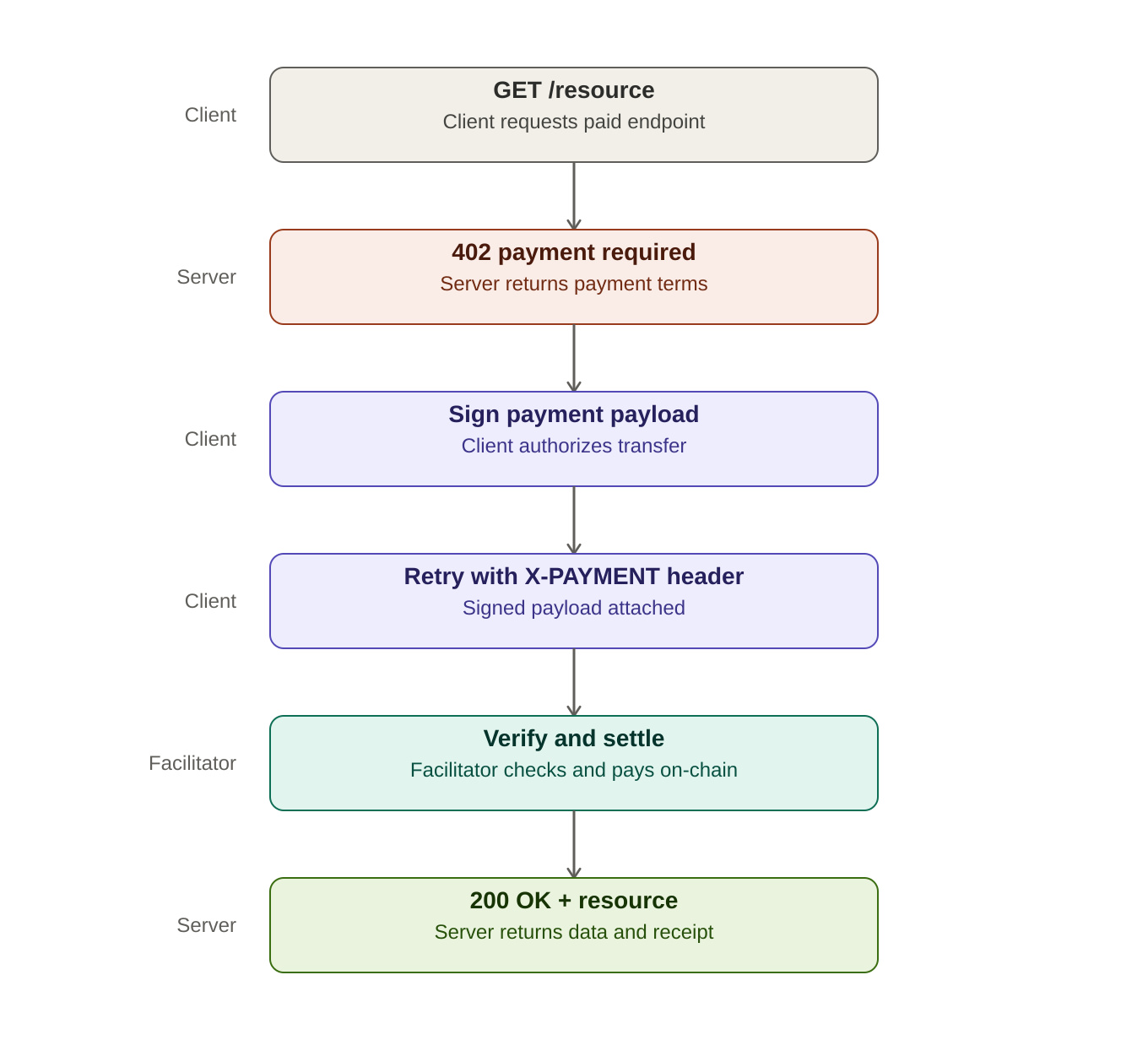 x402 Request-Response Flow
The effect is that pricing shifts from "sign up for a plan" to "pay per use," down to fractions of a cent. That's the piece that's new: no previous payment rail could profitably process a $0.001 charge for a single API call.
Is This Real Life?
Here's a scenario:
A logistics company runs an AI agent that monitors global shipping routes. Normally, getting live port-congestion data means negotiating an annual enterprise contract with a data vendor - often tens of thousands of dollars, whether the company uses the feed constantly or barely at all. With x402, that same agent can query the data provider on demand, get billed a fraction of a cent per query, and only pay for what it actually uses.
No annual contract or unused subscription.
That shift - from provisioning access in advance to paying only at the moment of use - is the practical promise behind the protocol, and it applies just as easily to AI inference calls, premium research data, or on-demand compute as it does to shipping data.
Payment Volumes Versus Hype
Volume on Coinbase's Base network went from near-zero in mid-2025 to over 100 million transactions by early 2026, though a large share came from a speculative meme-coin "pay-to-mint" campaign.
More recent data shows monthly volume swinging dramatically - dropping from a late-2025 peak before recovering to a few million dollars a month, with typical transactions well under a dollar. Activity is growing, but it's still early-stage infrastructure.
The much bigger numbers you'll see in headlines - often in the trillions of dollars - refer to a much wider definition of 'agentic': "Any AI-driven purchasing activity across any payment rail, not x402 specifically."
Analyst estimates for that larger category, for 2030, vary from roughly $1.5 trillion to as much as $17.5 trillion. That huge spread is a reflection of the market still being defined. The realistic takeaway for a business audience is that today's actual x402 volume is small, the growth trend is real, and the eventual size of the market is still uncertain.
The Foundation and Its Members
In July 2026, the Linux Foundation - the nonprofit home of major open-source projects like Linux itself - formally took over governance of x402, forming the x402 Foundation as a neutral, vendor-independent steward. No single company controls the protocol's direction.
The founding membership reads like a cross-section of finance and big tech: Visa, Mastercard, American Express, Stripe, Circle, Google, Amazon Web Services, Shopify, Adyen, Cloudflare, and Coinbase are all listed as Premier Members, alongside several major blockchain networks - including the Solana Foundation, the Stellar Development Foundation, and the Monad Foundation.
Ripple is also a Premier Member, and has been actively extending x402 support to the XRP Ledger, enabling agents to transact using both XRP and Ripple's own regulated dollar-stablecoin, RLUSD. Early activity on the XRP Ledger reportedly crossed a million agentic transactions.
The Inclusive Financial Technology Foundation (InFTF), a nonprofit organization that champions the Xahau ecosystem, joined the x402 Foundation as a nonprofit-institution-member.
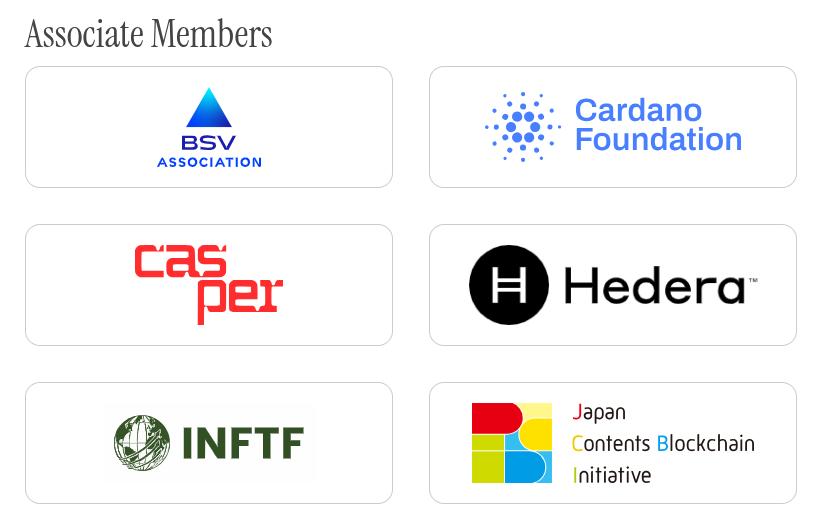 InFTF Membership In x402
This extends the x402 starndard to Xahau, a network that is, essentially, built using the XRP Ledger consensus and features, but with its own distinct approach to on-chain programmability.
Xahau: Perfect For x402
Xahau's standout feature is something called "hooks" - smart contracts attached to an account that can inspect, allow, or reject a transaction before it happens, rather than after the fact. That's a distinguishing feature compared to most other smart-contract networks, where logic runs in a separate contract that a transaction has to call.
Why does that matter for agentic payments specifically?
Because the central design problem in letting an AI agent spend money on your behalf isn't the payment rail - it's the guardrails. You want a way to say "this agent can spend up to $400, only with approved merchants, only this week" and have that rule enforced automatically. Xahau's hook architecture was designed with exactly this kind of use case in mind: the network's documentation highlights spending limits and transaction firewalls - rules that can reject unauthorized or oversized withdrawals - as native, ready-made building blocks. Other platforms can approximate this through additional smart-contract-wallet layers bolted on top of the base account, but Xahau organizes the gatekeeping attached to the account itself, at the protocol level.
This observation was echoed in the InFTF's official announcement & blog about their membership in the x402 foundation, which dove into greater detail about three different implementation models:
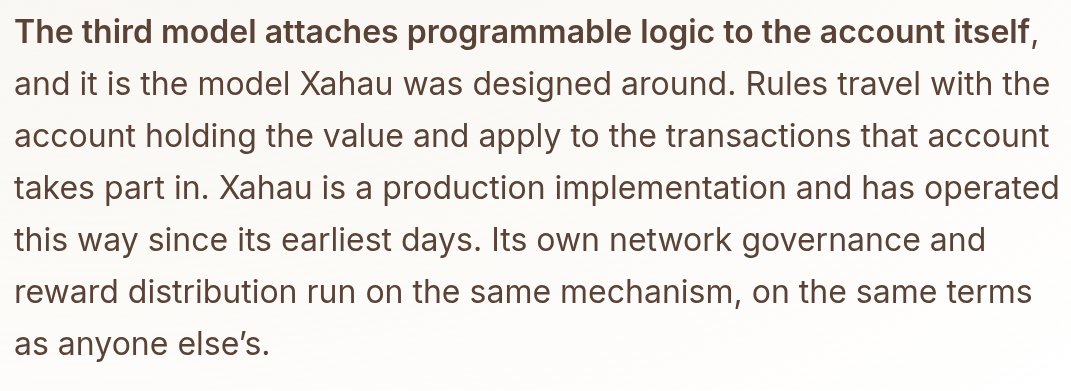 Detailed Model-Based Implementation Comparison
It's a purposeful design constraint: Hooks are intentionally not capable of unlimited, arbitrary computation. That sounds like a limitation, but for a financial guardrail, it's actually an important feature; simple, predictable rules are easier to audit and harder to exploit than open-ended code.
What x402 Capability Means
x402's pay-per-use model, together with a stable, MiCA-compliant euro stablecoin already live on Xahau, opens up new possibilities:
- Metered API and data businesses. Any company selling data, AI services, or compute could move from subscription pricing to true pay-per-call billing, capturing revenue from occasional users who'd never sign up for a plan.
- Autonomous procurement agents. A business could deploy agents authorized to shop across multiple vendors for the best price on a recurring purchase - travel, supplies, cloud capacity - with hook-enforced spending limits acting as an automatic compliance layer.
- Cross-border and remittance tools. Xahau's roots in fast, low-cost settlement make it a natural fit for developers building agent-driven remittance or treasury tools that need predictable fees and quick finality.
- Compliance-friendly agent commerce. For regulated industries, the ability to enforce spending rules at the account level - not just after a transaction clears - offers a cleaner audit trail than bolting compliance checks onto a general-purpose smart contract platform.
None of this requires a business to abandon existing payment infrastructure. x402 is designed to sit side-by-side with traditional rails; not replace them overnight.
Future Payments
x402 and the broader agentic-payments movement is still early - growing, perhaps overhyped, and not yet mature.
 Xahau Agentic x402 Payments
But the direction is clear: software is starting to pay for things on its own, and the infrastructure to do that safely, with programmatic guardrails, is being built by a growing group of high-profile players. Among the list of members to the x402 Foundation, Xahau stands out as having one of the most natural integration pathways among smart contract networks. X>
Sources
- x402 Whitepaper: https://x402.org/wp-content/uploads/sites/10/2026/06/x402-whitepaper.pdf Chainalysis, "Inside x402: 100M Agentic Payments on Base": https://www.chainalysis.com/blog/x402-agentic-payments-adoption/
- CryptoNews, x402 volume and transaction data: https://cryptonews.net/news/market/32927114/ AgentPayTrend, "5 Forces Behind $1.5T AI Agent Payment Market": https://agentpaytrend.com/ai-agent-payment-forces-2030/
- PYMNTS, "Digital Money Has a New Payment Standard and It's Not Built for Humans": https://www.pymnts.com/digital-payments/2026/digital-money-has-a-new-payment-standard-and-its-not-built-for-humans/
- Linux Foundation, "Announces Operational Launch of x402 Foundation": https://www.linuxfoundation.org/press/linux-foundation-announces-operational-launch-of-x402-foundation-to-standardize-internet-native-payments-for-ai-agents-and-applications
- "Ripple Is Now a Premier Member of the x402 Foundation": https://247wallst.com/investing/cryptocurrency/2026/07/14/ripple-is-now-a-premier-member-of-the-x402-foundation-alongside-visa-and-mastercard/
- InFTF "Giving Software a Mandate, Not a Wallet": https://inftf.org/article/giving-software-a-mandate-not-a-wallet/
- InFTF Official announcement over 'X': https://x.com/IncFinTech/status/2083843775256842354?s=20
- Xahau Network, "Hooks" documentation: https://xahau.network/docs/hooks/
- Xahau Network, "Features": https://xahau.network/features/
- Quantoz, "INFTF and Quantoz collaborate to bring EURQ stablecoin to Xahau Blockchain": https://www.quantoz.com/blog/inftf-and-quantoz-collaborate-to-bring-eurq-stablecoin-to-xahau-blockchain