Evergram: Orion Release
Brad Garlinghouse, Ripple's CEO, has called XRP the company's "North Star" - a guiding fixed point that every product decision eventually orbits back to.
It's a fitting metaphor for a space that loves its cosmological branding.
Andrei Rosseti, the Brazil-based developer behind the Web 3.0 chat app Evergram, seems to agree: his newest release isn't called "2.0" or "v3" - it's called Orion, after one of the night sky's most recognizable constellations.
 Constellation Orion
For a product built on the idea that your identity and your messages should answer to no one but you, a name borrowed from the stars feels appropriate. Orion marks Evergram's move from its first incarnation into a much richer version; and it's worth understanding both what Evergram is and why this particular update matters.
Evergram
Evergram is a messaging app built on a creative idea: no accounts, no passwords, no central server storing your conversations. Instead, your identity is your wallet - specifically, a wallet on the XRP Ledger or its smart-contract-enabled sibling network, Xahau. Log in with a non-custodial wallet like Xaman, and you're in.
There's nothing to sign up for, nothing to forget, and no company database of usernames and passwords for anyone to breach.
In its original form, Evergram covered the essentials: one-on-one encrypted messaging, a functioning client on both the Xaman wallet (as an embedded "xApp") and a standalone website, and a working demonstration that a chat app could run on decentralized rails instead of conventional cloud infrastructure.
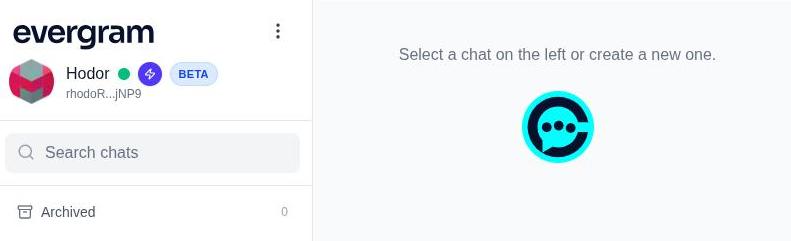 Evergram User Interface
Andrei Rosseti kept the initial rollout limited and precise, so that he could analyze the early data, address any roadblocks or issues, and then methodically add his wish list of new functions according to his own schedule and preferred level of high quality.
Wallet-Based Encryption
The core trust model behind Evergram is worth unpacking, because it differs dramatically from how mainstream messaging apps work.
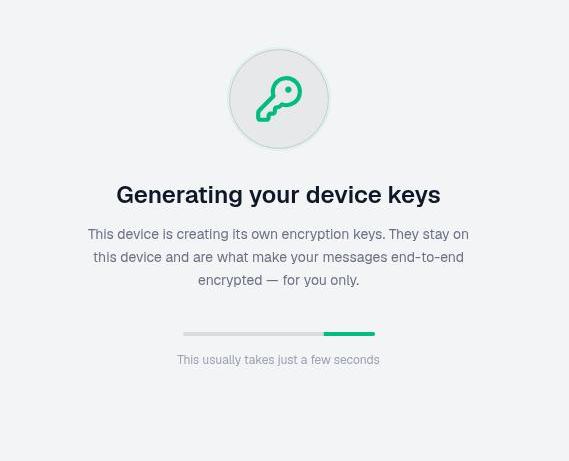
Every chat in Evergram gets its own unique symmetric encryption key, generated with AES-grade strength. That key is used to encrypt message content on the sender's device, before anything ever leaves it.
 Encrypted Chat
The key itself is then re-encrypted separately for each participant and each of their devices, and delivered using public-key cryptography - the same underlying mathematical approach that secures cryptocurrency wallets. The result, according to Rosseti, is that:
"... neither Evergram nor the underlying infrastructure can decrypt messages."
If new devices join, keys automatically rotate; if a device goes inactive for too long, it's automatically cut off.
Identity works the same way. Instead of a phone number or an email address tying you to your account - both of which are ultimately controlled by a third party who can be pressured, subpoenaed, or hacked - your identity is a cryptographic wallet address.
You prove who you are by controlling the private keys to that address.
It's a system that trades convenience for resilience. And it's also, as it turns out, a natural extension of everything Rosseti had already spent the past year and a half building.
Andrei Rosseti's Trophy Room
Evergram didn't appear out of nowhere: It's the third act in a run of Xahau-based projects from Andrei Rosseti.
The connecting thread across all three projects is identity and trust: proving that a document, a signature, or a message really came from who it claims to have come from - without leaning on a centralized authority.
| Date | Project | What It Did |
|---|---|---|
| Early 2025 | Xahau DocProof | A blockchain-based notary service. Two or more wallets can cryptographically prove that a document had been signed by the parties involved, with the proof recorded immutably on Xahau. |
| November 2025 | Origo | An evolution of DocProof for single-signer verification - checking that a document is authentic and came from the domain it claims to, using a TOML-file verification method borrowed from the XRP Ledger. |
| January 2026 | Evergram | A full step into a Web 3.0 messaging app: encrypted, wallet-authenticated chat, hosted on decentralized infrastructure. |
| August 2026 | Orion | Evergram's graduation from initial roll-out to a greatly-enhanced version. |
Each project built on lessons from the last.
DocProof proved that Xahau's "Hooks" - account-level smart contracts, most commonly written in C - could enforce complex trust logic (checking payments, verifying signatures, recording proof) using very little code; DocProof's entire notarization logic runs through a single Hook. Origo then explored what verification could look like without needing an on-chain transaction for every check. Evergram took the identity and trust lessons from both and applied them to something far more real-time and personal: private conversations.
August 27, 2026: Orion
Which brings us to now. On August 27, 2026, Evergram's Orion release went live.
Orion's High Points
Orion isn't a minor version bump. It's closer to a relaunch, expanding Evergram from "a wallet-based chat client" into what its own release notes describe as a full communication stack: chat, discovery, payments, and a developer SDK, all without a central account system.
User Features
The most visible changes are in the day-to-day experience of using the app. Groups now live in a proper left-hand navigation panel, showing the most recent message from each conversation at a glance.
More significantly, Orion introduces public discovery: users can browse and search public groups across the network and request to join ones that interest them ... no invite link required.
For groups that do want to control their doors, admins can generate shareable invite links, approve join requests before granting access, and run fully moderated chats where only approved participants can speak.
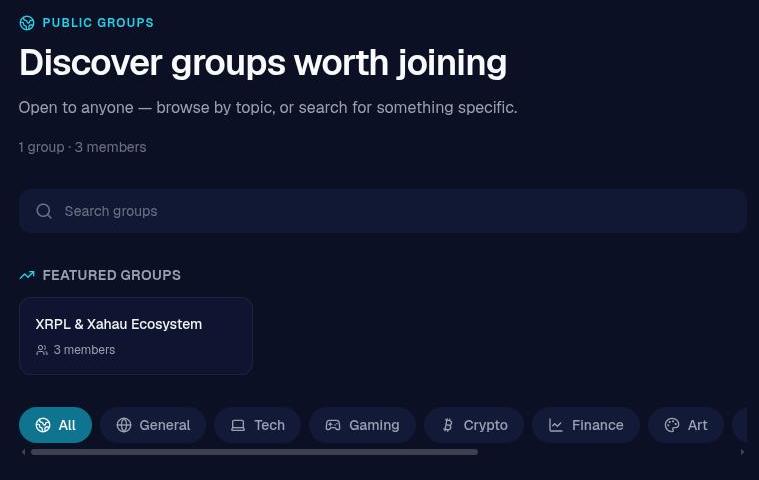 Public Group Chats
Bots can join through these same public links - a detail that hints at where the developer ecosystem is headed.
It's worth noting that joining a group this way - whether through discovery or an invite link - still requires a wallet; group membership itself is wallet-authenticated.
Wallet-free access comes from a different feature: embeddable widgets.
Any website can drop in a single script tag and get encrypted chat for its visitors, with no account or wallet required on the visitor's end. This capability builds directly on Evergram's original anonymous chat feature, which was the first to prove that a wallet-authenticated user and a wallet-less user could hold a fully end-to-end encrypted conversation with each other. Widgets take that same proven mechanism and make it embeddable anywhere.
One more addition rounds out the social layer: slash commands - an homage to old-school IRC — bring chat and payments into the same composer box; typing /pay, /nick, or /leave handles actions that used to require switching screens or apps entirely.
User Customization: Device & Account Management
Orion also puts real effort into the unglamorous but important parts of running a security-conscious app: account hygiene. A new unified settings screen gives users one place to manage their account, connected devices, and preferences.
Device management gets an upgrade.
Previously, hitting a device limit could mean getting blocked outright; now, users can simply revoke an older or lost device and keep going. Every connected device is listed in one place, and storage management tools let users see exactly how much space each conversation is using - and clear it, per chat, if they want to.
Users also gained finer control over their own exposure. Example: A link-security feature, which previously blocked clicking or copying any external link shared in a chat, can now be toggled off in Settings for users who want that flexibility back.
Technical Stuff
Under the hood, Orion represents a substantial engineering push.
The release is backed by more than 400 unit tests spanning the full stack - the smart contract layer, the SDK, the web client, and the gateway/relay server that bridges them. That's a notable level of test coverage for a project of Evergram's size, and it signals an intent to be taken seriously as production infrastructure rather than a hobby project.
Performance was also a focal point.
Evergram's backend runs on HotPocket, Evernode's smart-contract execution environment, which is architecturally solid but historically slow on writes due to the round-trips required for decentralized consensus. Orion ships several front-end and back-end performance improvements to soften that cost. On the scaling side, early estimates put a single node's capacity at around 5,000 users - with a relay architecture already being explored to push well past that ceiling as adoption grows.
Evernode
Evergram continues to run entirely on Evernode, a decentralized hosting network built on top of the same consensus technology as the XRP Ledger. Instead of paying a conventional cloud provider, Andrei pays for Evergram's infrastructure in EVR, Evernode's native token, and the app runs across independently operated nodes rather than a single company's servers.
This is the detail that turns Evergram from "a chat app that happens to use crypto wallets for login" into a fully-built-out Web 3.0 application. A centralized chat app - no matter how well encrypted - can still be pressured, deplatformed, or shut down at the hosting layer. An app running on Evernode is architecturally much harder to switch off, because there's no single company or server to switch off in the first place.
Corporate Use Cases
Evergram's embeddable widgets open up a use case that goes beyond peer-to-peer conversation between crypto-native users. Because a widget only requires the site owner embedding it to be wallet-authenticated - not the visitor on the other end - anyone can land on a page and start talking without a wallet, an account, or any setup at all.
This is the same anonymous-chat mechanism described earlier, packaged into a drop-in script tag.
The most obvious application is customer support: the kind of live chat widget nearly every business now runs, but with the conversation encrypted end-to-end and the underlying infrastructure resistant to outages or takedown. But the same mechanism generalizes well beyond support tickets.
Anywhere an organization needs to collect sensitive information from someone who shouldn't have to create an account to share it - tip lines, intake forms, one-off consultations - an embedded, encrypted Evergram widget is a plausible, privacy-preserving alternative.
Moderation
No messaging platform that prioritizes privacy and resists centralized control gets to skip the hard conversation about misuse. Any tool that makes it easy to reach strangers anonymously will, inevitably, attract people who want to scam, harass, or exploit others - including the most vulnerable users, such as children.
Orion's moderation tools are a robust starting toolkit:
- join approval
- moderated-mode groups
- admin-gated invites
- block lists
- per-user interaction permissions
- per-user link-security settings
Generally, Evergram, and platforms like it, will need to keep evolving their tools and norms as adoption grows and bad actors test limits.
My Take
The new feature set in the Evergram Orion release is lengthy, but two additions stand out as the ones most likely to change how people actually use Evergram day to day.
The first is searchable, public groups. Discovery has always been the missing piece for decentralized chat - encryption and censorship-resistance don't matter if nobody can find the community they're looking for. Public discovery finally gives Evergram a way to grow organically instead of purely through direct referral.
The second is the invitation model - shareable links that let anyone join a public group chat with just a wallet, no separate invite or approval needed, plus the parallel ability to embed that same conversational experience, wallet-free, directly on a website via widgets.
Together, these two paths are the exact mechanic that turned Telegram and Discord into default infrastructure for online communities: a link (or an embed), dropped into a bio or a page, that turns a stranger into a participant in one click.
Evergram now competes in that same category, but with a very different trust model.
Evergram: A Bet On Security & Privacy
Privacy and security are basic human needs.
Using technology should not mean that you take risks with either one - and with Orion, Evergram is making a serious bet that you shouldn't have to.
X | X> | E>
Sources
- Orion photo by Photo by Pascal Debrunner: https://unsplash.com/photos/stars-in-the-sky-during-night-time-b_8cJyp2BwI
- Brad Garlinghouse on XRP as Ripple's "North Star": https://x.com/bgarlinghouse/status/2049187934843093167
- Evergram's official site: https://evergram.app
- Evergram Orion staging release notes: https://staging.evergram.app/releases/orion
- "Evergram" - Intro to Evergram: https://xpert.page/hodor/blog/evergram
- "Origo" - background article on Origo and Xahau DocProof: https://xpert.page/hodor/blog/origo
- Xahau DocProof, live notary application: https://xahaudocproof.com
- Xahau DocProof source code (open source): https://github.com/rosseti/xahau-docproof
- Xahau Coding Competition: https://xahau.network/contest/
- Orion Promo video: https://www.youtube.com/watch?v=7mmMjjp7NLE
- Evernode Hot Pocket: https://docs.evernode.org/en/latest/platform/hotpocket/index.html