Stablecoins: XRP Ledger & Xahau
In July 2014, a small team led by Dan Larimer - the same engineer who founded EOS - launched something called BitUSD on a blockchain called BitShares. The idea: lock up volatile crypto as collateral, and mint a token that tracks the US dollar. Charles Hoskinson, who'd later found Cardano, was involved in the early concepts. Two months later, a project called NuBits tried a different approach - no collateral at all, just an algorithm that expanded and contracted supply to defend a $1 peg.
Then, in October 2014, a third project called Realcoin launched on top of the Bitcoin network. It was renamed a month later ... to Tether.
 Tether
Tether: Of the three, only Tether survived contact with a real market. BitUSD's collateral crashed with the rest of crypto in 2018 and never recovered. NuBits' algorithm broke under sustained selling, twice. Tether won because because it was easy to understand: one token, backed by one dollar.
That's the model that dominates the market today.
In 2015, stablecoins existed as a convenience - they let new centralized crypto exchanges (CEXes) give traders a place to park value that wouldn't crash overnight. It let people move between crypto and "cash" using cryptocurrency ... without touching a bank.
That was the secret sauce.
Fast-forward to 2026: The total stablecoin market now sits above $300 billion. Three of the world's largest economies - the United States, the European Union, and Hong Kong - now regulate stablecoin issuance.
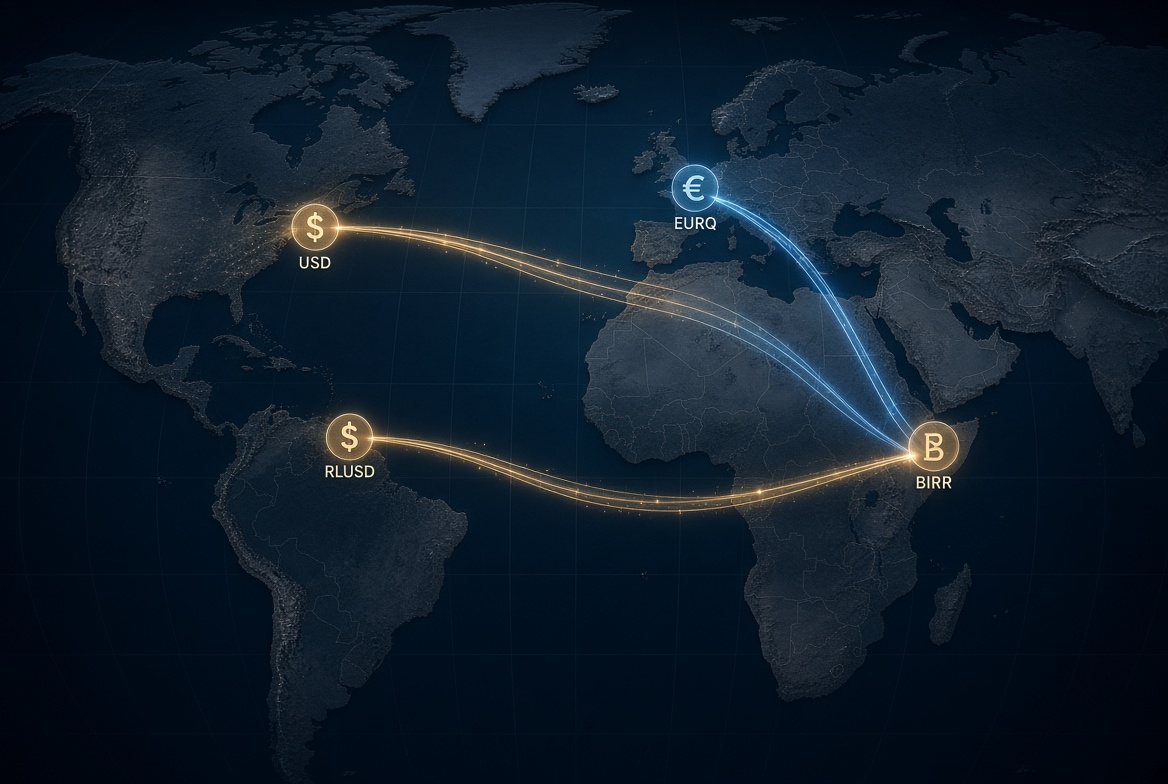
Stablecoins are settling remittances into Ethiopia, funding B2B supplier payments in Latin America, and used directly by the proprietary machinery of Visa, Mastercard, PayPal, and a growing list of banks. What started as an exchange's small project has become something regulators, central banks, and Fortune 500 payment companies are all racing to understand.
Why The Attention?
Stablecoins solved a problem: moving money across a border.
Lower cost: Traditional cross-border transfers through correspondent banking typically take two to five business days, cost around 6% in fees, and route through multiple intermediary banks - each one adding a delay, and more cost. By contrast, stablecoin rails settle the same transfer in seconds to minutes, for a fraction of a percent.
Trust: A dollar sitting in a fractional-reserve bank account is, strangely-enough, a loan the bank made to itself. The deposit is an IOU, not cash in a vault, and you're relying on regulation and deposit insurance to make you whole if something goes wrong.
 Stablecoins Moving Across Borders
A properly regulated stablecoin, by contrast, is legally required to hold reserves 1:1 against every token in circulation, with periodic public disclosures.
Add to that: 24/7/365 settlement with no banking-hours restriction, and it's clear that using stablecoins is highly preferable to traditional rails.
It's Happening
The numbers, while still small relative to world-wide payments as a whole, are moving fast in one direction.
B2B - "business to business" - stablecoin payment flows reached roughly $226 billion annually as of early 2026, growing 733% year-over-year - and B2B now represents the large majority of (non-trading) stablecoin payment volume.
Stablecoin B2B transfers cost roughly 0.1–0.5% per transaction, against 3–6% for traditional wires. In Latin America specifically, 71% of firms surveyed already use stablecoins for cross-border settlement. 😲
Remittance corridors into Sub-Saharan Africa, where traditional fees still average over 6%, are a particular focus for stablecoin rails. The Ethiopia remittance corridor - discussed later - is a noteworthy example.
U.S. Headline Legislation
The regulatory turning point in the U.S. was the GENIUS Act, signed into law July of 2025.
Genius Act: It restricts issuance to "permitted payment stablecoin issuers" operating through a bank subsidiary, an Office of the Comptroller of the Currency (OCC)-supervised nonbank, or another state-qualified entity. Reserves must be 1:1 in cash or similarly liquid assets, monthly disclosure is mandatory, and - notably - issuers cannot pay interest or yield to holders. The FDIC & FinCEN/OFAC have been rolling out changes and updates to their policies and procedures.
Clarity Act: A companion bill, the Digital Asset Market Clarity Act, would go further - establishing which digital assets count as securities versus commodities, and which regulator oversees exchanges and brokers.
It passed the House in July 2025 and cleared the Senate Banking Committee in May 2026, but it has since stalled: a Senate floor vote was pushed to mid-September 2026. Unlike GENIUS, CLARITY is not yet law - it remains the most-watched, unresolved piece of US crypto policy as of this writing.
World-Wide Regulation
Outside the U.S., the regulatory picture is a patchwork - some jurisdictions are fully operational, and others are finalized on paper, but not yet binding.
The following table provides an executive summary of those efforts.
| Jurisdiction | Law | Regulator(s) | Status (Aug 2026) | Issuer Requirements | Reserve Rules | Threshold/Tiers |
|---|---|---|---|---|---|---|
| US | GENIUS Act | OCC, Fed, FDIC, states, FinCEN/OFAC | Enacted; rules in NPRM stage | Must be a PPSI: bank sub, OCC nonbank, or state-qualified | 1:1 cash/liquid assets; monthly disclosure; no yield to holders | State issuers capped at $10B, then move to federal |
| EU | MICA | NCAs, ESMA, EBA | Fully in force | EMT: e-money/credit institution license. ART: Art. 16 authorization | Segregated, held at EU credit institutions, par redemption | No hard cap; "significant" EMTs face added limits |
| UK | FSMA Cryptoassets Regs 2026 | FCA, BoE | Rules final (Jun 2026); full effect Oct 2027 | FCA authorization to issue a Qualifying Stablecoin | Single-currency backing only; systemic issuers: 70% gilts/30% BoE deposits | Standard FCA track vs. BoE "systemic" designation |
| Hong Kong | Stablecoins Ordinance | HKMA | In force; first licenses granted Apr 2026 | HKMA license; ~HK$25M min. paid-up capital | 100% high-quality liquid assets, segregated, audited, par redemption | Small first cohort; entity-by-entity approval |
| Singapore | MAS SCS framework | MAS | In force (Jul 2026) | Major Payment Institution license required | MAS-set reserve/capital/redemption standards | SGD or G10-currency pegs only |
| Japan | Payment Services Act | FSA | In force; full effect Jun 2026 | Bank-only: banks, trust cos., or fund transfer providers | 100% segregated liquid assets; par redemption | No size cap; gated by entity type, not volume |
| South Korea | DABA (proposed) | FSC vs. BOK (disputed) | Not in force; delayed to H2 2026+ | Unresolved: BOK wants ≥51% bank ownership; FSC opposes | Draft: ≥100% reserves, segregated custody | No final tiers; ownership rule still contested |
The pattern. Across nearly every finalized approach - MICA, GENIUS, Hong Kong's Ordinance, Japan's Payment Services Act - there are commonalities: full reserve backing, licensed issuers, and guaranteed redemption.
Functional Standards
Regulation hasn't stopped at "hold enough reserves." Increasingly, it reaches directly into how a stablecoin has to behave on-chain.
The (U.S.) GENIUS Act requires issuers to maintain the technical capability to "block, freeze, and reject specific or impermissible transactions" - and this extends to seizing or burning tokens in response to a lawful US order.
MICA grants EU regulators freeze powers during reserve investigations and requires issuers to maintain the technical ability to freeze tokens for sanctions enforcement. Hong Kong has gone further, publishing a reference smart-contract architecture with named roles - a PAUSER to halt transfers during an incident, a FREEZER to lock individual wallets, a BLACKLISTER to manage prohibited addresses - all deliberately separated so no single key can do everything.
None of this is theoretical.
Major issuers had already built freeze and blacklist functionality into contracts before regulation caught up - this is one case where industry practice led, and law is now formalizing those standards.
A true "clawback" - a function that reverses a completed transfer without the recipient's cooperation - is rare; what's actually required is closer to freeze-then-burn: lock a wallet, then destroy tokens through a lawful redemption or seizure process, rather than debiting an account.
Layer One Fit: XRP Ledger & Xahau
Most of the compliance architecture - freeze functions, blacklists, role-based access control - has to be built by the issuer, from scratch, as custom smart contract code on general-purpose chains like Ethereum. Every issuer effectively reinvents the same wheel; every implementation is a new audit & attack surface, and may contain unforeseen weaknesses.
The XRP Ledger takes a fundamentally different approach: freeze and clawback are native, protocol-level features, not application code an issuer has to write and maintain. XRPL's trust-line system supports Individual Freeze, Deep Freeze (blocking a wallet from both sending and receiving), and Global Freeze - a direct match to the "block, freeze, and reject" language written into the GENIUS Act. Clawback is similarly built-in: an issuer opts in with a flag before ever issuing a token, then executes a native transaction to reclaim funds, including tokens deposited into an automated market maker.
 Ripple's RLUSD
Ripple's RLUSD already uses this pattern: Deep Freeze to lock an account during an investigation, followed by Clawback once a court order arrives. And it works identically whether RLUSD is running on the XRP Ledger or on its Ethereum-based counterpart, according to David Schwartz - which is itself a demonstration of how much more directly XRPL maps onto what regulators are now demanding, compared to a general-purpose smart contract chain.
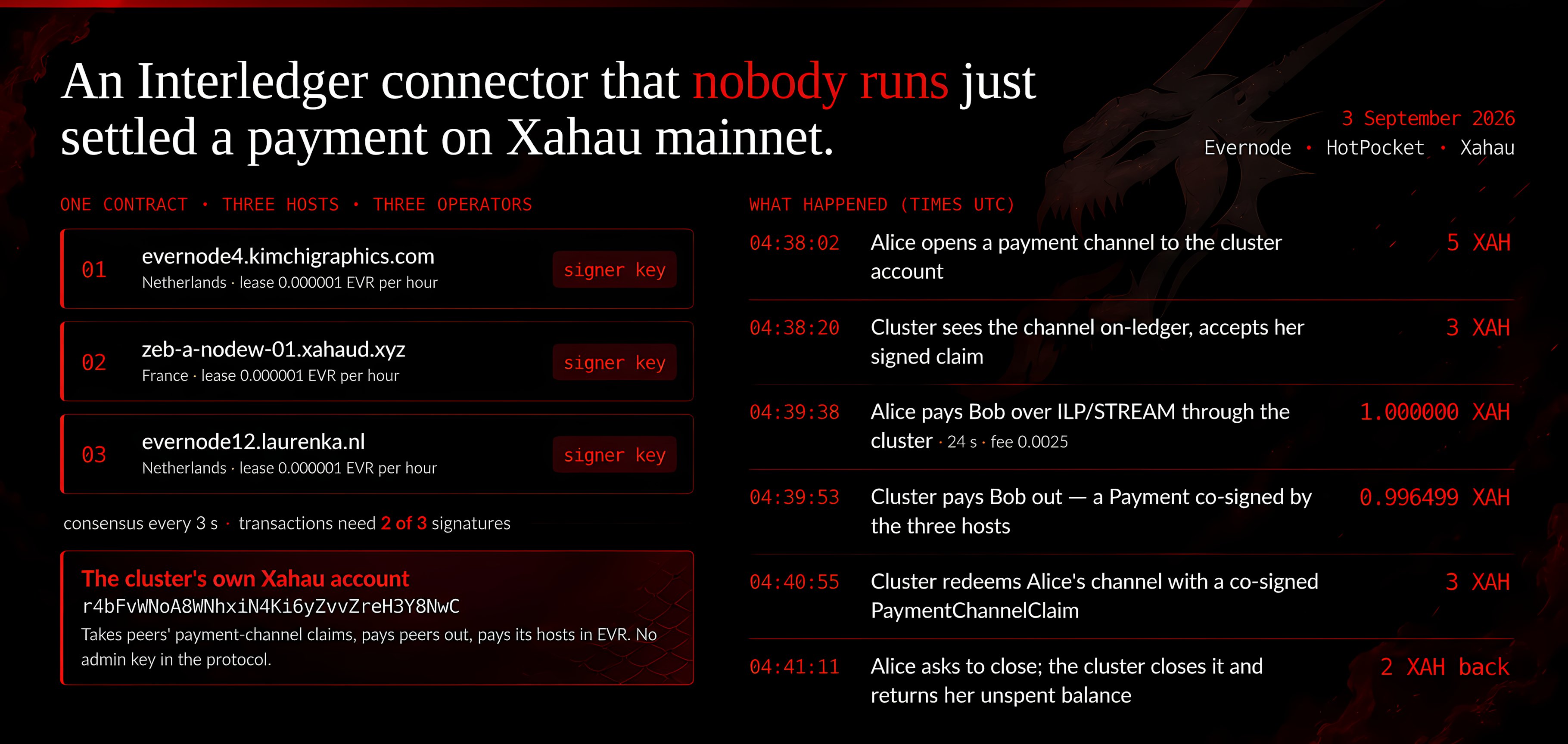
Xahau, a network built on XRPL's core, inherits a set of those native compliance primitives, and then adds something the XRPL doesn't have: Hooks, a system of bounded, account-centric, WebAssembly-based programs that run inline with every transaction. Where the XRPL gives an issuer freeze and clawback as fixed, built-in tools, hooks let an issuer add a layer of custom logic - automatic transaction screening, conditional whitelisting via deposit preauthorization, and jurisdiction-specific rule engines. Xahau's own positioning is explicit about this: it's built with regulated and enterprise compliance use cases in mind, not as an afterthought.
Xahau is already operating according to this paradigm with real money.
 Xahau's Remittance-via-Stablecoin Application
An initial remittance project has since been scaled into a large three-way arrangement between TerraPay, Coopbank, and Quantoz Payments - a Dutch, DNB-regulated e-money institution - routing euro-denominated payments into Ethiopia's $5-billion-a-year inbound corridor. Quantoz's MICA-compliant euro stablecoin, EURQ, is the settlement asset for the euro leg, issued natively on Xahau alongside deployments on Ethereum, Stellar, Algorand, and the XRP Ledger.
XRPL and Xahau aren't the only chains built this way.
Stellar and Algorand both offer similar native freeze and clawback primitives as first-class ledger features rather than custom contract code, and Quantoz deliberately issues across several of these "compliance-native" chains rather than picking just one.
That's an interesting pattern - a regulated, supervised issuer choosing to deploy the same asset across XRPL, Xahau, Stellar, and Algorand in parallel suggests that the market sees real, practical value in this whole family of utility chains, not just enthusiasm for any one of them.
Within that family, Xahau's combination of inherited native primitives plus hooks-based programmability gives it an edge for issuers who need more than the baseline - without forcing them into the far larger complexity of a general-purpose smart contract chain to get there.
It Will Only Grow
The most visible examples of this thesis in practice are RLUSD on the XRP Ledger and EURQ on Xahau - a GENIUS-Act-aligned dollar stablecoin and a MICA-compliant euro stablecoin, both built on chains where the compliance machinery was already sitting there, as a native feature.
It is high-probability that more will be added.
As regulated issuers look for a chain that doesn't force them to build and audit their own freeze-and-seize logic from the ground up, and as more everyday users get comfortable moving value instantly through non-custodial wallets like Xaman rather than waiting on a bank's internal batch process, the compelling argument for XRPL and Xahau only gets stronger.
Why trust a third party to keep an accurate, honest copy of your ones and zeros - hoping they've reconciled their ledger correctly, hoping their reserves are real - when a crypto network can prove it, and hand you the keys?
X | X>
Sources
- Early stablecoin history: https://www.deltecbank.com/news-and-insights/the-history-of-stablecoins/
- Tether's origin and timeline: https://www.tradingview.com/news/beincrypto:7cd73f950:0-tether-usdt-turns-8-a-history-of-fud-regulation-and-growth/
- Stablecoin market and cross-border stats: https://reap.global/blog/stablecoin-statistics-2026
- B2B stablecoin payment growth: https://stablecoininsider.org/stablecoin-b2b-cross-border-payments/
- Stablecoins' share of world-wide payment flows: https://www.openfx.com/stablecoins-cross-border-payments-report-2026
- GENIUS Act overview: https://www.fintechweekly.com/magazine/articles/stablecoins-mainstream-payments-genius-act-2026
- CLARITY Act status: https://tech-insider.org/clarity-act-2026-status/
- EU MICA dashboard: https://defillama.com/mica
- RLUSD freeze/clawback on Ethereum and XRPL: https://u.today/ripple-cto-explains-crucial-rlusd-stablecoin-feature
- EURQ launch on Xahau: https://thecryptobasic.com/2025/10/30/quantoz-unveils-euro-backed-stablecoin-eurq-on-xrp-ledger-sidechain-xahau-network/
- TerraPay/Coopbank/Quantoz Xahau deal: https://xpert.page/hodor/blog/xahau-settlement-terrapay-coop-bank-and-quantoz
- Quantoz expansion to Algorand: https://www.quantoz.com/blog/quantoz-brings-european-regulated-stablecoins-eurq-and-usdq-to-algorand
- Quantoz multi-chain roadmap: https://stablecoininsider.org/quantoz-payments/