One Xahau
⚠️ As with all my articles, this does not constitute financial advice. Please consult a financial expert before making any financial decisions.
"DeFi"
Decentralized finance - DeFi - has become one of the most talked-about concepts in the blockchain world, promising open, permissionless access to financial tools like lending, trading, and yield generation.
For Xahau, a new smart-contract-enabled network, DeFi is arriving right now - and a developer from Atlanta, Georgia is the one making it happen.
One Xahau is one of the first DeFi platforms built natively on the Xahau network. It's bringing a suite of financial products - automated market making, lending, and perpetual contracts - to a network that, until now, had none of them.
Understanding the Xahau Landscape
To appreciate what One Xahau is doing, it helps to understand what Xahau is - and what it's been missing.
Xahau is, in simple terms, a fork of the XRP Ledger, distinguished primarily by its support for "hooks" - compact, event-driven pieces of code that attach to accounts and execute automatically when transactions occur.
You can think of hooks as the Xahau equivalent of Ethereum smart contracts ... but optimized for the speed and efficiency of the XRP Ledger's architecture.
The network's roadmap is ambitious. Features like a native Automated Market Maker (AMM), a Price Oracle, and a cross-chain capability called FeatureExport are all scheduled for release as early as the beginning of Q4 2026 (October). The native AMM in particular is highly anticipated - it would bring on-ledger liquidity to Xahau's decentralized exchange.
But "anticipated" and "available" are two very different things.
Until those amendments pass a network vote and are activated on-chain, the tools simply don't exist in native form. That gap - the space between what the Xahau roadmap promises and what users can access today - is exactly where One Xahau has stepped in.
One Xahau: Filling the Vacuum
The man behind One Xahau goes by the handle Cbot on X, and his path to DeFi development is not a conventional one. By his own account, he's primarily a construction industry professional who recently picked up coding around 2019 or 2020.
His motivation was less about financial opportunity and more about community.
"It kind of grew from there ..."
That's how he described the transformation of the original project into One Xahau during a recent live session on X. His original project was a data aggregator for tokens on the Xahau network, and it has changed into something far more ambitious. Cbot has also collaborated on the technical aspects of his project periodically with another Xahau community developer known as Gadget78.
His stated goal: to galvanize the Xahau community and push the ecosystem forward.
The result is One Xahau, a hook-powered DeFi platform that doesn't wait for native AMM support to materialize.
Not Just AMMs: A Full DeFi Suite
One Xahau launched with three distinct financial products, each powered by hooks running autonomously on the Xahau network.
Automated Market Making (AMM): One Xahau's AMM allows users to contribute assets to liquidity pools and earn fees from trades ('swaps') executed against those pools.
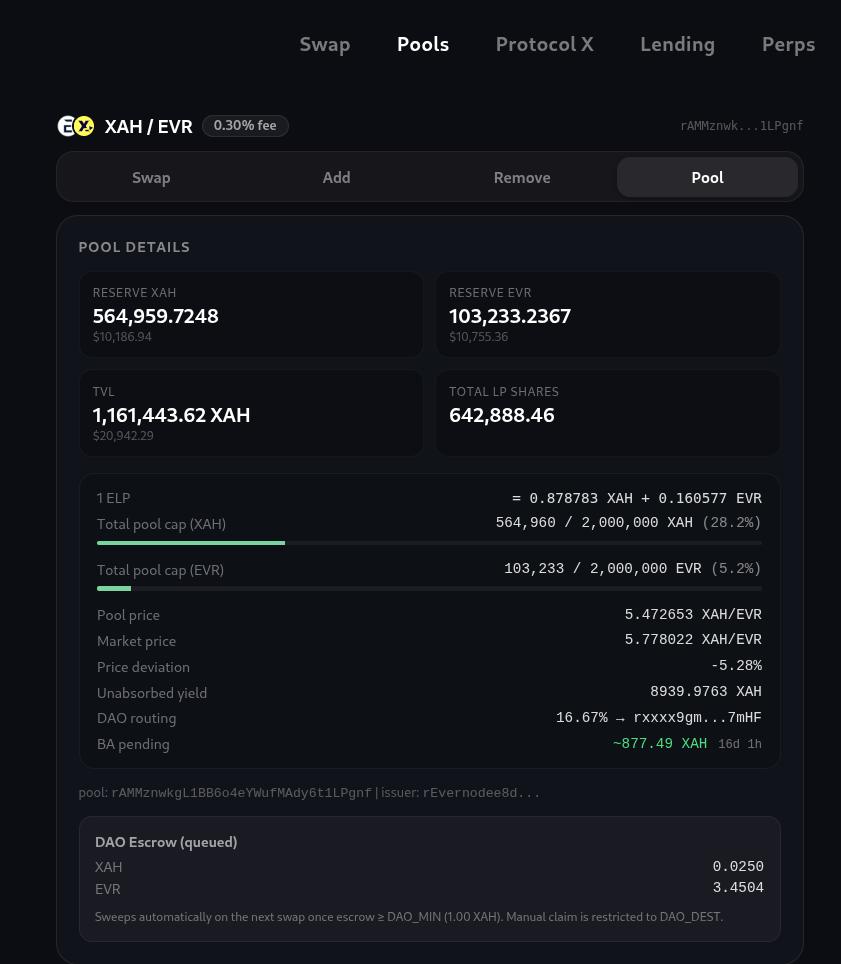 One Xahau's AMM Pools
New token pairings can be bootstrapped through a DAO vote, giving the community a direct say in which assets get listed.
What sets this AMM apart from what a native Xahau implementation might offer is that it was specifically designed to serve the One Xahau DAO - a portion of every fee charged by the AMM is automatically routed upward to fund the platform's decentralized governance structure. It also leverages Xahau's inherited XRP Ledger pathfinding capabilities, uses a yield curve to place strategic orders on the DEX, and even counterbalances the natural XAH accumulation that occurs due to Xahau's native balance adjustment rewards.
Very impressive thoughtfulness here.
Perpetual Contracts: One Xahau offers a futures-like product known as perpetuals - leveraged bets on the future price of an asset. Currently, the platform supports longs and shorts on EVR (Evernode's token) priced against XAH.
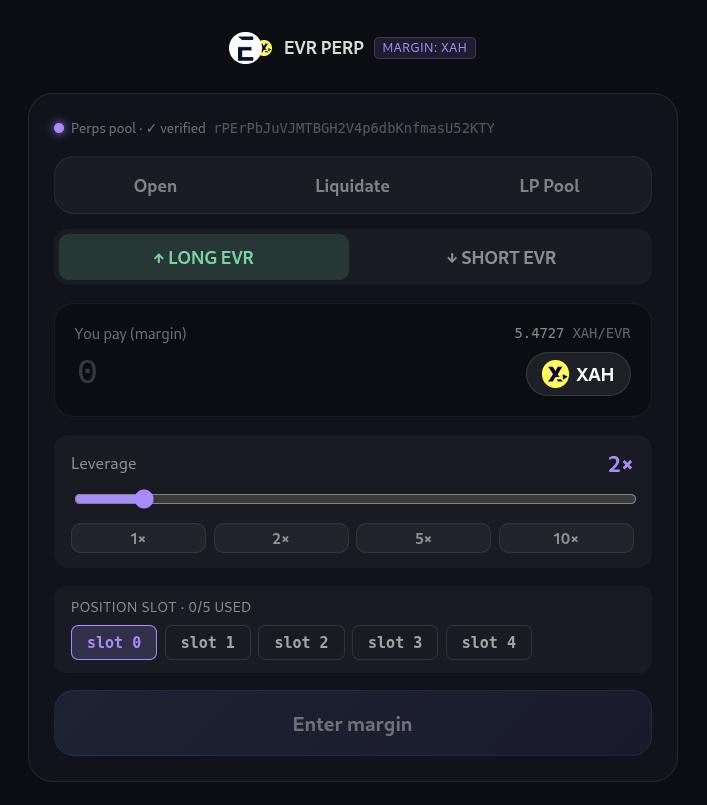 One Xahau's Perpetual Contracts
The pool absorbs wins and losses, and a system of funding rates keeps positions from becoming dangerously lopsided - if one side (long or short) becomes disproportionately large, participants on that side pay higher rates to compensate the pool for the additional risk.
Position sizes are also capped relative to the pool's total size, so no single trade can drain the pool. As Cbot noted during the X space:
"There was a lot of talk about creating a side chain to the XRPL for perps ... Xahau could drive perpetual contracts right now - this could be put in a hook."
Lending Protocol: One Xahau's lending product is a one-sided, collateralized lending system.
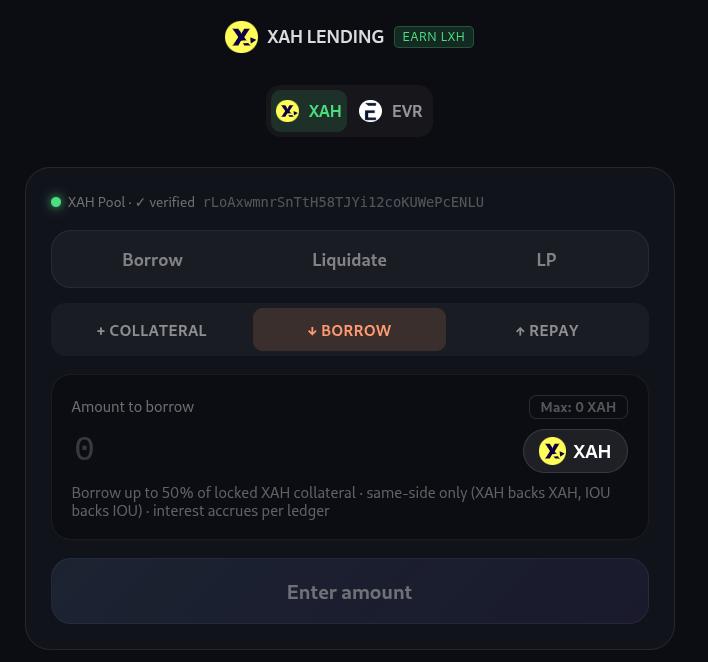 One Xahau's Lending Function
Users who want to earn yield contribute to a lending pool. Borrowers then post collateral and take loans of up to 50% of that collateral's value, at a current rate of 10% interest.
If a borrower fails to repay, the hook automatically claims their collateral on behalf of the pool. Notably, the current implementation does not liquidate based on collateral price drops - a feature Cbot is eager to add once Xahau's planned Price Oracle goes live. The 10% interest earned on loans flows directly to LP token holders, making the lending pool an income-generating position for liquidity providers.
The DAO: Governed by Hooks
All three products - the AMM, the lending protocol, and the perpetual contracts - funnel a percentage of their fees into a central, autonomous treasury: the One Xahau DAO. On the website, this appears to be referenced under 'Protocol X':
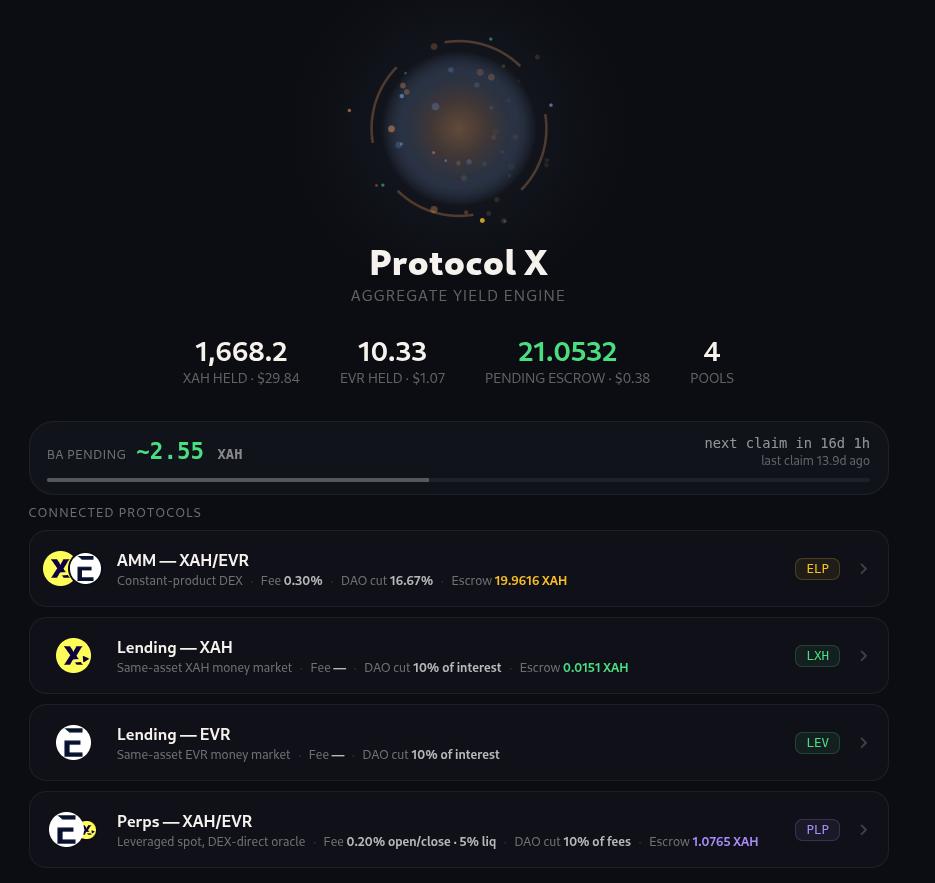 One Xahau DAO - Protocol X
The organization is governed by 5 to 6 hooks operating entirely on-chain, handling everything from fee collection to vote execution to profit distribution. When escrow thresholds are reached, hooks send funds to the DAO without anyone needing to press a button.
Every major platform parameter - fee rates for the AMM, interest rates for lending, which assets can be traded in the perpetuals pool - can only be changed through a DAO vote. That vote requires the use of XXX tokens, the platform's governance token, which are consumed when cast. This gives XXX a built-in deflationary mechanic: every governance decision reduces the token's circulating supply.
To protect against coordinated attacks or bad-faith voting, the DAO also features a council - a group of elected members who function similarly to a validator list in the XRP ecosystem.
Major decisions require council members to vote in alignment with the broader community vote, acting as a check against any single actor trying to weaponize raw voting power against the platform.
The XXX Governance Token
The XXX token is the connective tissue of the One Xahau ecosystem. Here's how it works in practice:
When users participate in any of the three DeFi products - the AMM, lending, or perpetuals - they receive LP (liquidity provider) tokens representing their share of the pool. Those LP token holders can then register with the DAO, at which point a hook reads their account, notes their LP positions, and issues XXX tokens to them.
The issuance schedule is designed to reward early adopters most generously - the earlier a user participates, the higher their relative XXX token earnings. As the platform matures, the per-user issuance rate declines, following an epoch-based schedule typical of token distribution models.
XXX tokens serve two functions: voting power within the DAO, and access to a share of the DAO's profits when staked. Approximately 10% of the DAO's revenue - including the XAH balance adjustment rewards earned by all XAH held across the platform - is earmarked for distribution to XXX token stakers. This creates a layered incentive: provide liquidity, earn LP tokens; hold LP tokens, earn XXX; stake XXX, earn a cut of platform revenue.
Balance Adustment
One of the attractive characteristics of Xahau is that both infrastructure providers and holders alike are able to access a 'reward' based on how much XAH they are holding. While infrastructure providers that occupy a governance seat on Xahau are rewarded much more than ordinary holders, all holders are able to access the basic balance adjustment.
Currently that balance adjustment rate is set to 4% APY.
Cbot indicated that, generally, anywhere where XAH is held in the autonomous One Xahau system - whether as part of the liquidity pools or as part of the DAO - that balance adjustment is leveraged for an increased return.
It's a way that One Xahau leverages the native reward mechanism to boost its earnings for liquidity providers and DAO participants.
It's Not Blackholed - Yet
There's an important caveat that any serious participant in One Xahau should understand: the hooks are not yet blackholed.
In Xahau's hook ecosystem, "blackholing" an account means permanently revoking the owner's ability to modify the code attached to that account. Once blackholed, the hooks run exactly as written - forever - with no possibility of alteration by anyone, including the original developer. It's the ultimate form of trustless operation, because it eliminates any single point of human control.
One Xahau isn't there yet.
Currently, changes to the hook code require a multi-signature process involving Cbot and approximately three other individuals. This means that, in theory, the code could still be altered by those parties acting in concert.
This is a deliberate choice. With any new platform, unexpected bugs or edge cases emerge as real users interact with the system in ways that testing couldn't anticipate. Cbot has opted to keep the multi-sig safety net in place while the platform accumulates usage data and proves its stability in the wild.
"In probably thirty-to-sixty days we'll be blackholed ... Right now, we're not."
For users evaluating risk, this is a meaningful distinction. The platform is backed by multi-sig security rather than the absolute trustlessness of a blackholed account.
Significance for the Xahau Ecosystem
Xahau has long held the theoretical promise of powerful DeFi capabilities through its hooks architecture. What has lagged thus far for the new network is the application layer - the number of actual platforms where users can put those capabilities to work. One Xahau is one of the few applications to bridge that gap at scale, demonstrating that hooks can power sophisticated, multi-product financial applications without relying on native protocol upgrades.
There's also the matter of timing.
With Xahau's native AMM, Price Oracle, and FeatureExport feature all queued up for potential activation in Q4 2026, the ecosystem is on the cusp of a significant expansion. One Xahau positions itself as a foundation - a platform already battle-testing the concepts that native features will eventually offer, and one with a governance structure capable of adapting as those new features come online.
Perhaps most significantly, Cbot has announced plans to release the hook code for the AMM, lending, and perpetuals as open-source tools (without DAO integration) for other developers to use. If successful, One Xahau won't just be one of Xahau's first DeFi platforms - it may become the reference point for the next generation of Xahau applications.
For a network that has focused relentlessly on layer one tools and utility, that's no small thing. X>
Sources
One Xahau on X: https://x.com/One_Xahau
Cbot on X: https://x.com/Cbot_Xrpl
Gadget78 on X: https://x.com/gadget78
"DeFi is Live on One Xahau on XahauNetwork" — X Space recording: https://x.com/i/spaces/1vJpPPgDrwdJE?s=20
Xahau Network Roadmap: https://xahau.network/roadmap/