Proving Hooks Are Safe
A Xahau community developer, HugeGreenCandle, has written something that sounds like we've stepped into a science fiction movie where the protagonist finds a diary entry from a missing scientist:
"Been building something weird. Protozoa. A little creature that lives on Xahau. One account, the hook is its DNA. It eats real XAH to stay alive, burns energy every ledger on its own, and when it runs out it dies and cleans itself up. Nobody runs it, the chain does."
A creature. On a blockchain. That eats money and dies of old age. 🤔
After that initial report, early on July 4th, the posts kept coming - that same day, and the days after - and each one added a capability that added to the mystery - and my own private skepticism and questions: hunting, sharing food with starving relatives, going dormant instead of dying, even reproducing with genetics decided by a coin flip.
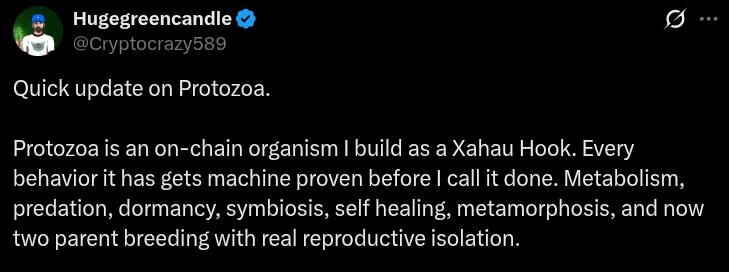 July 7th Post
By the end of the week, the posts claimed that the creature could rewrite its own code to grow up.
I'll come back to what that actually means, and whether the claims hold up, in a minute. First, it's worth understanding why a serious developer would spend a holiday week building a digital organism instead of something more conventional. The answer has almost nothing to do with biology, and everything to do with a problem that's currently costing real money in the AI industry: agents that can't stop spending.
The Problem For Agentic Payments
AI agents are starting to pay for things on their own - API calls, data lookups, compute time - without a human clicking "approve". A new protocol called x402 (and several competitors) makes this possible: an agent hits a paywall, pays automatically in digital currency, and proceeds.
The obvious safeguard is a spending cap: "this agent may not spend more than $10 a day." Simple enough - until you remember that agents don't do one thing at a time. A single agent, or a fleet of them, can fire off dozens of requests within the same second.
That's where things break.
Most spending caps work by checking the balance, then approving the payment - two separate steps. If five requests hit that check in the same instant, each one can see the same balance, because none of the other four have been recorded yet.
All five get approved.
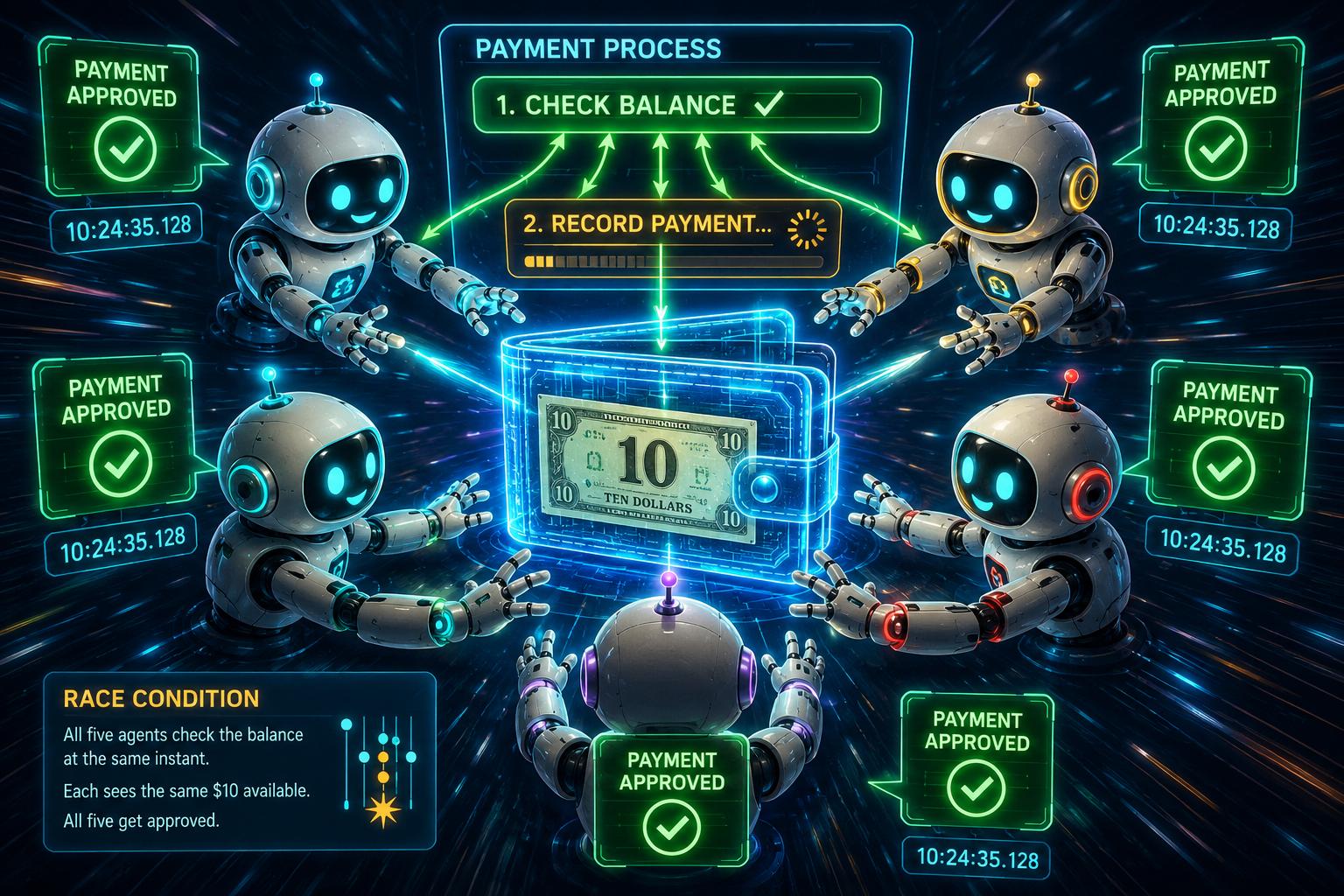 Agentic Payments And Race Conditions
A $10 cap becomes an $18 bill. This isn't a hypothetical: real-world reports from teams running these systems have described near-total budget leakage during high-traffic bursts, and it's the same category of bug that lets someone redeem one gift card twice by using two browser tabs at once - just happening at machine speed, thousands of times a day.
A funding cap tells you the most an agent could ever spend. It says nothing about whether the agent's own code behaves the way you assumed it would.
The Challenge of "Proving" Safety
This is where a small but growing industry comes in: smart contract auditors. Firms in this space test contract code against known attack patterns, run automated scanners, and increasingly use AI-assisted tools to flag issues like reentrancy bugs and timing races before code goes live. It's become a narrow specialty precisely because payment code that looks fine in a demo can fail in ways nobody thought to test - especially under the kind of concurrent, high-speed conditions agentic payments create.
But testing has limits.
A test suite can only try the scenarios someone thought to write. A race condition, by definition, only shows up under specific, hard-to-reproduce timing - which is exactly why it tends to slip past normal QA and show up in production.
The stronger alternative is formal verification: instead of testing a handful of cases, you mathematically prove a property holds for every possible input and every possible ordering of events. It's a much harder discipline, and far less common - which is part of why HugeGreenCandle's summer project is worth paying attention to.
The Organism Living on Xahau
It turns out the 'Code Protozoa' isn't really about the organism. It's a stress test.
As HugeGreenCandle put it directly:
"If I can prove a self-reproducing, self-modifying organism can't cheat, then proving a normal payment hook is easy."
The creature is the hardest thing he could think of, to build and formally verify - metabolism, reproduction, predation, cooperation, self-modification - precisely so that verifying an ordinary payment contract looks trivial by comparison. Every "life stage" the creature gained over the week was really a new category of mathematical proof he'd learned to check.
Decoding the Protozoa
Once you swap out the biology metaphor for the underlying technology, the picture is a lot less exotic - and a lot easier to trust.
Here's the translation, mapped directly from HugeGreenCandle's own explanation:
| Label | What It Actually Is |
|---|---|
| Organism / creature | A Xahau account |
| DNA / genome | A small chunk of saved data (traits) stored on that account |
| Body / life-stage form | The program ("hook") installed on the account |
| Energy | Real XAH the account holds - never fabricated |
| Metabolize | The program subtracts a little energy each time it's triggered |
| Feed | Someone sends the account a payment |
| Reproduce | The parent funds a pre-made empty account and writes a new genome into it |
| Die | The program deletes itself and clears its data |
| Predation / cooperation | Accounts sending payments or messages to each other |
| Vivarium (the viewer) | A separate app that reads the accounts and draws a picture of the "world" |
Nothing here is is from a dark, medieval laboratory ... it's (mostly) standard engineering on Xahau's Hooks - its native smart-contract layer - described in language built to activate people's imagination.
It worked; that's how this article exists. 😁
A Hook Installing a Hook? And Other Madness
The strangest-sounding claim in the whole thread is that the creature "rewrites its own code" to grow up. That sounds like it should be impossible - and in a sense, it is. HugeGreenCandle was careful to correct my understanding on exactly how it works:
"It never modifies source and never generates or compiles code at runtime... 'Self-modification' means the hook calls SetHook on its own account to replace the installed hook with a different, pre-compiled, pre-proven hook, referenced by hash... it can ONLY ever install a hash from a closed, pre-proven allowlist, or delete, never arbitrary code."
In other words: nothing is invented on the fly.
It's less "a caterpillar spontaneously growing wings" and more "a caterpillar flipping to a pre-approved butterfly blueprint that was already sitting on a shelf."
 Electronic Protozoa
The idea - proving a program that can install different pre-approved versions of itself can never sneak in an unapproved one - is, in HugeGreenCandle's words, "the hardest verification target," and the whole reason the demo exists.
That difficulty points at something bigger than one creature.
A Hook can, by design, construct and send nearly any transaction type on its account's behalf. That flexibility is powerful, but it also means the space of things a Hook could theoretically do is far too large for any one developer to reason through. Guard rules built into Xahau ensure a Hook can't run forever or loop out of control - but that only proves a Hook stops.
It says nothing about whether it stops having done the right thing. That gap between "it halts" and "it behaves correctly for every possible input" is exactly what formal verification is built to fill.
What's Public, What's Private
HugeGreenCandle has an existing crypto company & site, Kairo Vault Technologies, and is positioning Protozoa as the proof-of-capability behind a paid hook-auditing service - a formal-verification offering for Xahau smart contracts, with agentic (or hook) payment safety certification as an idea.
It's a useful offering: verification services like this barely exist yet in the Xahau ecosystem, and one arriving now says something about how quickly the space is maturing.
It also presents a challenge.
He's been explicit that the prover - the tool that actually does the checking - and the creature's source code stay private: It's a practical desire to prevent his competitive advantage from being copied.
Next Up
The organism itself was never really the point - it was a proof of a different kind.
If Kairo Vault can turn that into an auditing service for Xahau Hooks, it fills a real gap at a moment when the ecosystem clearly needs one. Technology adoption is never a straight line; Kairo Vault is positioned with a useful offering for entrepreneurs and businesses that would like an extra level of assurance as they begin to use Xahau hooks for more and more projects. X>
Sources
Q&A over X DM with the creator of xahau-mcp and evernode-mcp HugeGreenCandle
HugeGreenCandle posts on X, July 4–9, 2026
July 4th Post: https://x.com/Cryptocrazy589/status/2073315704095510559?s=20
July 4th Post: https://x.com/Cryptocrazy589/status/2073429788984050106?s=20
July 4th Post: https://x.com/Cryptocrazy589/status/2073578182142541979?s=20
July 4th Post: https://x.com/Cryptocrazy589/status/2073637391097897203?s=20
July 7th Post: https://x.com/Cryptocrazy589/status/2074398699040735251?s=20
July 9th Post: https://x.com/Cryptocrazy589/status/2075127276547801293?s=20
July 10th Post: https://x.com/Cryptocrazy589/status/2075426678956814343?s=20
Kairo Vault Technologies (https://kairovault.com/)
Xahau Network documentation, Hooks (https://xahau.network/docs/hooks/)
Xahau Network documentation, Debugging Hooks (https://docs.xahau.network/concepts/debugging-hooks)
x402.org, protocol overview (https://x402.org/)
Coinbase Developer Platform, x402 Core Concepts: Facilitator (https://docs.cdp.coinbase.com/x402/core-concepts/facilitator)
"Free-Riding in the AI Economy: Demystifying Logic Flaws in x402-Enabled Payment Systems," arXiv (https://arxiv.org/html/2605.30998v1)
"Five Attacks on x402 Agentic Payment Protocol," Li, Wang & Wang, arXiv (https://arxiv.org/html/2605.11781v1)
"Hardening x402: PII-Safe Agentic Payments via Pre-Execution Metadata Filtering," arXiv (https://arxiv.org/pdf/2604.11430)
Chainalysis, "Inside x402: 100M Agentic Payments on Base" (https://www.chainalysis.com/blog/x402-agentic-payments-adoption/)