The Memecoin Lifecycle
You heard it from a friend of a friend: someone just launched a new memecoin on the Xahau network called BanksterCoin.
No utility, no roadmap, just a logo of a cartoon banker in a top hat. Normally you'd scroll past. But something makes you pause - maybe it's the name, maybe it's the timing - and you pull up the DEX pair to take a look. 🤔
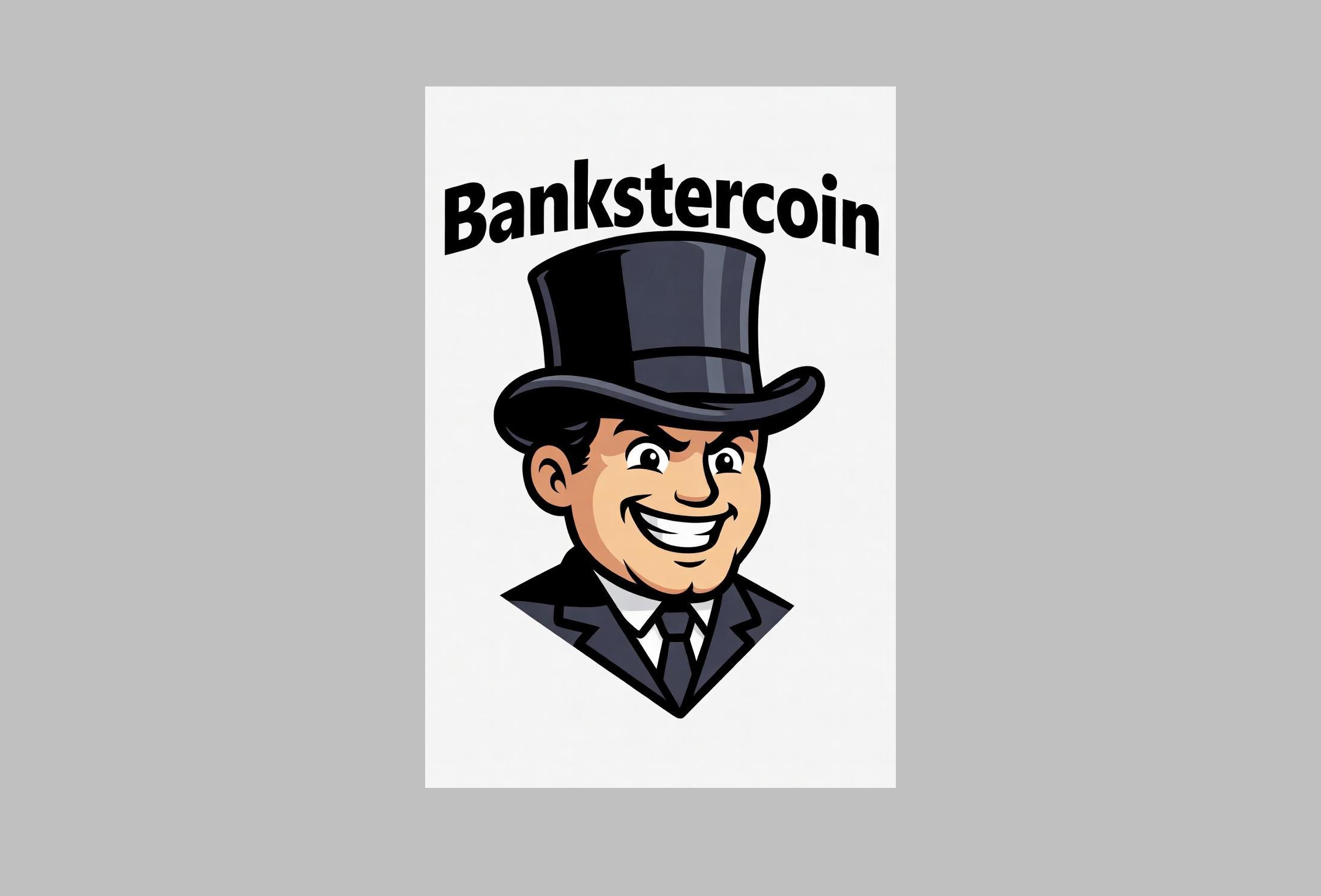 Bankstercoin
There's almost nothing there. A few hundred dollars of liquidity. A handful of wallets. Twelve transactions total, half of them belong to the developer moving tokens between their own addresses. You close the tab. Nothing about this told you it was going anywhere, and you were right not to buy - statistically, this is where almost every memecoin ends: nowhere, with a chart nobody will ever screenshot.
But every so often, one doesn't die quietly. The interesting part about memecoin economics isn't the meme itself - it's the sequence of very old economic ideas that a coin has to pass through, in order, to become the exception.
Cascade
Before a memecoin can be interesting, it first has to clear a lower bar: it has to get noticed by more than the person who created it. This is where an idea called an informational cascade does the work.
Once a few people take a visible action, the next person often copies it - not because they have new information, but because they assume the earlier movers must know something. If you see three wallets buy a token, you don't ask "what do these three people know that I don't" and go verify it yourself; you just infer that they know something, and you buy too. You've now become the fourth data point for the fifth person.
Nobody in the chain needs to be right. The chain only needs to start.
This is why so many tokens - the vast majority - never make it past this stage. A cascade needs an initial nudge: a KOL post, a coordinated Telegram push, or a lucky repost. Without it, a coin can sit at twelve transactions forever, because people do not ordinarily buy a token simply because it exists.
BanksterCoin, in our hypothetical example, catches a break here.
A Xahau community account reposts the logo as a joke about a recent DeFi exploit. A dozen wallets buy in the next hour, mostly out of curiosity, mostly small amounts. The chart ticks up. And now, for the first time, BanksterCoin has cleared the gate - which means it's eligible for a new, different kind of game.
The Beauty Contest
Once a coin has real trading activity, the question buyers are asking shifts.
It's no longer "do I think this is funny" - it's "do I think other people will think this is funny." This is the territory of what economist John Maynard Keynes called a beauty contest, from a thought experiment in his 1936 book The General Theory of Employment, Interest and Money. Keynes imagined a newspaper contest where readers pick which face, out of many, they think the average reader will also pick as prettiest. The winning strategy isn't picking your own favorite - it's guessing the crowd's guess.
 Studying Memecoin Charts
And a sophisticated player goes one level further, trying to guess what the crowd thinks the crowd will guess.
Memecoins run this exact loop, with one twist that makes it even more intense than Keynes' newspaper: the "photo" changes in real time. A rising price is evidence to the next layer of buyers that the crowd has already spoken, which pulls in more buyers, which pushes the price further - a feedback effect economists call reflexivity. At this stage, a coin is competing against every other coin trying to win the same contest.
Back to BanksterCoin: say the joke lands well enough that it spreads past the original community, and for a few days it's competing with a handful of other trending Xahau tokens for the same pool of speculative attention. Holders aren't asking "is the banker joke good" anymore - they're asking "is this the one that's about to be everywhere." Then, inevitably, the buying pressure runs out of new entrants, and the price does what nearly every memecoin price eventually does: it falls, hard.
This is the fork in the road. Most coins that reach the beauty-contest stage die here too - the crash ends their story.
But a small number don't ...
Durable Focality: The Lindy Effect
There's an older, more established idea in economics and probability for what happens when something survives a test like this: the Lindy effect. The name comes from a New York deli where comedians reportedly observed that the longer a show had already run, the longer it tended to keep running. The general version of the idea, discussed by various writers, is that for certain "non-perishable" things - ideas, institutions, cultural objects - survival itself is evidence of durability.
The longer something has lasted, the more reason there is to expect it will continue lasting.
Applied to a memecoin, this is the difference between a coin that pumped once and a coin that has history. If BanksterCoin crashes 90% and then - rather than dying - stabilizes with a smaller, stickier group of holders who keep the joke alive, reference the crash as "the first banker bailout," and keep trading it through a second and third cycle, something has changed. It's no longer competing purely on freshness.
It has lore.
 Bankstercoin Community Meetup
New buyers aren't discovering it cold; they're discovering a coin that other people already decided was worth remembering. That's a fundamentally different, more durable kind of demand than the beauty contest produces - closer to genuine, if informal, brand equity than to a bet on the next viral wave.
A memecoin's staying power is earned through lived, observed survival.
BanksterCoin, if it gets here, becomes something close to the "obvious" banker-joke coin on Xahau, less because of any inherent quality and more because everyone remembers it was the one that survived.
Knowledge Is Power
None of this makes memecoin speculation safe - at best, mapping the mechanism makes the risk more understandable.
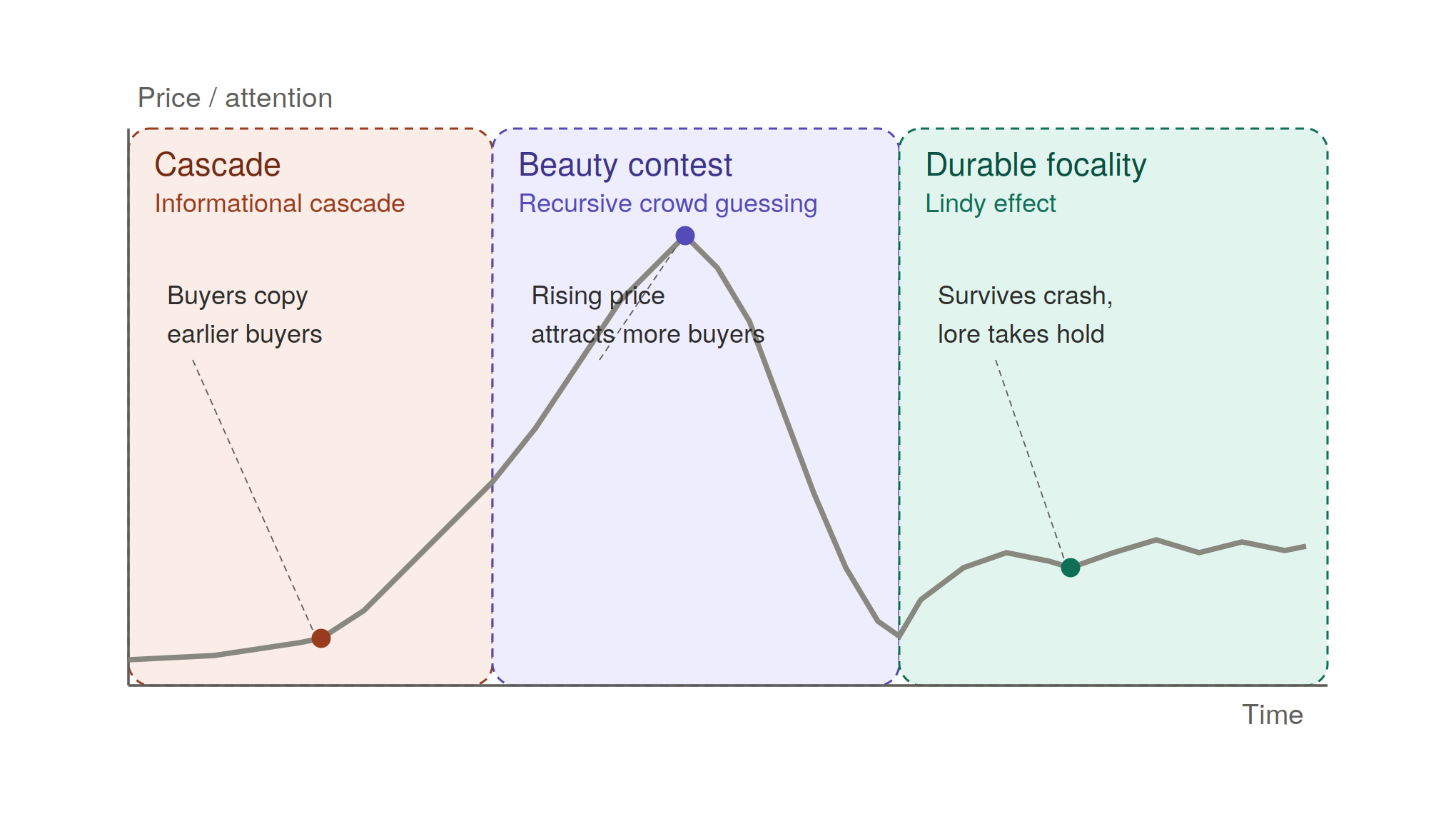 Hypothetical Memecoin Example
The preceding chart is an example of the three phases described in this article; the price action, of course, may be wildly different in real-world examples. It serves to demonstrate the high-level concepts visually, and show the distinct lifecycle phases.
A coin with twelve transactions is not in a beauty contest, no matter how good its meme is. A coin mid-pump has not yet earned any durability, no matter how confident its holders sound. Recognizing which game you're actually playing - cascade, contest, or durability - is a small piece of the puzzle in a market built almost entirely on human psychology.
Sources
Bikhchandani, S., Hirshleifer, D., & Welch, I. (1992). A Theory of Fads, Fashion, Custom, and Cultural Change as Informational Cascades. Journal of Political Economy.
Keynes, J. M. (1936). The General Theory of Employment, Interest and Money, Chapter 12.
Soros, G. (1987). The Alchemy of Finance (for reflexivity).
Ord, T. (2023). The Lindy Effect. University of Oxford working paper, arXiv:2308.09045.
Wikipedia: "Lindy effect": https://en.wikipedia.org/wiki/Lindy_effect
Xahau Network: https://xahau.network