Protect Your Assets
It's a familiar story.
You get into crypto with small amounts. Maybe your journey starts at a centralized exchange - Binance, Bitstamp, Coinbase - somewhere with a clean interface, customer support, and the comforting illusion of a safety net. At that stage, security is largely handled for you. Your job is simple: keep your login credentials private, enable two-factor authentication, and don't click on suspicious emails.
 Keep Credentials 'safu'
That's about it.
But for many in the XRP community, the bull market of 2025 changed everything almost overnight. What had been a modest, manageable balance on an exchange quietly transformed into something much more ... life-changing money, sitting in an account you don't fully control, on a platform you may not fully trust.
That's when people start asking questions they probably should have been asking all along.
Life-Changing Amounts
"It's a good problem to have."
That phrase gets used a lot when the numbers in your exchange account start looking less like a speculative bet and more like a down payment on a house, a college fund, or a retirement nest egg. And it is a good problem ... but it's still a problem.
Once your holdings cross a threshold that genuinely matters to your financial life, the calculus around security changes completely. Suddenly, questions you could afford to put off become urgent:
- Where do I put the crypto? Leaving large amounts on a centralized exchange is a risk. Exchanges have been hacked, frozen, or gone insolvent, sometimes without warning.
- What wallet do I use? Hardware wallet? Software wallet? A combination of both?
- Do I use a mix of cold and hot wallets? A hot wallet (connected to the Internet) offers convenience; a cold wallet (offline) offers stronger security.
- How do I keep my keys secure? Your seed phrase is everything.
- How do I protect myself against scammers and fraudsters? The crypto space attracts sophisticated bad actors.
These are problems that require real, thoughtful, personalized answers.
Reality Versus Ideal
Most of us adopted security practices when our stakes were low.
A mental note here, a screenshot of a seed phrase there, a wallet app on a phone that also has 47 other apps installed. Informal, imperfect, and probably fine — at the time. But when fortunes change fast, the gap between our actual security practices and what we should be doing can become dangerously wide.
This is an uncomfortable realization, because it requires admitting that what we've been doing might not be good enough.
Competing Risks
Security and accessibility are often in direct conflict with each other.
 Secure Vault
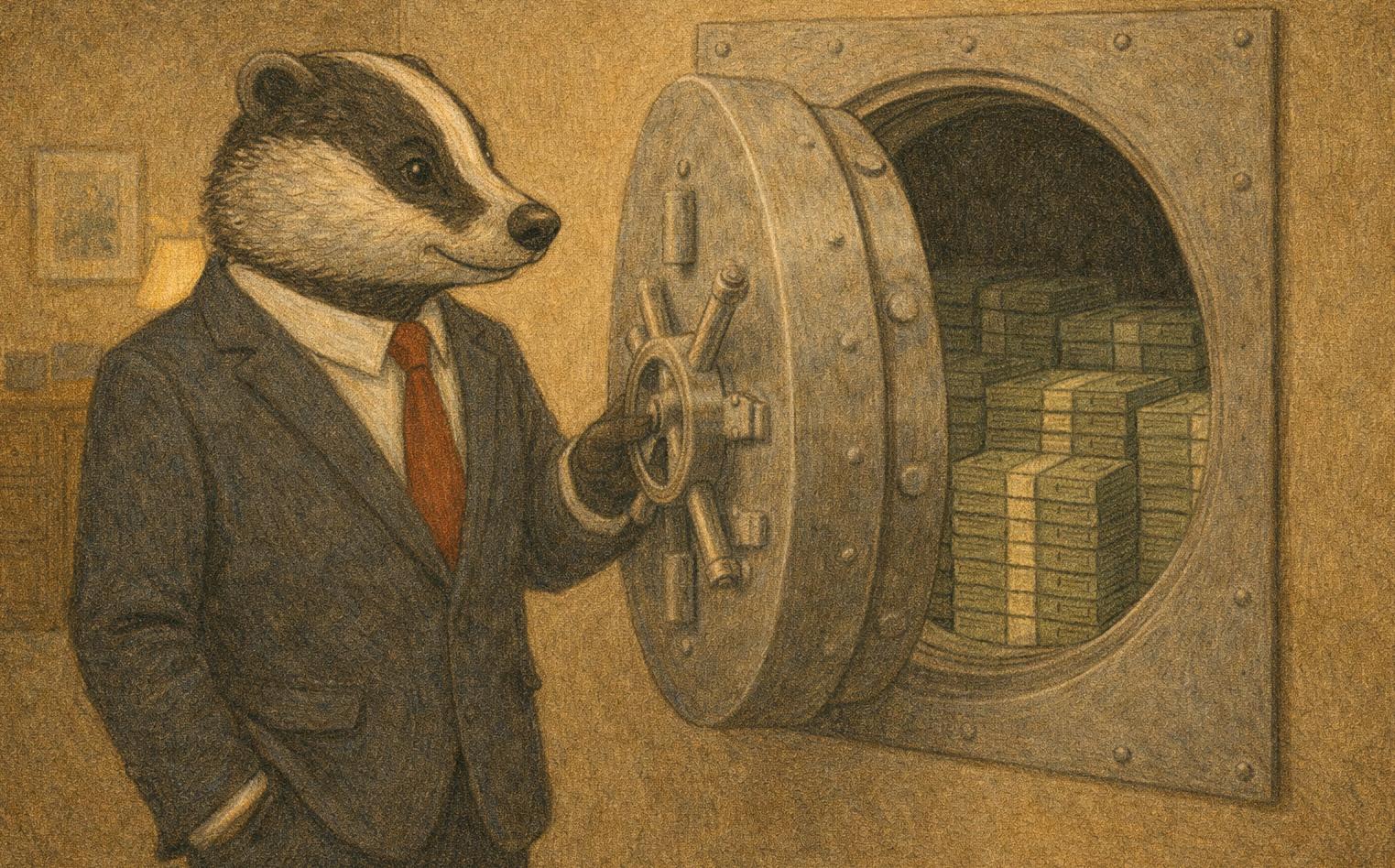
A seed phrase etched onto a fireproof steel plate, stored in a bank safety deposit box, with a backup in a second location ... that is a form of a 'vault' wallet that is much more difficult for criminals to access. It's also a logistical challenge every time you need to access it. Meanwhile, a wallet on your phone is incredibly convenient ... and potentially exposed to malware, device loss, or a compromised app.
Every individual has to navigate this tradeoff for themselves, weighing factors like:
- How often do you need to access your holdings?
- Do you have a succession plan ... in case of your death or incapacitation?
- Do you have a safe deposit box at a bank?
- How technically comfortable are you with hardware wallets and multi-signature setups?
There's no universal right answer. The best security setup is one you can actually maintain and execute correctly - not necessarily the most theoretically secure one.
Scammers Are Evil
Most people are good.
So at their core, they do not want to consider that there exist people who can act with extremely malicious intentions, and that wish to steal any amount of money ... even from strangers or from those that can least afford it.
These modern crypto scammers are sophisticated, patient, and psychologically astute. They understand human nature, and they exploit it.
Scammer Tactics
The most common tactics all share a common thread: they're designed to override your rational thinking with an emotional response.
Urgency: "Act now or lose this opportunity forever." Scammers manufacture time pressure because they know that rushed decisions are poor decisions.
If someone is pushing you to act right now without time to verify, that's a red flag.
Authority: Fake customer support accounts, impersonators of well-known figures in the XRP community, spoofed emails from exchanges. Scammers impersonate trusted entities to borrow their credibility.
Greed: "Send 1 XRP, receive 2 XRP back." Offers that seem too good to be true always are.
Fear: "Your account has been compromised. Verify your seed phrase immediately." Fear short-circuits careful thinking just as effectively as greed does, and it's used just as often.
Romance and Trust: Long-con schemes where fraudsters build genuine-seeming relationships over weeks or months before introducing a "can't-miss" investment opportunity. These are devastating — financially and personally.
The defense against all of these is the same: slow down, verify independently, and never share your seed phrase with anyone for any reason.
Ever. 😐
Ego Is Your Enemy
"I already know this stuff."
It's the most common reaction among experienced crypto holders when someone suggests they could benefit from a security course or educational resource. And sometimes it's even true — partly.
But "partly" is the problem.
Crypto security is not a static field. The threat landscape evolves constantly. New attack vectors emerge. New tools - including AI-powered tools used by both defenders and attackers - change what's possible. What was best practice two years ago may be inadequate or even counterproductive today.
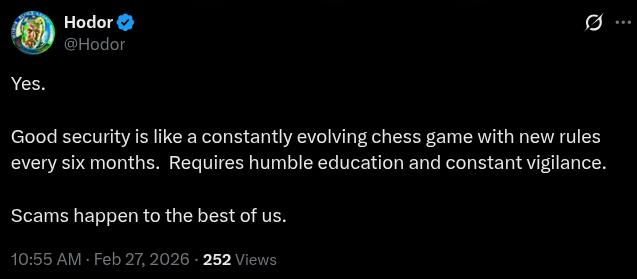 Good Security Is A Moving Target
Genuine security isn't just knowledge ... it's applied, examined, and regularly tested knowledge.
"But Security Education Costs Money"
Yes. It does. And that's often enough to stop people from pursuing it.
But consider the math: a comprehensive security course might cost $50, $100, or $200. For someone holding a meaningful amount of XRP, that represents a fraction of a fraction of a percent of their holdings. The cost of not having that knowledge ... a compromised seed phrase, a successful phishing attack, a poorly executed wallet migration ... could be catastrophic and irreversible.
Unlike most financial losses, a stolen crypto wallet offers no recourse. There's no fraud department to call, no chargebacks, no regulatory protection. When it's gone, it's gone.
Investing in education isn't an expense. For anyone holding life-changing amounts of crypto, it's a critical asset.
Security Education for XRP and XAH Holders
One of the practical advantages for XRP holders is that XAH (the native token of the Xahau network) operates on a nearly identical underlying protocol. The same security principles, wallet structures, key management practices, and threat models apply to both. If you learn to secure one properly, you've essentially learned to secure both.
Xahau has one additional threat vector that is important, however; the installation of smart contracts.
Install the wrong smart contract on your account, and it could result in a loss of funds. The topic of reviewing Xahau (XAH) smart contract hooks and their underlying programs is a topic which I've covered previously here: XAH Hooks: Smart Contract Transparency
The remainder of the topics that impact security on both networks is nearly identical, however.
Whatever your source of education - articles, forums, courses, or community resources - the underlying goal is the same: translating general security principles into a customized approach that fits your specific situation.
An Introduction to "Practical Crypto Security"
One resource worth serious consideration is the course offered at krisdangerfield.com, titled Practical Crypto Security. The course is focused specifically on XRP holders and covers the full spectrum of wallet management and security practices.
I've taken it personally.
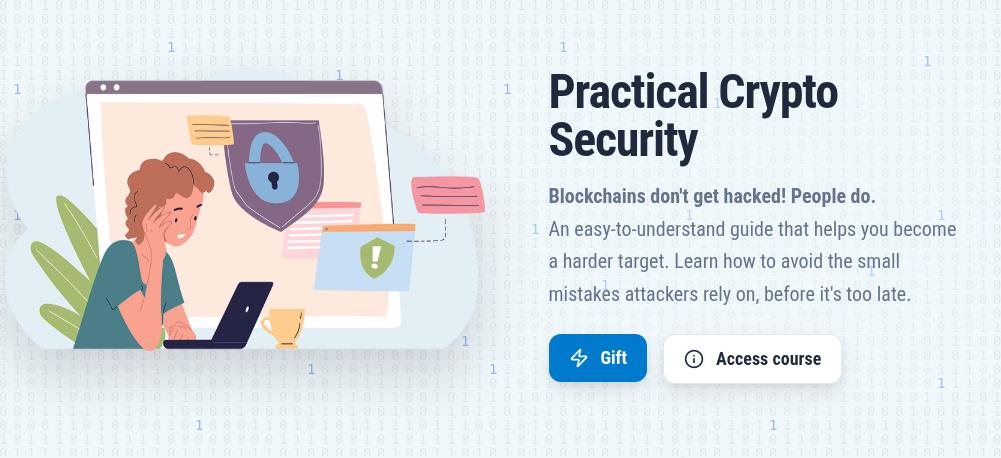 Practical Crypto Security Course
At roughly 14 hours of content, it's genuinely comprehensive — and my experience with it broke down into three meaningful categories:
Refresher on practices I already knew. Some content covered ground I was familiar with. It was reassuring to have my existing practices validated, and occasionally I caught a nuance I'd previously missed.
Updated my knowledge with contemporary approaches. The course addresses how modern tools - including AI - factor into the current threat landscape. This was new territory for me, and valuable.
Challenged me to actively evaluate my own setup. This was, perhaps, the most important outcome. It's one thing to understand security principles; it's another to hold them up against your actual, current practices and assess where the gaps are. The course prompted exactly that kind of honest audit.
It was definitely worth the small investment of time and money. (The site accepts XRP as payment)
Discounted Price
Kris Dangerfield has offered a discounted price for his "Practical Crypto Security" class for readers of my blog. 🙂
Use this link to apply the discount at the start of your own registration for the course: krisdangerfield.com/hodor
Keep Yourself Sharp
If you're holding a material amount of XRP or XAH - an amount that would matter to your life - then security education isn't optional; It's part of the responsibility that comes with self-custody.
The source of that education matters less than the act of pursuing it. Community resources, open-source documentation, and reputable courses all have value. If you want the most comprehensive, structured starting point specifically designed for XRP holders, the "Practical Crypto Security" course at krisdangerfield.com is a great step to take. If the cost isn't feasible right now, bookmark it and keep it on your list. And in the meantime, start examining your current practices with as critical an eye as you can.
What you should not do is nothing. X | X>
Sources:
"Practical Crypto Security" via https://krisdangerfield.com/hodor
Q & A with Kris Dangerfield
https://www.kaspersky.com/resource-center/preemptive-safety/guide-to-cryptocurrency-safety
https://xrpl.org/docs/introduction/crypto-wallets
https://xrpl.org/docs/concepts/transactions/secure-signing
https://learn.xrpl.org/lesson/security-best-practices-for-xrp/