What Is The "Finternet"?
The term arises from a BIS (Bank for International Settlements) working paper authored by Agustín Carstens and Nandan Nilekani.
The paper defines the term 'Finternet' as:
"... multiple financial ecosystems interconnected with each other, much like the internet, designed to empower individuals and businesses by placing them at the centre of their financial lives.
It advocates for a user-centric approach that lowers barriers between financial services and systems, thus promoting access for all. The envisioned system leverages innovative technologies such as tokenisation and unified ledgers, underpinned by a robust economic and regulatory framework, to dramatically expand the range and quality of financial services.
This integration aims to foster greater participation, offer more personalised services and improve speed and reliability, all while reducing costs for end users. Most of the technology needed to achieve this vision exists and is fast improving, driven by efforts around the world."
The authors of the paper do not have a monopoly on the term's definition, but what they've written here seems to get at the heart of the concept for many people - including me.
How It All Fits Together
In contrast, traditional finance ("trad-fi") places the authority and control of the old financial system in the hands of intermediary institutions, like banks and brokers.
The 'Finternet' goes in the opposite direction, and places the control back in the hands of the people who have a financial stake in crypto networks, along with holding tokenized fiat currencies - a.k.a. 'stablecoins' and real-world assets (RWAs).
It changes the paradigm through tokenization, which is a further step down the road of dematerialization, a controversial development where paper-based ownership like stock certificates were replaced with electronic representations at third parties.
The danger of course, to the consumer, from (traditional) dematerialization, is that their interest in these electronic representations has been methodically removed to that of a 'creditor' ... most people find this concept repugnant, or don't even really understand the danger, until it presents itself in the form of a bankruptcy ... like what happened to Bear Stearns during the 2008 financial crisis.
While the sharks on Wall Street like the idea of 'creditor layers', most ordinary people do not. Ordinary people want to truly 'own' what they buy, without the risk that their ownership rights can be removed or diminished by unknown third parties as part of an invisible collateral agreement.
For more information about the dangers of traditional finance's definition of dematerialization, I recommend people watch a documentary called 'The Great Taking', which is an extended interview with David Webb, a former Wall Street investment banker:
The 'Finternet' has the potential to restore property rights to their intuitive state before dematerialization even occurred; it's difficult to argue against a consumer's property rights if they can simply point to a decentralized source of information as proof of their interests ... a.k.a. a 'blockchain' (decentralized ledger).
Three Networks
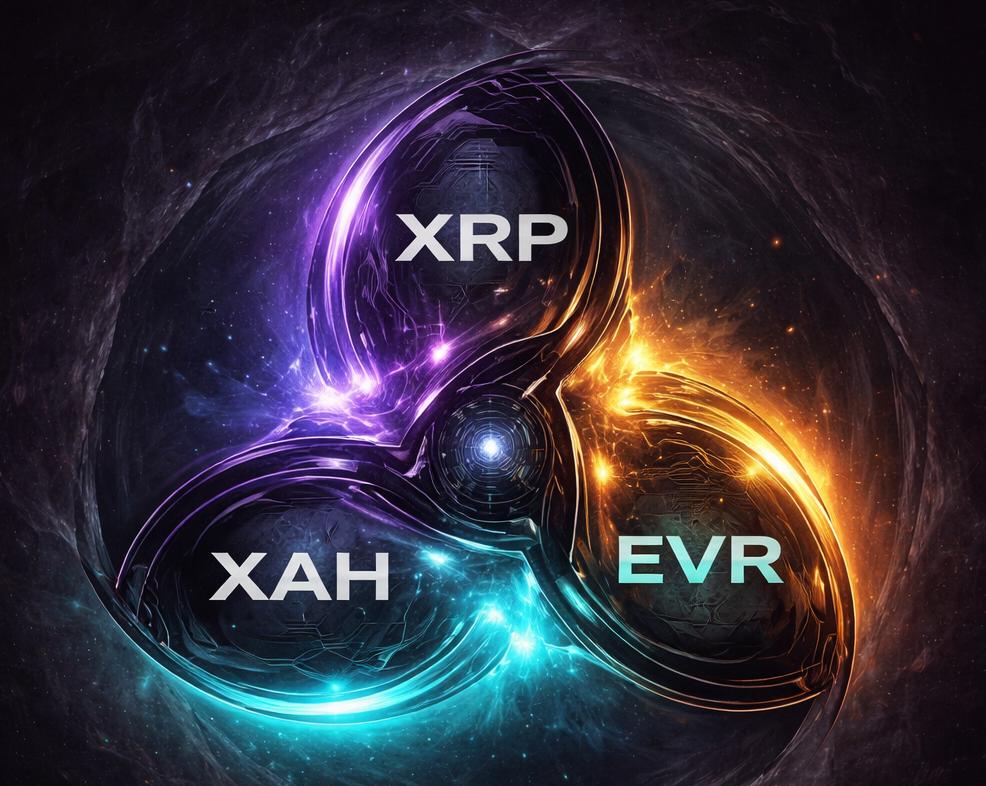
My own speculative crypto holdings reflect my beliefs about where I'd like to see the future go, in terms of financial self-sovereignty. The three networks that I believe can work together to address any conceivable use case for cryptocurrency, are the XRP Ledger, Xahau, and Evernode.
 Three Networks
The three networks have one thing in common: they use the agreement protocols to achieve transaction consensus and finality, instead of 'proof of work' or 'proof of stake'. This means that they do not depend on massive amounts of electricity to verify transactions, like the "Bitcoin" series of networks - BTC, BCH, and BSV.
The XRP Ledger is the first mover of agreement protocols, and has proven the concept by running successfully for well over a decade, and houses billions of dollars of financial value, including material levels of tokenized, real-world assets (RWAs).
The Xahau network is essentially the same code as the XRP Ledger, with similar capabilities, but with one major difference; this 'child' network of the XRP Ledger supports smart contracts associated with individual accounts. The smart contracts are known as 'hooks'.
The Evernode network is a decentralized infrastructure & smart contract network (DePIN), that removes the dangerous dependency on centralized infrastructure providers, like Amazon Web Services. In heated political climates, these third parties cave quickly to popular demands at the expense of individual freedom. Decentralized infrastructure raises the level of censorship-resistance for applications.
Finternet Requirements
It's not enough for crypto to offer novel proofs-of-concept.
Consumers demand the same level of service and protection for their interests that traditional finance currently provides. Ideally, the 'working' version of the finternet will provide banking services so that people can pay their day-to-day bills with the money that they earn.
In addition, people expect their finances to be private from anybody other than those with a legal interest, such as the government, or judicial representatives in various countries.
They also prefer to have an option for absolute control over their property, to mirror what physical coinage provides.
Can the Finternet meet these requirements, which are currently fulfilled by traditional finance?
"How" Is The Question
So how would all the cryptographic machinery work together? Consider a few potential ideas.
- Zero-knowledge proofs ("ZKP") have the potential to protect the privacy of people, even as they use public ledgers.
- Black lists and white lists have the potential to enforce (existing) compliance requirements, such as KYC & AML.
- Decentralized infrastructure has the potential to address nation-state independence concerns between countries about hosting metadata frameworks for these new interconnected ledgers.
Regardless of what ideas work, many times, what develops is a result of un-anticipated adoption of new technology in an asymmetric fashion.
My Take
Like many people that have been a part of the crypto revolution from the early years, I prefer technology that allows me to control my own property.
In the crypto world, this means only trusting yourself to manage your cryptocurrency; this desire is met through non-custodial wallets, such as the Xaman wallet.
If it were available - and possible - I'd like to store my other ownership proofs on-chain as well. I'd also like to handle my own government-issued identification in a secure manner, and share different levels of this information, as required by third parties.
The Finternet Is What We Make It
If we all collaborate to provide our opinion on the new financial system, the Finternet can take the shape of whatever we wish it to take.
 Future Money
Future generations deserve financial systems that empower and uplift them; if we contribute to building and using the first versions of these systems, we can create brilliant and unlimited possibilities, rather than dependence on weak, potentially-corrupt intermediaries.
The new Finternet will be what we decide.
Sources:
https://www.bis.org/publ/work1178.htm
https://en.wikipedia.org/wiki/Bear_Stearns
"The Great Taking" via YouTube: https://www.youtube.com/watch?v=dk3AVceraTI
https://github.com/Xahau/Whitepaper (whitelists)