PWA Loader On Xahau
In 2007, when the first iPhone launched, Steve Jobs told developers that the way to build apps for it was the web: HTML, CSS and JavaScript, delivered through the browser.
The App Store came a year later and changed all that; but the idea never went away. In 2015, Google engineer Alex Russell and designer Frances Berriman gave it a name: Progressive Web Apps ... websites that behave like installed apps.
Xahau, the hooks-enabled sister network to the XRP Ledger, launched its mainnet in October 2023. Since then, it's added features through its amendment process. Validators must support a change by more than 80% for five days before it activates. In October 2026, with xahaud release 2026.10.13, the network introduced an amendment called PWALoader.
It activated on Xahau mainnet on November 9, 2026.
PWALoader lets any Xahau account publish a small web page directly on the ledger.
What The Heck Is A "PWA"?
A Progressive Web App is an ordinary website that uses browser features to act like an app on your phone or computer. It isn't a new technology or a special protocol. It's delivered over normal HTTPS, like any other site.
On a first visit, it's just a website in your browser. But if the site includes two extra pieces, the browser can do more with it:
- A manifest: a small "ID card" listing the app's name, icon and colors. It lets the browser offer to install the site, putting an icon on your home screen or desktop that opens without the browser's address bar.
- A service worker: a script the browser runs in the background. Picture a personal assistant standing between the app and the internet. It can keep copies of the app's files on your device, so the app loads instantly and keeps working ... even if you lose your connection.
See one in action: Visit squoosh.app, Google's free image compressor.
Other examples: Twitter, Starbucks, Pinterest and the retailer Flipkart have all used PWAs to deliver fast, app-like experiences without requiring an app-store download.
The key point is that the browser does almost all the work. A PWA provides content, a manifest and a service worker. The browser runs it, installs it, updates it and enforces the security rules.
Xahau's Version of PWA
Xahau enables something like a PWA, called "PWALoader".
PWALoader lets an account store one HTML page of up to 4,096 bytes on the ledger. It's published with an ordinary AccountSet transaction. Xahau nodes that opt in can then serve that page to any web browser.
Why "Loader"?
Xahau's own release notes call the page a "bootloader" for a Progressive Web App. In computing, a bootloader is known as a small, trusted program that starts first and loads everything else. It isn't the operating system, but everything after it depends on it loading other programs and capabilities successfully. PWALoader is meant to play that role for a web app: a small, verifiable first step.
Not A "Full" PWA
Despite the name, the page a Xahau node serves cannot do the traditional PWA tasks. It can't register a service worker, it can't be installed, and it can't store data on your device.
This is intentional.
Every page is served inside a strict browser sandbox that gives it an "opaque origin." In effect, the browser treats each page as an anonymous stranger and refuses to give it storage, cookies or background scripts. That makes sense, because anyone can publish a page for a fraction of a cent ... and pages aren't reviewed. Locking them down protects visitors.
The Xahau "PWALoader" is best understood as a loader for a PWA, not a PWA itself.
What It Can Do
Within those limits, the page is otherwise a fully working web page.
It can run JavaScript, draw graphics, take form input, connect live to Xahau nodes, and fetch data from other websites that allow it. It can also link to ... anything. 🤯
Architecturally, Xahau takes the place of the web server that would normally hold a site's home page.
In a traditional setup, your browser asks a company's server for its home page, and the server reads a file from its disk. With PWALoader, your browser asks a participating Xahau node, and the node reads the page from its copy of the ledger.
The ledger is the disk.
How It All Works
Publishing. The account owner signs an AccountSet transaction. The transaction must contain the page's HTML in a new AppLoader field. The page is then stored in an AppLoader ledger object tied to that account. There can only be one per account. The cost is the normal fee, plus one drop per byte (~ 0.004 XAH for a full page), with no reserve. Like every ledger change, the new ledger is copied to every node on the network automatically.
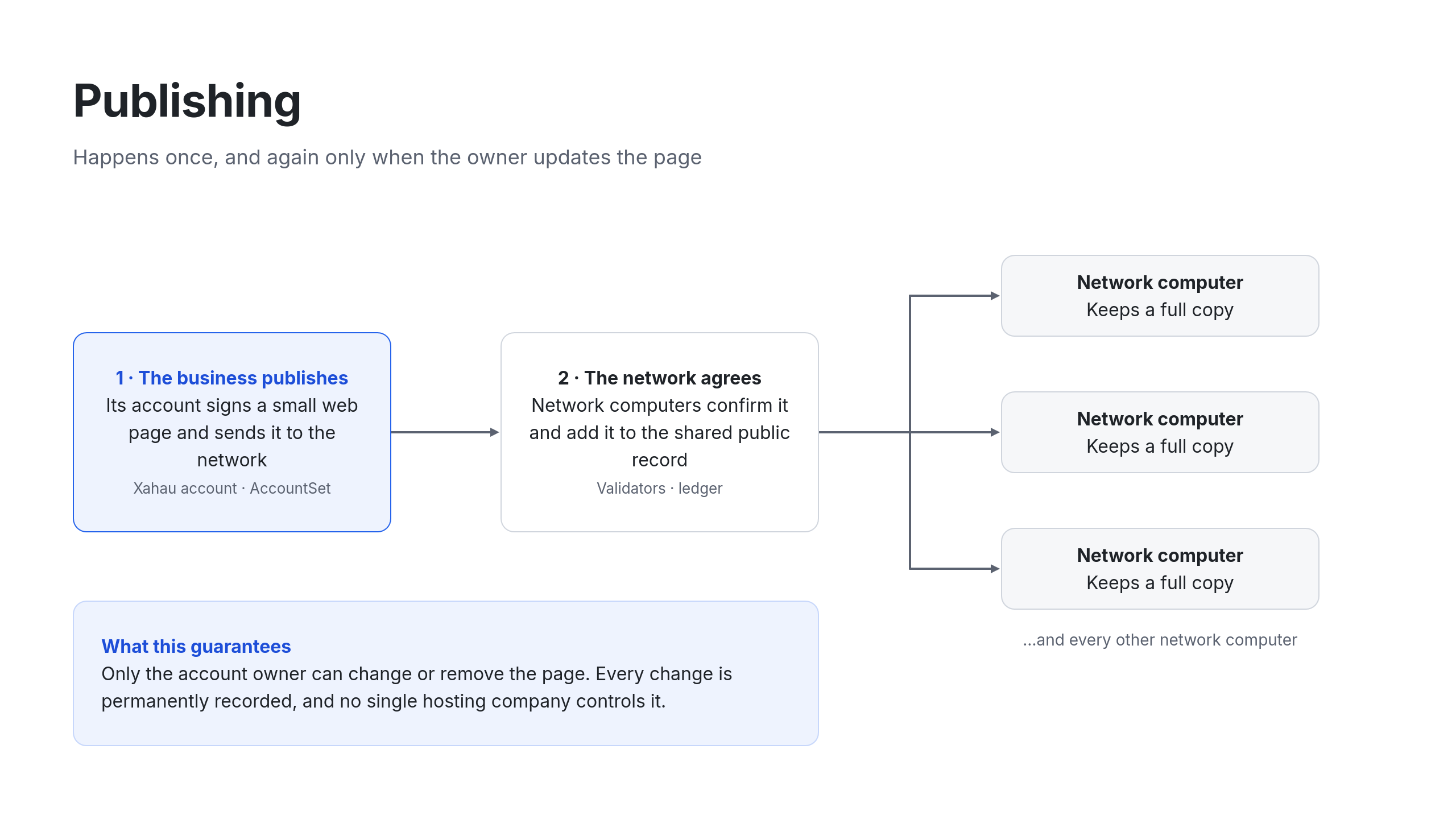 Publishing A PWA On Xahau
Visiting. Node operators can optionally enable a pwa port on their node, behind a standard web proxy with their own domain. A visitor's browser requests an address like https://pwa<AccountIndex>.<domain>/<r-address>. The node looks up that account's AppLoader in its own copy of the validated ledger and returns it as a normal web page. Each account gets its own subdomain to keep pages isolated from each other. Every response carries the ledger sequence and hash it came from. Anyone can confirm the page is genuine with the pwa_validate command against a second, independent node.
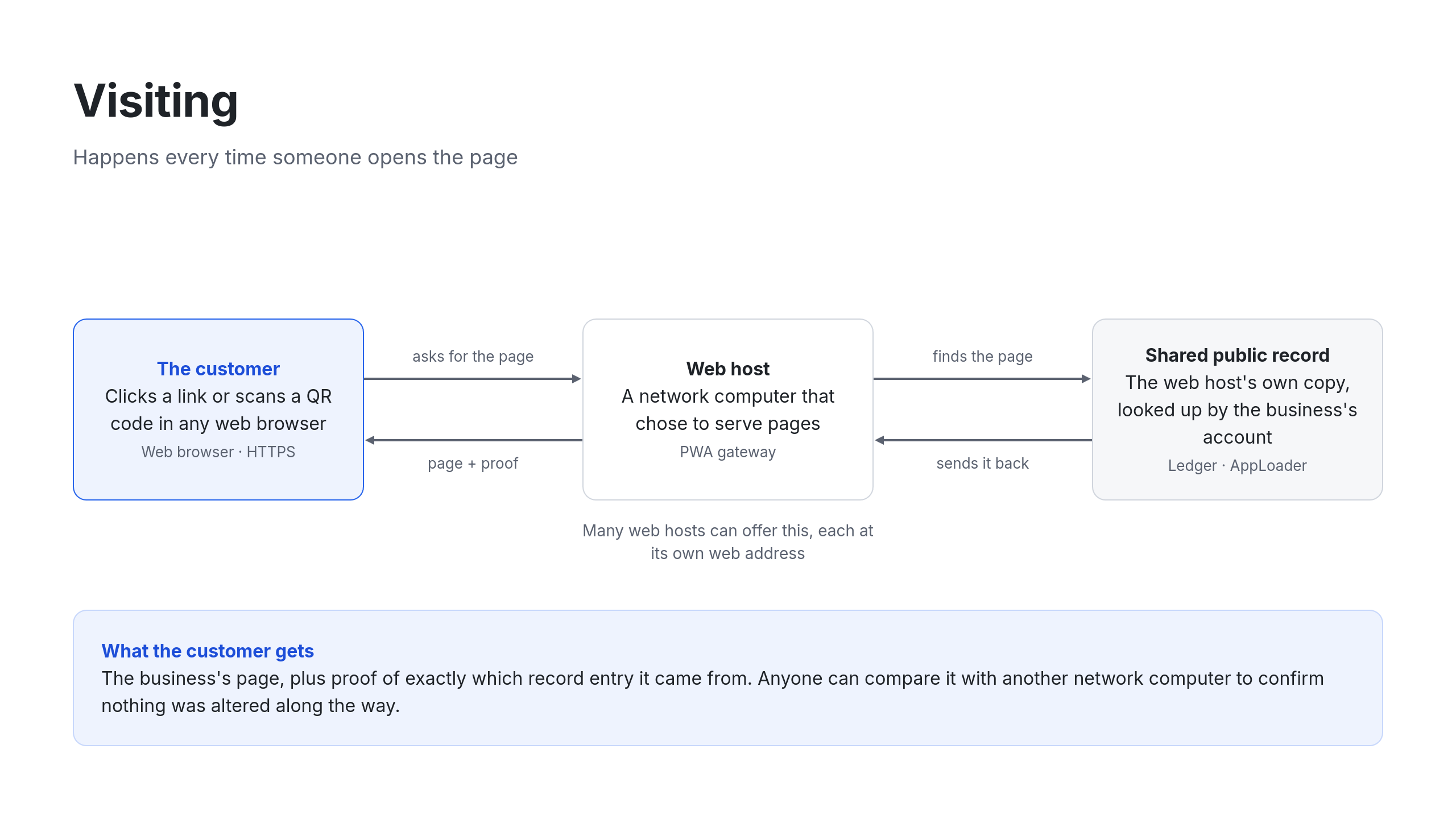 Visiting A PWA On Xahau
Two important points:
- Any participating node can serve any page, each at its own web address. The account, not the URL, is the true identity of the page.
- An account owner can link a custom domain, verified through DNS and the account's
Domainfield, so visitors see a familiar address.
The Value of Using Xahau's PWA Loader
A PWALoader page can do less than an ordinary website. Its value is in what you can know about it. With a normal website, one party controls everything ... and visitors have to trust it.
PWALoader splits those jobs up:
| Job | Normal website | PWALoader |
|---|---|---|
| Storing the page | Files on someone's server | An AppLoader object in the ledger, copied on every node |
| Who can change it | Whoever controls the server: the owner, the host, or an attacker who breaks in | Only the holder of the account's key, through a signed transaction |
| History of changes | Usually none visible to visitors | Every version is a ledger transaction, permanently recorded |
| Serving it over the web | The owner's server | Any node operator who opts in; many independent hosts can serve the same page |
| Checking you got the right thing | You trust the server | Each response carries the ledger sequence and hash, and anyone can check it against another node |
For a business, that means:
- Authenticity. If customers know your official Xahau account, they know its page is yours.
- Tamper evidence. A host that altered your page would be caught by checking it against a different node.
- A public audit trail. Every update is dated and visible.
- Resilience. The page doesn't live on one server. Only the owner can remove it.
- Near-zero hosting cost for small, permanent pages; no server to maintain.
It also has clear limits. Verification covers only the 4 KB page itself, not anything it loads or links to elsewhere. And authenticity is not the same as safety: verification proves who published a page ... not that the page is safe.
Use Cases
Ekiserrepe published a hands-on guide with working examples on the Xahau testnet. It included a links page with a built-in QR code, "Flappy hook," a canvas game that fits in a few kilobytes using compression, and a live ledger dashboard that connects directly to a Xahau node.
Separately, ShortTheFOMO has prototyped an on-ledger wallet protected by a hook that requires passkey approval for transactions!
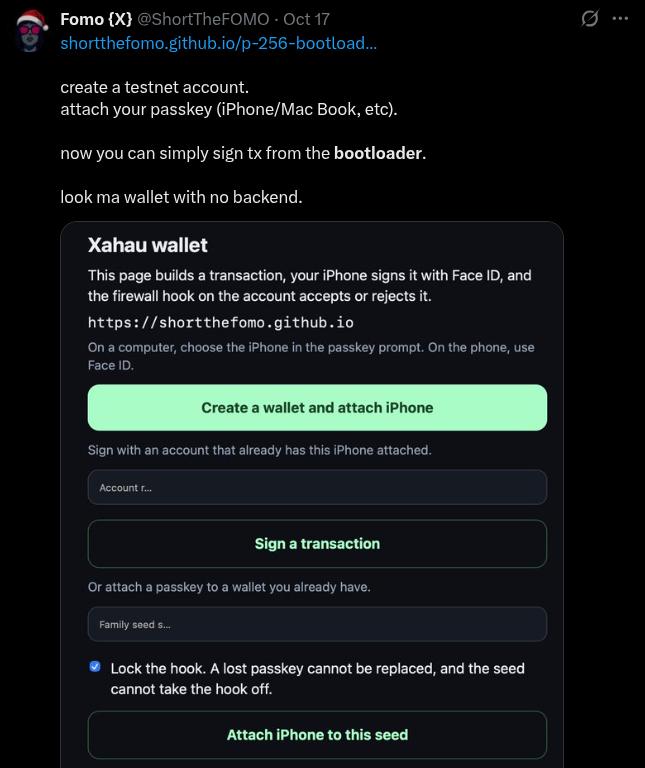 Experimental Wallet Using PWLoader
Other possibilities:
- Verified business cards and link hubs: "find us on-chain."
- Project and token landing pages tied to the project's own account.
- Wallet and payment front ends, where tamper-proof code matters most.
- Community, governance and membership portals for groups built on Xahau.
- Small games and utilities, such as calculators, converters and countdowns.
- Verified "front doors" that link to a full website or app hosted elsewhere.
First Adopter
@PeachCobblr was one of the first adopters of the PWA Loader once the amendment made it to activation:
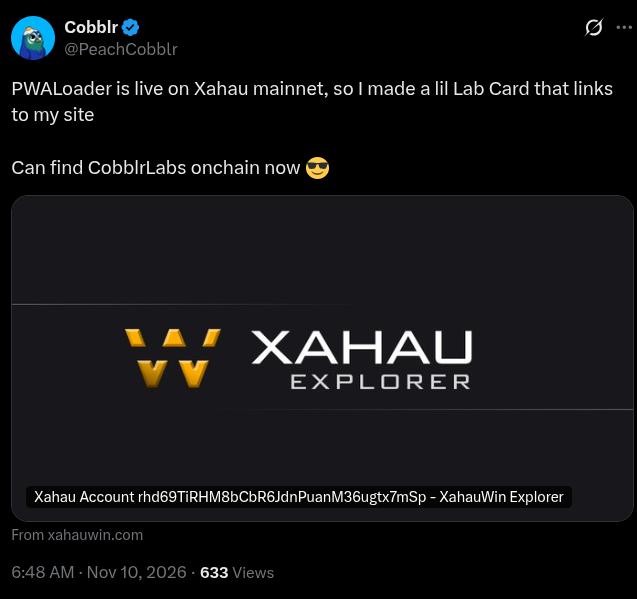 'X' Post From PeachCobblr
You can see his small "Lab Card" for CobblrLabs, linking to his site. The page can be viewed directly from his account in the XRPLWin Xahau explorer, which renders on-ledger pages right inside the account view:
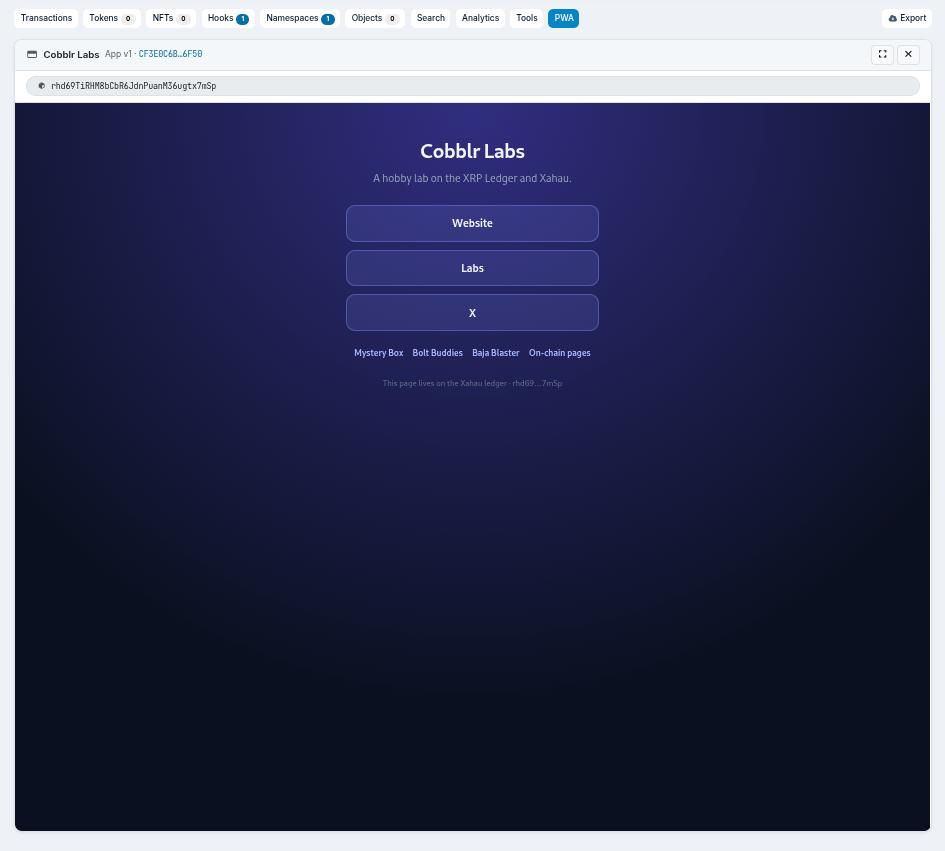 PWA Loader Displayed By XahauWin Explorer
It is a unique distinction for his company.
Open-Ended Possibilities
We've now suggested several possible uses for the Xahau PWALoader, but history suggests that the most interesting one hasn't been imagined yet.
Someone will find a use for PWALoader that nobody anticipated.
Like hooks, URITokens, Random Number Generation (RNG) and Xahau's other building blocks, PWA Loaders open a new avenue for creativity on the chain. A crypto account can now hold assets, run logic, and can be - or verify - the front door to an application.
X>
Sources
- Xahau docs, serving PWA apps: https://xahau.network/docs/infrastructure/serving-pwa-apps/
- Xahau docs, amendments list (PWALoader): https://xahau.network/docs/features/amendments/
- Xahau docs, amendment process: https://docs.xahau.network/features/amendments
- xahaud 2026.10.13 release notes: https://github.com/Xahau/xahaud/releases/tag/2026.10.13-release%2B4119
- XRPLWin explorer, amendment status: https://xahauwin.com/amendments
- XRPLWin explorer, CobblrLabs account page: https://xahauwin.com/account/rhd69TiRHM8bCbR6JdnPuanM36ugtx7mSp#webapp
- Ekiserrepe's PWALoader guide (dev.to): https://dev.to/ekiserrepe/learning-xahau-on-ledger-web-apps-with-pwaloader-163f
- Xahau Network announcement on X: https://x.com/XahauNetwork/status/2118626854114320591
- PeachCobblr's mainnet post on X: https://x.com/PeachCobblr/status/2120151566242234579
- PeachCobblr's PWA Loader content via Xahauwin explorer: https://xahauwin.com/account/rhd69TiRHM8bCbR6JdnPuanM36ugtx7mSp#webapp
- Passkey wallet bootloader example: https://github.com/shortthefomo/p-256-bootloader
- 'X' Post from ShortTheFOMO about wallet bootloader example: https://x.com/ShortTheFOMO/status/2111509935582544003?a=euqUv5Jy8lmeUE6AEgE&s=20
- Xahau mainnet launch coverage (U.Today via Investing.com): https://ca.investing.com/news/cryptocurrency-news/xrp-ledger-sidechain-xahau-now-live-in-mainnet-3158252
- Squoosh as a PWA (InfoQ): https://www.infoq.com/news/2018/11/google-squoosh-pwa-webassembly
- PWA background and examples: https://tic-tac-toe-niranjan.vercel.app/article-pwa.html
- Jobs' 2007 web-app vision (ITNEXT): https://itnext.io/progressive-web-apps-will-replace-your-native-app-4427f2df6604
- Squoosh: https://squoosh.app