Xahau (XAH) Tokenomics
Every layer one crypto network needs a native token.
In the case of Xahau, it funds the validators who protect the ledger, it discourages spam, it rewards long-term participants, and it governs how the network evolves over time. The native token is less like a "coin" and more like an economic operating system.
The General Idea
XAH is designed around a simple premise: every wallet on the network can earn new native tokens by claiming a reward each month, but validators who actively secure and govern the network earn an additional reward.
Think of it as a two-tier incentive structure - a base layer of participation rewards available to everyone, and a performance layer reserved for the organizations that hold "seats at the table."
That phrase - "seats at the table" - is not a metaphor. Xahau implements a Governance Game, a mechanism built directly into the genesis account’s smart contract (a hook). Up to 20 seats exist at the top-level (Layer 1) governance table. These seats are occupied by approved account addresses belonging to validators running infrastructure for the network. Seat holders vote on three categories of decisions:
- Who occupies which seats
- Which hooks are installed on the genesis account
- The reward rate
A supermajority of 80% of votes is required for any change to take effect.
The entire governance structure - who sits at the table and what rules they vote on - is enforced by open-source code visible to anyone on the network.
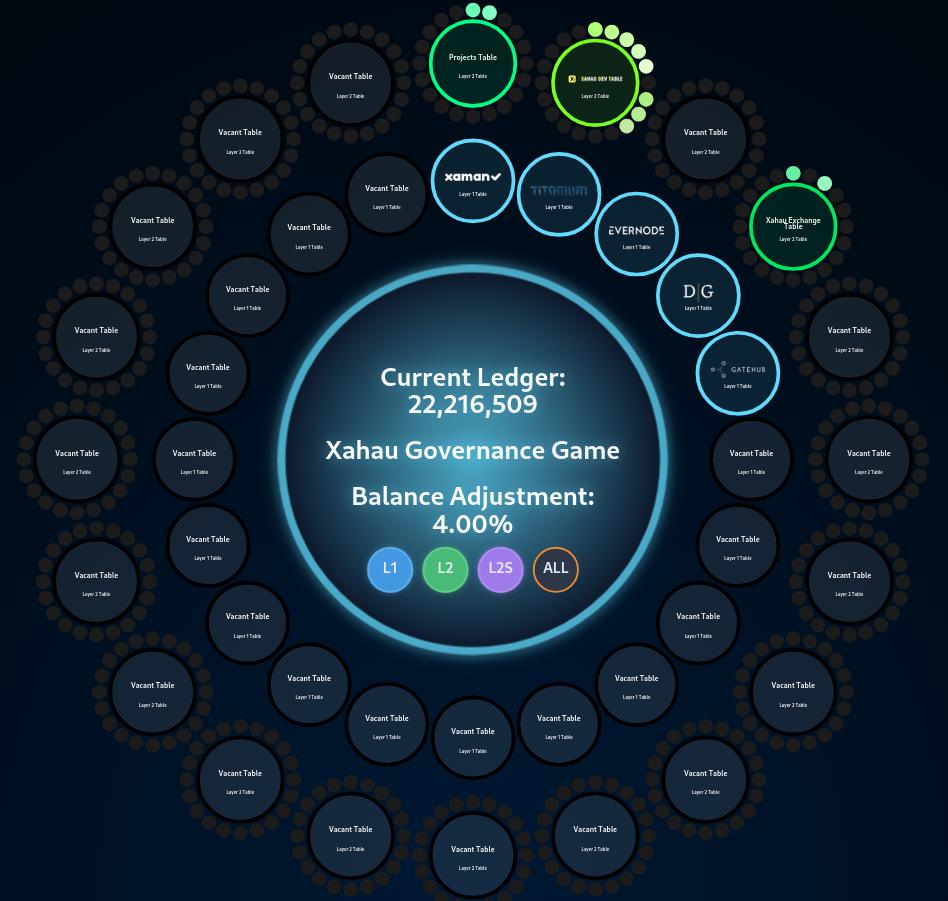 Xahau Governance Seating Chart via Xamini
This enhanced level of reward for trusted validators leads to a group of serious infrastructure providers. The goal is to connect the desired outcomes of: increasing network use, native token demand, and continual infrastructure investment.
I've written about Xahau's departure from the "no incentive is the best incentive" philosophy here: XAH Incentives: Scaling
Distribution Timeline
The Genesis: Account Zero
Xahau launched on October 30, 2023. At the moment of network creation, a special account - known as Account Zero (address: rrrrrrrrrrrrrrrrrrrrrhoLvTp) - was funded with the initial XAH supply through what is called XahauGenesis. This is the blockchain equivalent of an origin story: a one-time event that established the token supply and immediately distributed it to the network’s founding contributors.
The whitepaper called for exactly 600 million XAH to be distributed across four main categories:
- 96 million XAH to the 8 initial governance validator seats (12 million each, to bootstrap the Governance Game)
- 16 million XAH to GateHub (for DEX stablecoin liquidity)
- 160 million XAH to XRPL Labs / Xaman (recognizing years of Hooks development work)
- 328 million XAH to the XRPL Foundation, now known as the Inclusive Financial Technologies Foundation (InFTF), for long-term ecosystem development
Plan vs. Reality
In practice, the genesis transactions from Account Zero distributed approximately 599 million XAH - nearly identical to the plan - but with some gaps to reconcile.
The 'actual' distribution included amounts paid to various parties, including a vendor that supplied services. It also included other early investors, and excluded a specific amount that had initially been earmarked for validators. This was to reward those that had financed the project's early years, along with the associated research.
The bottom line on the reconciliation: the spirit of the whitepaper was followed very closely. The "no-VC, reward-the-builders" philosophy was honored.
The Treasury Hook Lockups
Shortly after launch, the two largest holders of XAH - XRPL Labs (Xaman) and InFTF - each voluntarily locked the majority of their XAH holdings into a specially designed smart contract called a Treasury Hook.
This is significant because it demonstrates that Xahau’s own "hooks" technology was immediately put to work solving a real governance problem: how do large token holders credibly commit to not dumping their holdings on the market?
XRPL Labs announced in late November 2024 that it was locking 125 million XAH into its Treasury Hook, with a controlled release mechanism allowing up to 2 million XAH to be unlocked per month. The open-source Hook code is publicly reviewable on GitHub, and a live dashboard allows anyone to monitor the treasury balance and unlock activity in real time.
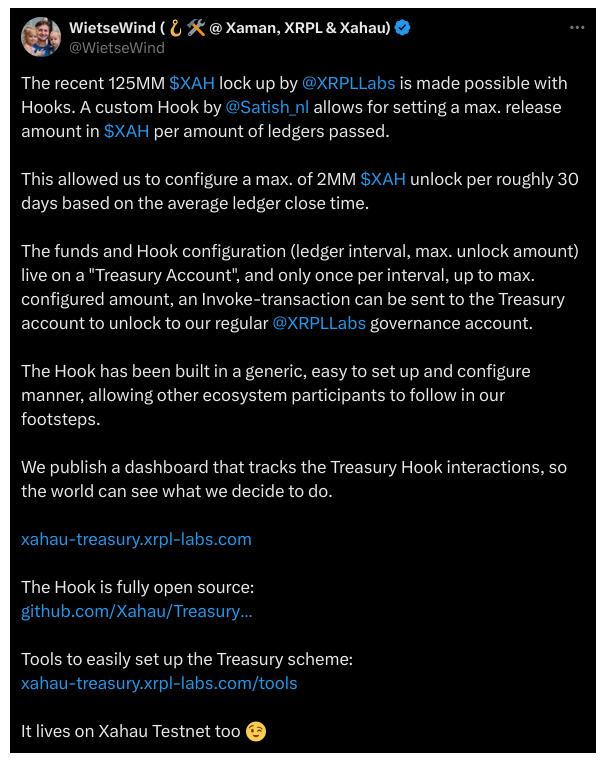 Tweet About The XAH Treasury Hook
The InFTF similarly locked approximately 250 million XAH into a comparable treasury structure.
Combined, these two organizations voluntarily placed roughly 375 million XAH - well over half of the original genesis supply - behind a time-release lock, with the stated intention of eventually black-holing (permanently destroying) the keys to these treasury accounts ... making the lockup irreversible.
Current Supply Numbers
Total XAH: 648 million
In Circulation: 281 million
Locked: 367 million
These supply numbers - and in the other parts of this article - are taken as of ~ mid-April, 2026.
Inflation Or Deflation?
Xahau is inflationary, but labeling it such is an oversimplification. The reality is a dynamic equilibrium between three interacting forces:
- Rewards claimed by hodlers
- Rewards automatically sent to (Layer 1) governance seats
- Fees burned for smart contracts and transactions
To date, here are the raw numbers that reflect this equation:
XAH minted ... minus ... XAH burned ... equals ... XAH inflation
53,450,000 - 5,140,000 = 48,310,000
The 4% Reward ... For Everyone
Any XAH holder can claim a monthly balance adjustment of up to 4% annually on whatever XAH they hold.
This is done by interacting with the genesis account’s hook (smart contract). The interaction is opt-in: wallets that never claim rewards simply don’t receive them, which effectively reduces the realized inflation rate across the full network. You can learn more about this 'hodler' reward here: XAH: Simple Monthly Reward
The Governance Seat Bonus
Validators who hold a seat at the Layer 1 governance table earn an additional reward on top of the 4% that all holders receive. Specifically, when any wallet performs a balance adjustment (claims its 4% reward), 1/20th of that adjustment amount is distributed to each qualifying validator.
This means that validators receive two rewards:
- The 'hodler' reward on any of their XAH in their wallet
- The bonus paid out to validators with a governance seat
... as long as they are actively participating and in good standing.
The Deflationary Counterweight: Hook Fees
Every time a smart contract (hook) executes on Xahau, it consumes XAH in fees. Unlike the flat, near-zero transaction fees on the XRPL mainnet, hook execution fees scale with computational complexity.
Burned To-Date: 5 million XAH
Heavy smart contract usage burns meaningful amounts of XAH, and that burned XAH is removed from the supply permanently.
Theoretical Inflation Versus Actual
In Xahau's first year, the end-result of the early distribution and governance decisions were still unknown. But now, well into 2026, we can compare the "maximum theoretical inflation" with "actual results".
Theoretical inflation is a result of governance-determined reward rates. The current reward rate for all holders is 4%. Not everybody claims their monthly reward perfectly - or at all, in some cases. But to get the theoretical inflation amount, we can calculate the result given a 100% claim rate.
We can also assume that all twenty possible governance seats are occupied (only five are currently filled). This means that 20/20 seats are being rewarded one-to-one for each XAH being claimed by holders. So we effectively double the inflation rate to 8% APY.
Here is the comparison between this theoretical, maximum inflation rate, versus actual results:
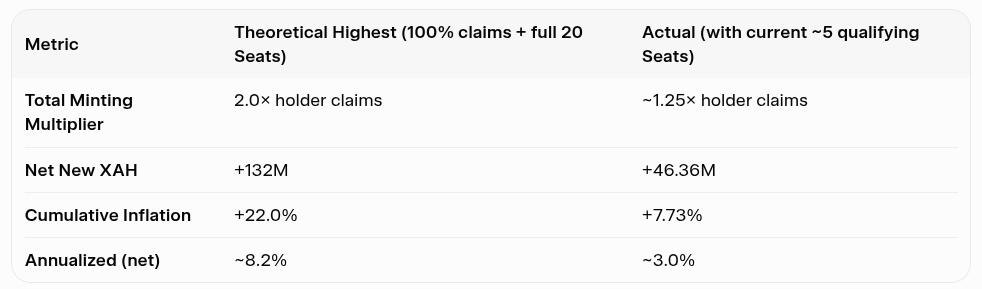 Maximum Versus Actual Inflation of XAH
The current supply number reflects this much lower 3% annualized net inflation. This means that, since Xahau was created, the supply has been increased, through rewards, by ~ 46 million XAH.
This lower-than-expected number is primarily due to fifteen unfilled governance seats.
This means that the governance-participating-validators are currently only receiving 25% of the total potential reward, resulting in dramatically reduced XAH inflation.
Comparisons
To put XAH’s supply in perspective, here is a comparison of token supply metrics across major smart-contract-capable networks as of early 2026:
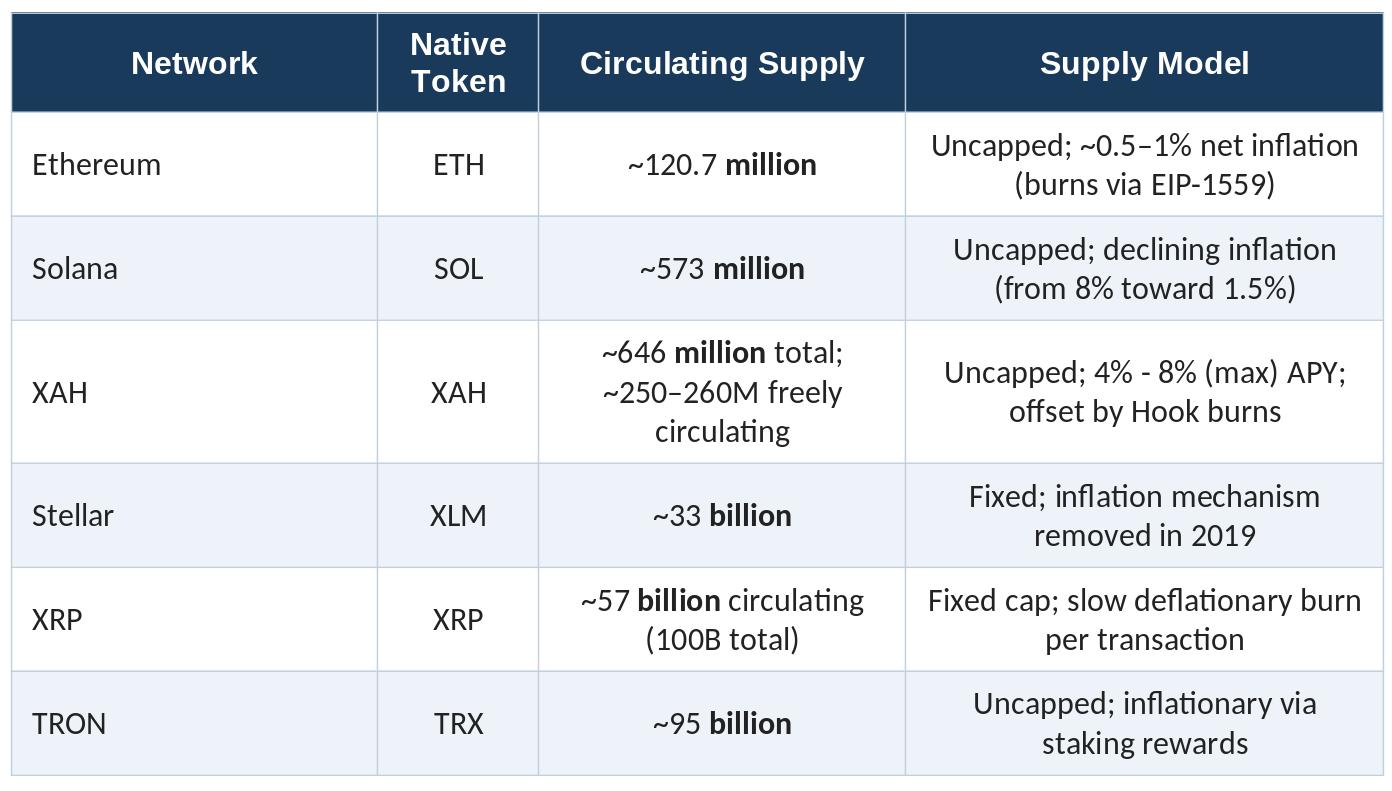 Tokenomics Comparisons
XAH’s total supply - even accounting for inflation - is tiny compared to networks like TRON (95 billion TRX) or Stellar (33 billion XLM). Solana, widely regarded as a top-tier smart-contract network, has a circulating supply of over 572 million SOL ... comparable to XAH’s supply.
Ownership Percentages
What percentage of the total network supply does a single token represent?
XRP currently has approximately 100 billion tokens in total (including Ripple’s escrowed holdings). One XRP therefore represents about 0.000000001% of total supply — one one-hundred-billionth.
XAH, starting from roughly 600 million tokens, gives each single token a proportional ownership stake of approximately 0.000000167% of total supply at genesis. That is roughly 167 times larger a percentage stake than one XRP represents out of the XRP total supply. Put another way: owning 1 XAH is mathematically equivalent - in pure percentage-of-supply terms - to owning approximately 167 XRP.
This comparison becomes even more favorable when accounting for the Treasury lockups.
With 375 million XAH locked and effectively non-circulating, the freely liquid XAH supply is closer to 250 million tokens - meaning each circulating XAH represents an even larger fraction of the tokens that can actually be traded or used.
Distribution & The Rich List
There are currently ~ 206,000 wallets on the Xahau network.
The rich list is a fascinating visual display of the raw token ownership necessary to place an individual wallet in various categories that contain less and less people. However, the categories are, by definition, too lofty, given that many people's individual wallets may be XRP Ledger wallets with IOUs for XAH instead of the real native asset on the Xahau network.
In addition, many people only have an account at a centralized exchange (CEX), and those wallets are not visible to external parties. Given that caveat, this is what the rich list looks like, only considering wallets on the Xahau network:
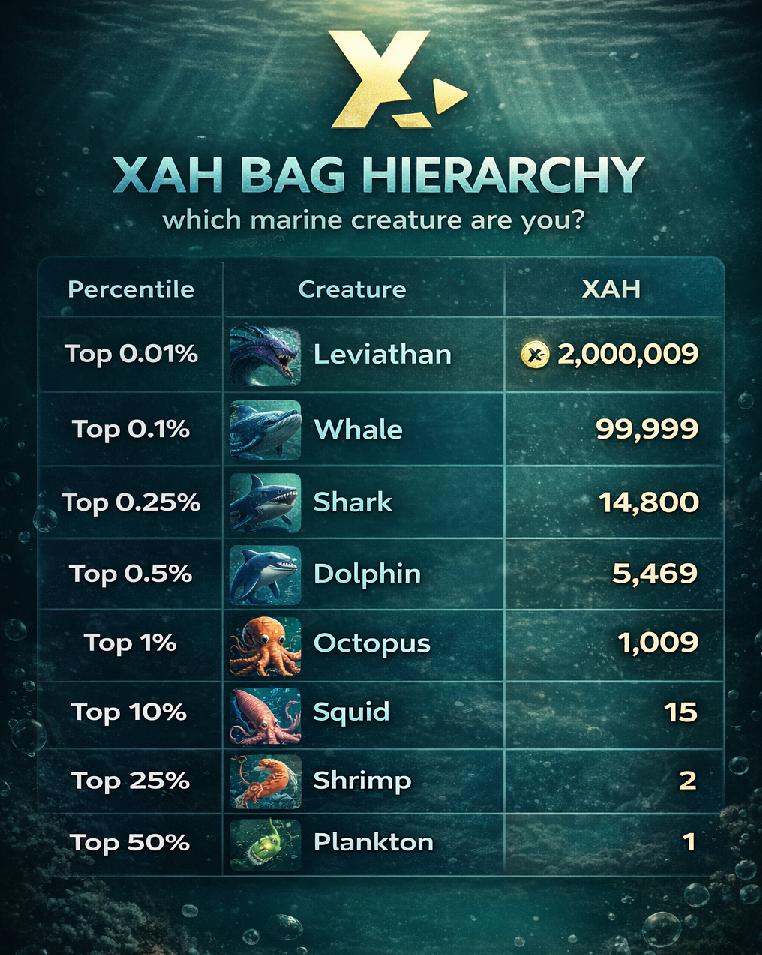 XAH Rich List
Bold Tokenomics
Xahau is small.
But its smallness is precisely what makes the ownership math compelling. At a circulating supply of a few hundred million tokens, every XAH holder controls a meaningful fractional stake in a network that, if it achieves measurable adoption in smart contracts, cross-border payments, and institutional DeFi, will look very different in a decade than it does today. X>
Sources:
https://xahau.network/docs/resources/whitepaper/
https://github.com/Xahau/Whitepaper/blob/main/Xahau-Whitepaper.pdf
https://xamini.io/rules-of-engagement
Account Zero: https://xahauexplorer.com/explorer/rrrrrrrrrrrrrrrrrrrrrhoLvTp
https://xahauexplorer.com/en/activations?period=all
https://xahauexplorer.com/en/distribution
Rich List data from @XRPLWin
Minted Versus Burned XAH Totals from POC @XRPLWin
Marine theme for rich list from https://x.com/XRPBags
"Treasury Hook" Lockup timeline and methodology:
https://x.com/WietseWind/status/1861070626112536802
https://xaman.app/blog/xahau-treasury
https://github.com/Xahau/TreasuryHook
Burned Fee Data from @XRPLWin