Evernode (EVR) Tokenomics
Evernode is a decentralized infrastructure ("DePIN") network that houses its governance and token on the Xahau network.
Evernode's purpose: to enable anyone to run smart contracts & applications in a fully decentralized way, without relying on a central company or point of weakness. Instead of servers in a data center, Evernode runs on a cross-border network of independent host computers that earn its native token, EVR (also called “Evers”), in exchange for providing computing power.
What makes Evernode interesting from a speculator's perspective is not just what the network does, but how its token supply is structured. The designers built a tokenomics model - a set of rules governing how tokens are created, distributed, and earned - that is creative ... and deflationary.
This article reveals that model.
Epochs, Halving, and Automated Rewards
The core of Evernode’s tokenomics is a system called “epochs.” Think of it like Bitcoin’s halving schedule, but applied to infrastructure rewards rather than mining.
Here is how it works.
Every hour, the Evernode network triggers what it calls a “moment” ... a heartbeat during which eligible host computers submit proof that they are online and running properly. The network then distributes a pool of Evers proportionally among all active, reputable hosts. There is no committee deciding who gets paid. The entire process runs automatically through “hooks” - lightweight smart contracts attached to accounts on the Xahau network.
Each epoch contains exactly 5,160,960 EVR set aside for host rewards. Once that amount has been fully distributed, the epoch ends and a new one begins ... but with the hourly reward rate cut in half. This halving mechanic has a key implication: as each epoch passes, Evers become harder and slower to earn.
Early hosts captured the highest rewards; later hosts operate with increasing scarcity.
The schedule of epochs looks like this:
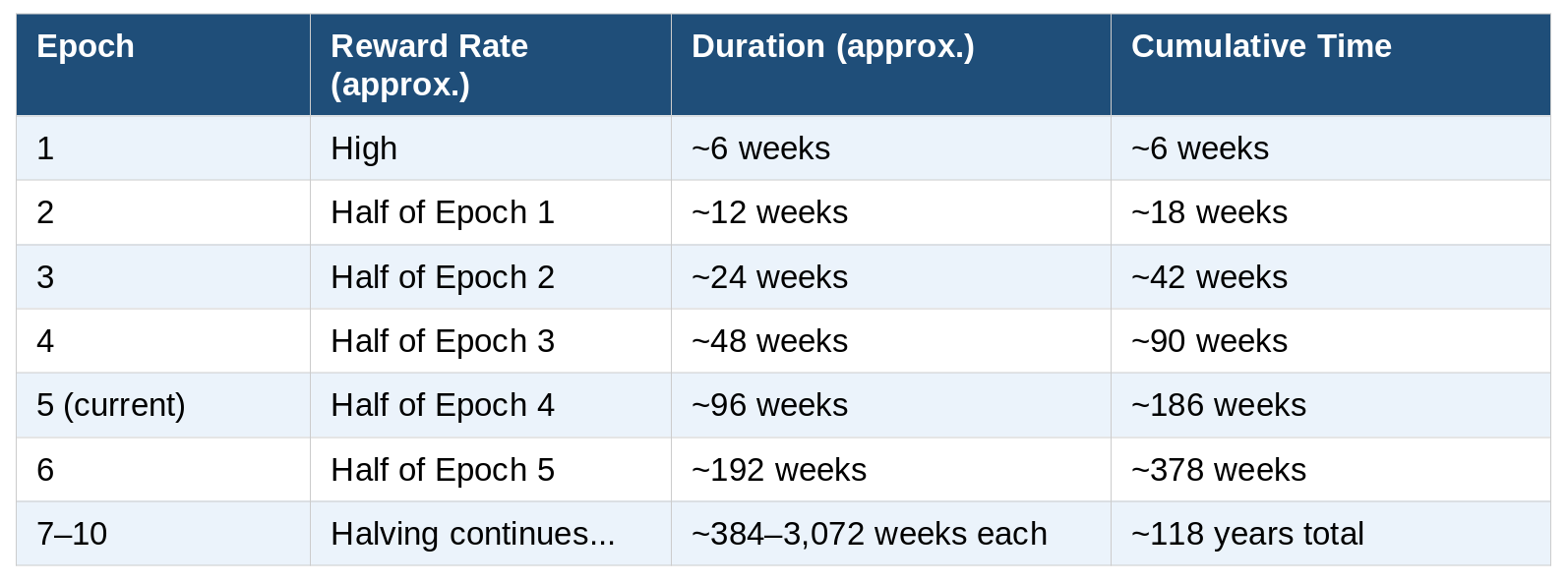 Evernode Epoch Schedule
Epoch boundaries are triggered automatically when the previous epoch's full allocation of 5,160,960 EVR has been paid out.
Because each epoch's hourly payout rate is fixed by the protocol, the duration of each epoch is actually highly predictable ... you can calculate it years in advance with simple division. Epoch 1 pays out at the highest rate; Epoch 2 pays out at exactly half that rate and therefore takes roughly twice as long to exhaust; Epoch 3 takes twice as long again; and so on.
The only real-world variable is whether individual hosts occasionally go offline or fail their hourly heartbeat check, which can slow the drain on the pot very slightly. In practice this is a minor edge effect. The overall schedule - stretching 118 years - is baked into the protocol math from day one.
Who Got What: The Initial Distribution
Here is a timeline of the key events and how the initial supply was distributed.
 EVR Supply Is Fixed
September 2023: The Snapshot
On September 1st, 2023, a snapshot was taken of every XRP Ledger account holding XRP. This snapshot - recorded at Ledger #82237135 - determined which XRP holders would be eligible for the upcoming airdrop.
Holders were capped at 50,000 XRP per account for eligibility purposes; larger holders had to split across multiple accounts to fully participate.
December 2023: Network Launch and Airdrop
Evernode launched on December 18, 2023, on the Xahau network. On launch day, all 72,253,440 EVR were pre-minted in a single transaction by the official issuer address (rEvernodee8dJLaFsujS6q1EiXvZYmHXr8). That issuer address was then “blackholed” - permanently disabled so that no one, including the founders, can ever create additional EVR.
Simultaneously, 20,643,840 EVR (about 28% of the total) were distributed in a structured airdrop:
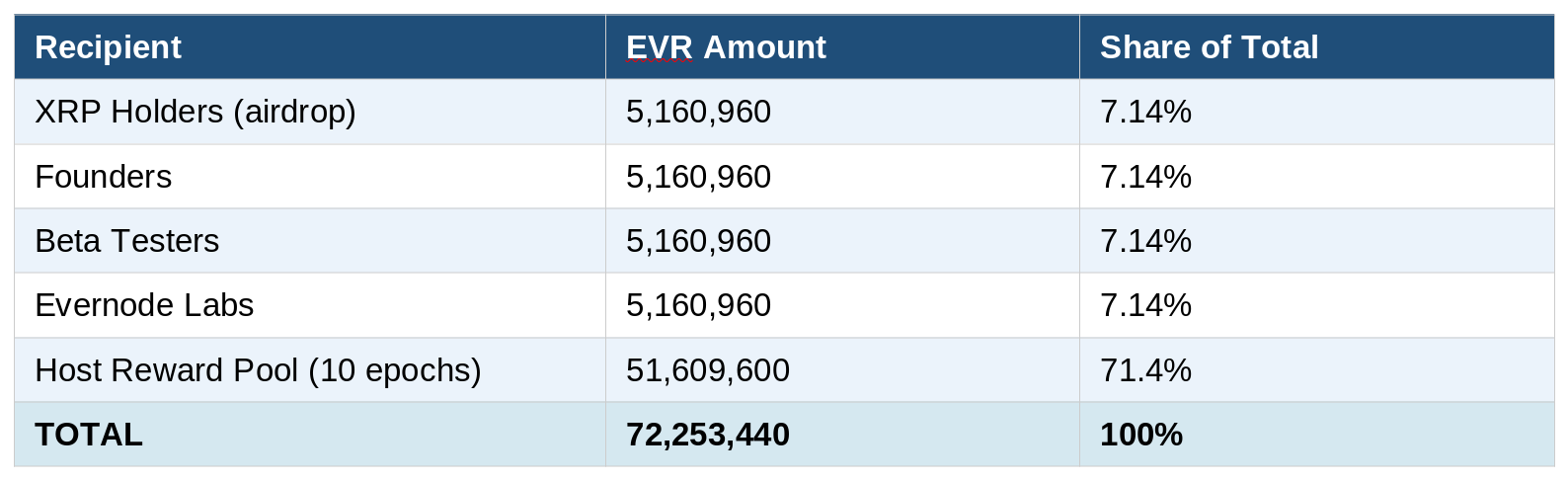 2023 EVR Initial Airdrop
The airdrop to XRP holders was proportional to the qualifying XRP balance each participant held at the time of the September snapshot.
Over 38,000 wallet addresses registered.
January 2024: Rewards Begin
Host rewards kicked off on January 15, 2024, marking the start of Epoch 1. The 51.6 million EVR allocated to the host reward pool are held inside the Evernode Heartbeat Hook - a smart contract that cannot be tampered with. Hosts earn from this pool exclusively through the automated heartbeat process.
Now: Epoch 5
According to the XRPLWin Evernode Dashboard, the network is currently operating in Epoch 5.
To put that in perspective: Epoch 1 lasted only about six weeks (from mid-January to late February 2024). Epoch 2 ran for roughly twelve weeks. Each subsequent epoch doubles in length, because the reward rate halves while the total EVR to be distributed per epoch stays the same.
Epoch 5 is estimated to run for approximately 96 weeks - nearly two years. That pace of distribution will continue to slow ... dramatically ... through the later epochs, with Epoch 10 projected to last roughly 59 years! 😵
This is by design.
The slow, predictable release of tokens creates a long-tail incentive structure that is meant to attract and retain quality infrastructure providers over decades, not just months.
Max Supply: A Number That Cannot Change
The total maximum supply of EVR is 72,253,440 - and that number is genuinely fixed. Unlike many cryptocurrency projects where “max supply” is a stated intention that can be overridden by a governance vote or a protocol upgrade, Evernode’s supply cap is enforced by the fact that the issuer account has been permanently blackholed.
It is not possible to mint a single additional EVR.
Of that 72.25 million:
- About 28% (20.6 million EVR) was distributed in the initial airdrop to founders, labs, beta testers, and XRP holders.
- About 72% (51.6 million EVR) funded the host reward pool and is being distributed across 10 epochs over an estimated 118 years.
At the current rate of distribution - we are in Epoch 5 with approximately 36 million EVR now in circulation - more than a century of scheduled distribution remains.
Distribution So Far: The Rich List
The EVR rich list is an interesting data point, but it requires some context: the rich list currently reflects holdings on the Xahau network only.
Since EVR also trades on the native XRP Ledger DEX, and a small number of centralized exchanges, a significant portion of circulating supply sits in exchange wallets or with traders who hold their EVR as Gatehub IOUs on the XRP Ledger.
This means the top-wallet concentrations visible on the rich list are somewhat inflated in appearance. As the ecosystem matures and more wallets convert their IOU balances to Xahau, the distribution picture will naturally become more granular.
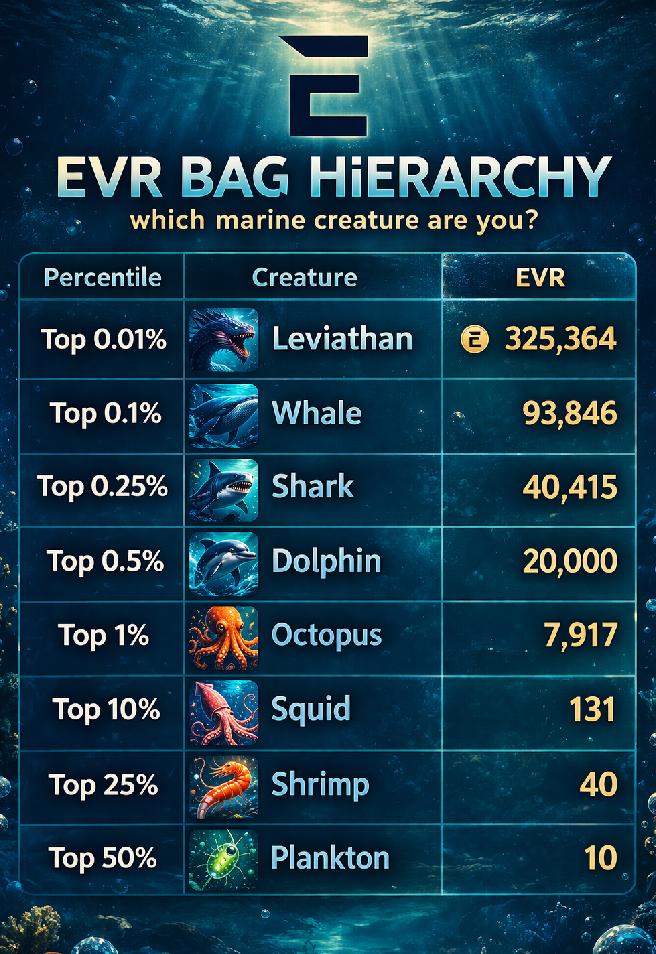 EVR Rich List
There are a total of ~ 36,000 wallets containing EVR on the Xahau network alone; counting the XRP Ledger wallets with EVR tokens may significantly expand that number. It's a metric on par with some layer one chains.
Intentional Scarcity
The designers of Evernode built increasing scarcity directly into the system - and tied it deliberately to infrastructure quality.
Here is the logic: as EVR becomes scarcer and more valuable, the cost of registering as a host (currently a 500 EVR deposit) rises in real terms. That rising barrier naturally filters out low-quality or unreliable hosts over time. Only operators who are serious about providing good, consistent computing resources will find it profitable to participate.
The result, in theory, leads to an iterative loop: higher EVR value → higher quality hosts → better network performance → greater demand for hosting slots → further upward pressure on EVR. The tokenomics are not just about speculative value; they are meant to directly incentivize the quality of the infrastructure underpinning the network.
While this does not guarantee any specific price of EVR, it's a fascinating, intentionally-designed component of the overall network economics.
How EVR Supply Compares to XRPL and Xahau
Although EVR lives among complimentary agreement protocol networks, its supply is more akin to the early Bitcoin projects:
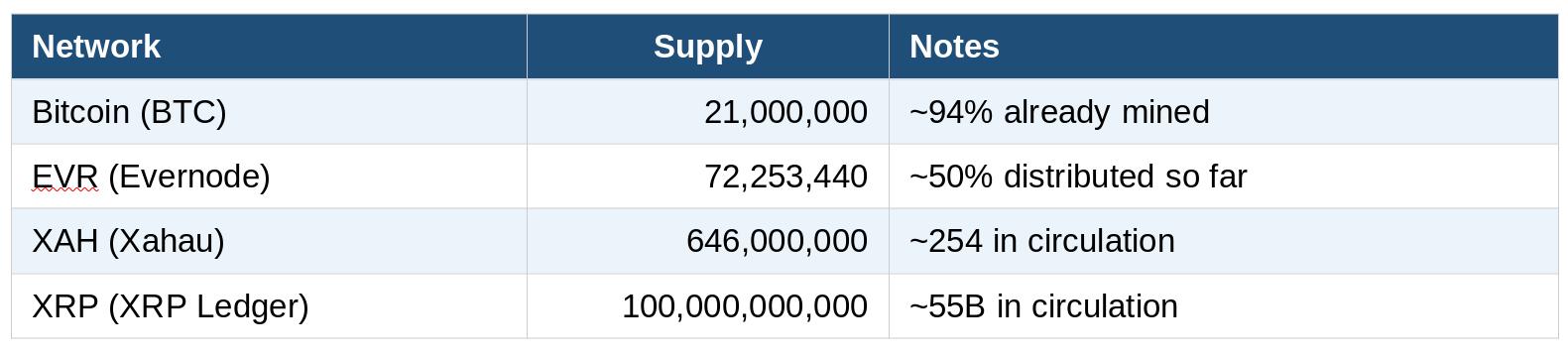 EVR Supply Compared
That scarcity, combined with the slow release schedule across 118 years, means there is no imminent supply shock from unlocking events or large new issuances. The emission schedule is known, deterministic, and fully visible on-chain.
More Than Fascination
Evernode’s tokenomics stand out for multiple reasons:
- The supply is permanently capped and immutably enforced.
- Distribution is fully automated by on-chain smart contracts, with no human discretion in the process.
- The halving schedule creates predictable, ever-increasing scarcity designed to reward long-term participants over short-term speculators.
- The link between EVR value and infrastructure quality gives the token genuine utility beyond speculation.
We are currently in Epoch 5 - early enough that the most dramatic halvings lie ahead, but late enough that the system has already demonstrated it works as designed. For those watching the XRPL ecosystem and the broader decentralized infrastructure space, EVR’s tokenomics are worth understanding carefully. The 118-year emission clock has only just started ticking. E>
Sources:
https://xahauexplorer.com/en/distribution
https://www.evernode.org/evers
https://www.evernode.org/news-listing/xrp-holder-airdrop-process
https://uphold.com/en-us/prices/crypto/evernode-evr
https://cryptopotato.com/airdrop-update-for-ripple-xrp-holders-evernode-details-reviewed/
https://xahau.xrplwin.com/evernode
Data for Richlist Graphic from @XRPLWin
Marine them for rich list from https://x.com/XRPBags
https://medium.com/@ilaNihas/evernode-become-a-pioneering-host-9ef88a0756d4
https://www.evernode.org/hosts
"The Village Politicians" (1819) by American artist John Lewis Krimmel