Hook Store: Update
The Concept Of The Hook Store
One month ago, I wrote about the concept of a 'hook store' ... a virtual marketplace of smart contracts where owners of a Xahau account could, conceivably, browse for hooks to install.
 Xahau Badger In The Hook Store
Each hook would have a different function, and in some cases, there may even be multiple authors that have hooks doing the same thing, but in slightly different ways.
The Need
If you're attempting to understand the 'whys and wherefores' of the new smart contract network, Xahau, it may be helpful to think of hooks as programs that are triggered each time your crypto wallet does a transaction. And the use cases could involve almost anything ... automatically retain a percentage of each payment and remit it to a specific address ("savings account hook", e.g.) ... or checking against a whitelist of other wallets about who is actually allowed to send you tokens. You could install multiple programs on one account, as well, to serve multiple functions.
But to adequately choose and evaluate a hook smart contract, and whether or not you trust the author of the code, there needs to be some way to evaluate pertinent information.
This step ... the entire, end-to-end process of gaining insight into a smart contract before deciding whether or not you want to install it on your own account ... is what we mean by 'hook store'.
We are visualizing something akin to a brick-and-mortar example where customers are viewing various watches under glass at a department store. Extending the example of watches, we need to evaluate the manufacturer ('hook author' in our hook store concept), and the functions that the watch provides ('hook function' in our hook store concept).
Only then will we be confident in what we're installing.
For the first two years of Xahau's life, this 'hook store' was a concept, but had never been fully built out.
Signature Verification Schemes
To address the technical requirements, it was discussed recently whether the authorship of the code compiled in a binary file can be traced successfully back to a person.
The answer was yes; and most likely, a solution that involves, to one extent or another, the same techniques that Andrei Rosseti is currenty using to verify authorship of legal documents. (See 'Origo', a follow-up on my original blog about Xahau docProof).
If a wallet owner can verify that a specific individual - somebody they really do trust - is the author of the code they're installing, then it removes one important barrier for adoption.
Bounty
To initiate the public effort to create the hook store concept - and possibly multiple public and private versions - the XRPL Labs team and Alloy Networks both pledged specific amounts to the person - or possibly divided among multiple people - responsible for building out a hook store(s):
- $10,000 USD stablecoin grant + $10,000 USD worth of XAH (XRPL Labs)
- $10,000 USD worth of XAH (Alloy Networks)
Total pledged: $30,000 dollars worth of crypto
While the specific bounty rules have not been published formally by either party, there are already hints about interested developers.
First Steps
Thomas Silkjaer of the InFTF has created a (beta) version of a non-profit hook 'registry' and basic 'hook store', and has open-sourced some tools & APIs that others will need to build out their version of a hook store. That site is here: hook store & registry.
He's published comprehensive threads about the hook store concepts. His initial thread, which covered multiple topics, as well as details about his initial pages and tools, is consolidated into one image here:
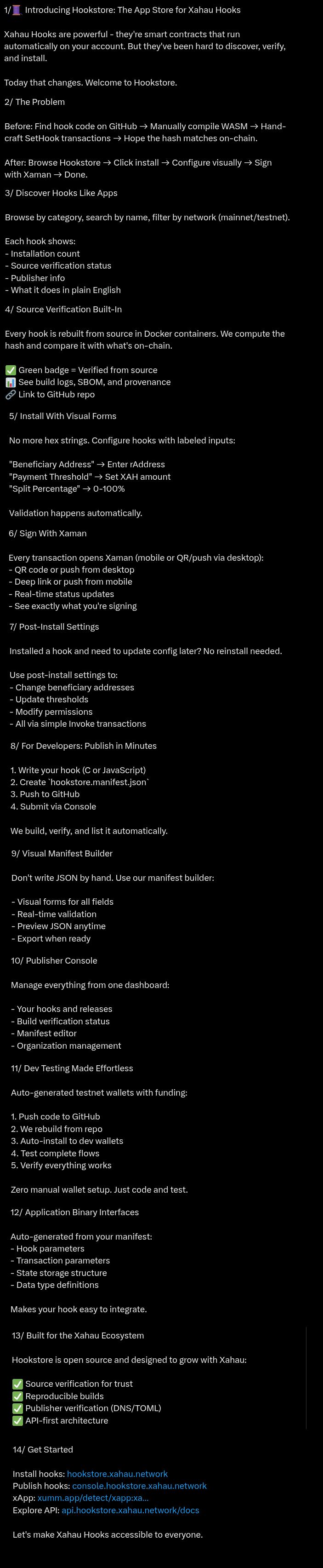 Hook Store Thread By @Silkjaer
While there are no production examples of hooks that can be installed yet, if the user changes their network to the testnet, they can choose from a series of known hooks in test mode:
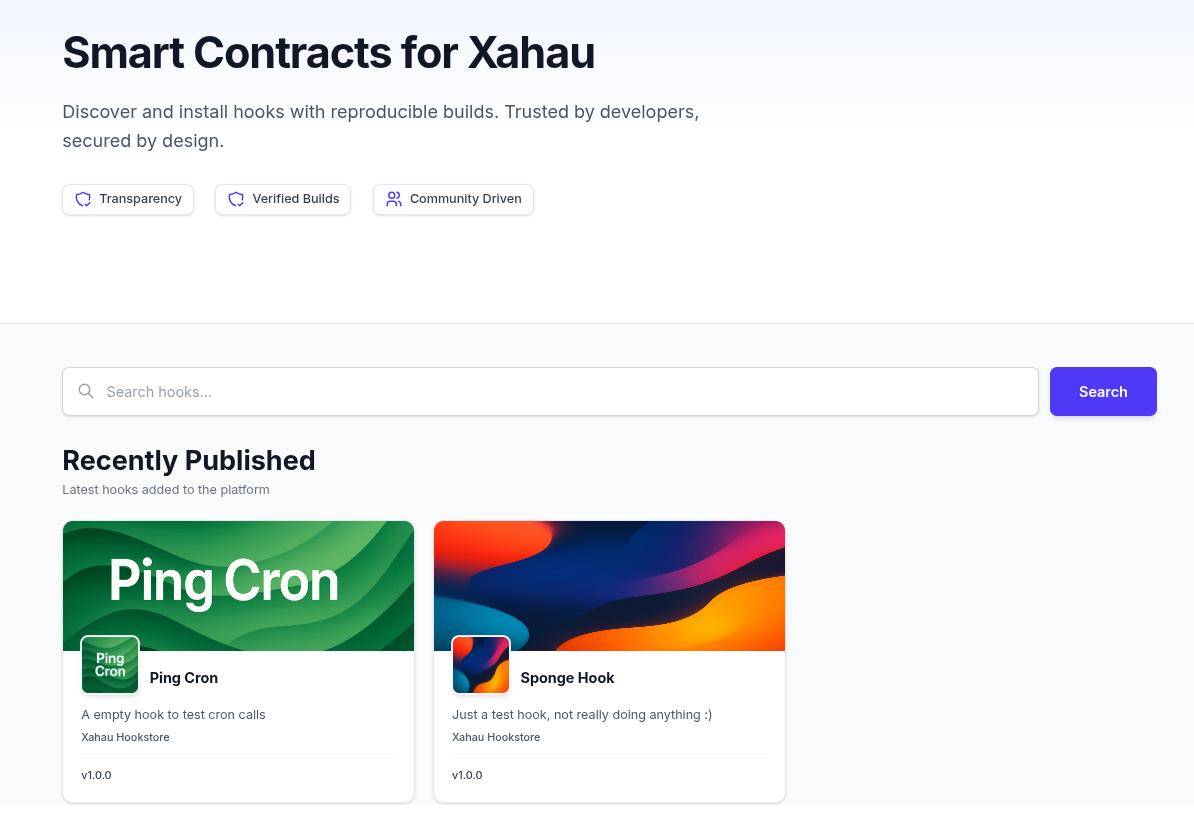 xahau.network Hook Store & Registry
The site, along with the concepts outlined by Thomas Silkjær, provide a template for other hook stores to emulate. When asked to put a label on what he'd created so far at the InFTF-run xahau.network domain, he said:
"The store is an attempt to make an NPM for hooks. The storefront is built with the public A.P.I., so this means that the hookstore can also serve as a backend for other stores.
So devs can make their own frontend on top of it and serve only their own, or even all, in a different way."
The concepts can be ported to whatever front end individual developers prefer, along with whatever customized version of the hook store they'd like to implement.
The biggest challenge is trust ... how can the hook store convince users that their site contains a trustworthy set of steps for publishing legitimate hooks?
Shape Of The Future
When a ten-thousand-foot view of the future comes into focus, it may include a Xahau ecosystem where there are multiple hook stores.
We may see non-profit-managed access points for hooks that are published completely open-source, to a mix of proprietary service providers that implement their own version of community standards. Think of the Apple app store on most iPhones.
The Vision Realized
It's not so much the specific route that gets us to our destination.
The important thing is that we get there! And where is our destination? It's the vision originally communicated by Wietse Wind, and emulated by Thomas Silkjær and others, like myself:
"... smart contract installation as easy as installing an app on your phone."
X>
Sources:
https://hookstore.xahau.network/
https://x.com/Silkjaer/status/1989077062280442298?s=20 (Hookstore thread)