Evergram
They're part of our life now.
Chat applications have become a ubiquitous feature on every Android and iPhone device; if it's not the native functionality of the device, then the app is a popular choice in the device 'store'.
 WhatsApp In The iPhone App Store
Sending a text to family or friends in your close circle has eclipsed ordinary conversation as a de facto mode of communication, and it is now more uncommon to receive a telephone call!
Privacy
While the native text capabilities of the iPhone are encrypted, as is Android (now default), this encryption is only as good as the lock on the device.
To offer an increased layer of security, messaging applications popped up to offer more protection, along with additional capabilities, including making VOIP phone calls. These apps offer and proclaim their commitment to privacy, and offer an enhanced level of protection beyond just the access to the device.
 WhatsApp Messenger
Governments in the Western world have resisted these new applications, because they tend to obstruct their near-total surveillance of the public at an individual level. While they may say that they value citizens' privacy, in practice, they have been almost universally resistant to the use of encryption without an intentional 'back door'.
However, the public has pushed back on these governmental initiatives, and In Europe, the latest request for client-side scanning of messages before encryption, has failed.
Web 2.0 Versus Web 3.0
While these apps may offer enhanced protection from prying eyes, no matter if they're criminals or the government, all 'web 2.0' platforms are vulnerable to social and legal pressure.
For example, if an application refuses to censor users, they may see their app dropped from the 'store' as a standard install choice.
Usually being dropped from the 'store' - whether Android or iPhone - means doom for most small applications; if a user must go to the trouble of a one-off manual install, most will balk at this requirement, even if they support the application author. The largest messaging apps - by user base - depend heavily on this ease of installation.
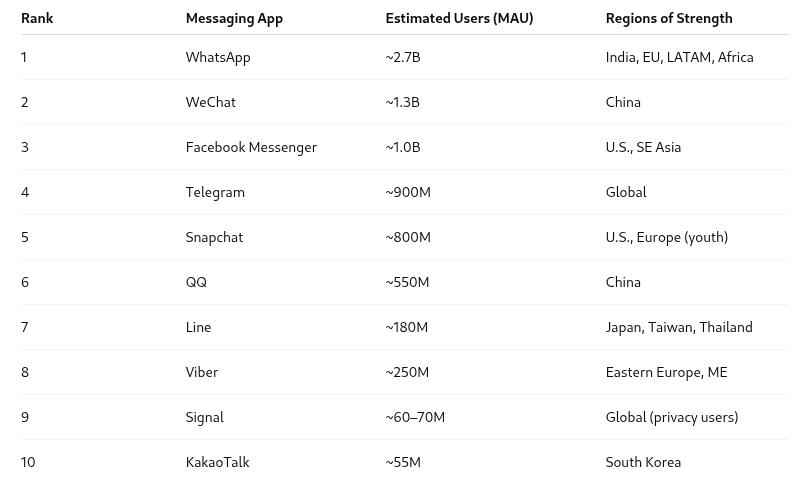 User Base Sizes Of Popular Messaging Apps
However, 'Web 3.0' developers assume that they might encounter trouble with these larger forces from the start. So, in essence, their entire mission is to create an application which is impervious - or highly resistant - to outside forces.
And they use blockchain technology and autonomous code to do it.
Evergram
Enter Evergram.
 Evergram
Developed by Andrei Rosseti, it is considered a full-fledged 'Web 3.0' messaging application.
It's infrastructure?
Not traditional servers housed at a Silicon Valley behemoth. Instead, he chose to pay for infrastructure in Evers (EVR), housing his new app on decentralized servers.
Andrei was quick to point out that 'Web 3.0' does not mean 'trustless' .... a mistake that many sometimes make when comparing it to traditional Internet technology. He noted:
"(The) device is a part of trust. (The) wallet is part of trust. (The) blockchain is part of trust. (The) websocket server acting as a gateway is part of trust. Hotpocket is part of trust."
His down-to-Earth understanding of Web 3.0 comes from developing other blockchain applications and code. In the case of Evergram, he fully acknowledges these trust points, even while still aiming for an invulnerable application.
Xahau Hooks
Xahau is, grossly oversimplified, the XRP Ledger code base; streamlined, to allow for account-specific programs called 'hooks'.
Each program on the Xahau network is triggered by a transaction of some kind, or by the passage of time. Hooks can be in various programming languages, but the most common on Xahau are those constructed in 'C', which allow for the most efficient (and therefore cheap) processing.
How Evergram Uses Hooks
These C hooks allow a wide range of programmability, and Andrei uses them for tracking payments for the Evergram 'Pro' membership, and for registering a new account (wallet) as a unique user.
How Evergram Protects Privacy
When I specifically asked Andrei 'how does Evergram protect privacy?', he immediately went low-level, and methodically described the steps his app takes while processing messages:
" Privacy is enforced by design, not by policy:
- No plaintext ever leaves the client
- No centralized message storage
- Keys never leave the user’s control
- Per-device encryption, with automatic key rotation when a new device joins
- Device cleanup: inactive devices are automatically invalidated after a defined period
- User identity is based on cryptographic addresses, not emails or phone numbers
Evergram does not rely on trust — it relies on cryptography."
It's a compelling description of Evergram's privacy-protecting architectural details.
Evergram's Use Of Encryption
Andrei described the specific elements of Evergram where encryption is used:
"Yes — end-to-end encryption by default. Each chat has a unique symmetric key (AES-grade entropy). Message content is encrypted client-side, before leaving the device. Symmetric chat keys are:
- Encrypted per participant
- Encrypted per device
- Delivered using public-key cryptography
Neither Evergram nor the underlying infrastructure can decrypt messages."
How To Use Evergram
The app can be launched from two locations; either through the Xaman wallet as an xApp, or on its stand-alone website. It's really simple; just log in using Xaman, and then voila, the client is started:
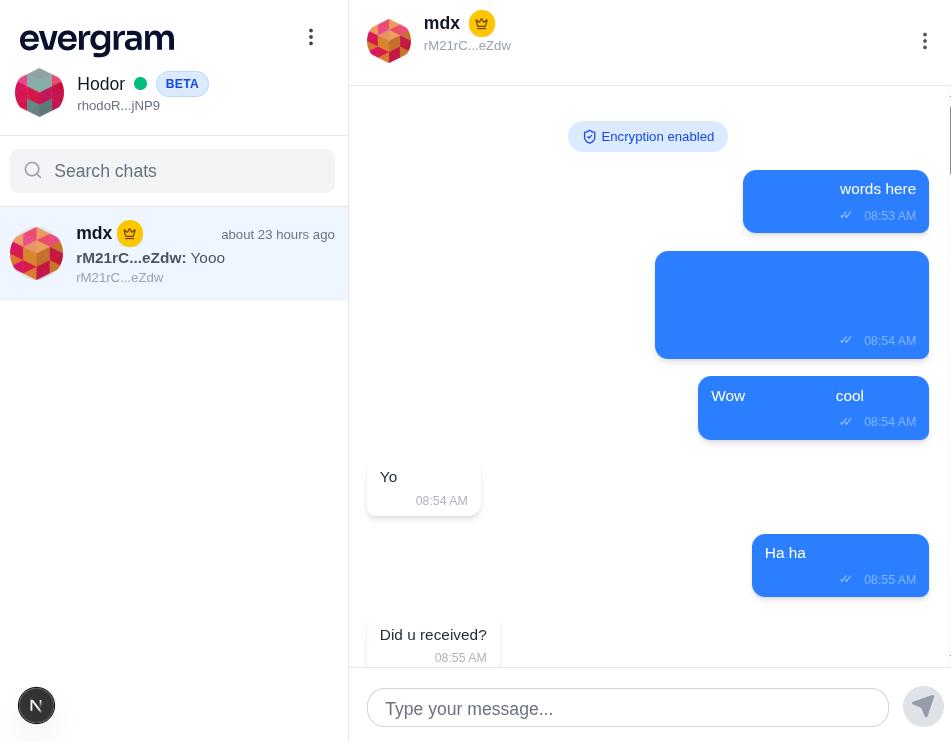 Screenshot Of Evergram Chat
Other participant(s) in their chat must also be successfully authenticated.
Another Project Leveraging Encryption
After constructing Xahau DocProof and Origo, two apps that utilize blockchain immutability to store proofs of signatures for external documents, another successful project by Andrei, so soon, was a surprise to me.
Noting how quickly Evergram was created on the heels of those two impressive additions to the Xahau ecosystem, Andrei told me that, although it seems sudden, he's actually been working on this idea for months, and credits conversations with Wietse Wind for propelling him toward finishing the first version of Evergram.
Go-Live Timing
Although a lot of anticipation is building for Evergram, Andrei prefers to keep the roll-out informal for now, and will begin in phases; most likely starting in February with the earliest first-adopter testers and users.
If you wish to be one of these early adopters or testers, he recommends that you follow the official 'X' account to keep up-to-date on the latest information: Evergram on 'X'
Exceeding Expectations
Xahau fans would have been overjoyed with a 'messaging app' built using Xahau.
But Andrei delivered something even more impressive; a messaging app that is an authentic 'Web 3.0', censorship-resistant app that can enable encrypted text communications between parties.
And he used two networks!
Both Evernode and Xahau were integrated, and both of those networks' tokens are used at different points; either by Andrei to procure infrastructure on Evernode (EVR), or to accept payment for the pro Evergram membership (XAH). His new project serves as an impressive addition to the messaging app market, and also, more importantly, as an example for how distributed-ledger technology can offer privacy and censorship resistance for ordinary people.
Welcome to Web 3.0.
X>
Sources
https://datareportal.com/global-digital-overview
https://docs.evernode.org/en/latest/platform/hotpocket/index.html
DM with Andrei Rosseti via X and Evergram
README.md file for Evergram client