The New TipBot
Many of us have fond memories of the old tip bot.
Wietse Wind launched it on Reddit in November of 2017 as a hobby project, and later brought it to Twitter (now 'X'), and Discord. The idea: reply to someone's post with a short command, and a small amount of XRP is sent to their account. No wallet setup required to receive your first tip!
Recipients often discovered crypto because someone had just tipped them.
So ... why did it go away?
The short answer is custody. Behind the scenes, the original TipBot was a classic custodial service: XRPL Labs ran the wallet that held everyone's XRP, and their database kept track of who owned what. That worked fine until 2020, when the Netherlands implemented the EU's Fifth Anti-Money Laundering Directive. That directive meant that anyone holding crypto on behalf of others had to register with the Dutch central bank, perform identity checks on users, and pay compliance costs estimated at tens of thousands of Euros.
For a free hobby project, that math didn't work for Wietse Wind:
"When Dutch crypto rules changed in 2020, registration, identity checks and the cost of compliance were more than I could take on ..."
A last-minute partnership with Uphold kept the bot alive for a while, but users had to link an Uphold account before they could receive a tip. That removed the one thing that made the TipBot special.
"That took away my favorite part, the friction-less on-boarding of new users. It was the end of the viral aspect that made the TipBot grow."
Which raised an obvious question: what if nobody had to hold the money?
The New TipBot
The new Xahau TipBot went live on November 19, 2026, and runs on Xahau, a sister network to the XRP Ledger designed for smart contracts.
From the user's point of view, it feels just like the original TipBot: you post a short reply on X, and someone receives a tip. What has changed is everything happening underneath.
What's Different This Time?
The original TipBot was a company holding your money. The new one is a set of rules holding your money.
Instead of a database controlled by a company, tipping balances now reside inside a hook, which is Xahau's name for a smart contract. The hook is a small program attached to the TipBot's account on the Xahau ledger. It keeps a record of everyone's balance, and it moves funds only according to its programmed rules.
When someone posts a tip, a group of independent node operators reads the post and reports it to the hook. Only when enough of them agree does the hook update the balances. As Wietse Wind put it:
"Nobody has to trust me with their funds."
There is no company in the middle deciding who owns what. The rules are transparent; they run on a public ledger, and they apply the same way to everyone.
The High-Level Concept
Using the TipBot comes down to three stages: Fund, Tip, and Withdraw. The colors in the diagram below show where each step happens: on 'X' (Twitter), in your own Xaman wallet, or inside the TipBot's hook.
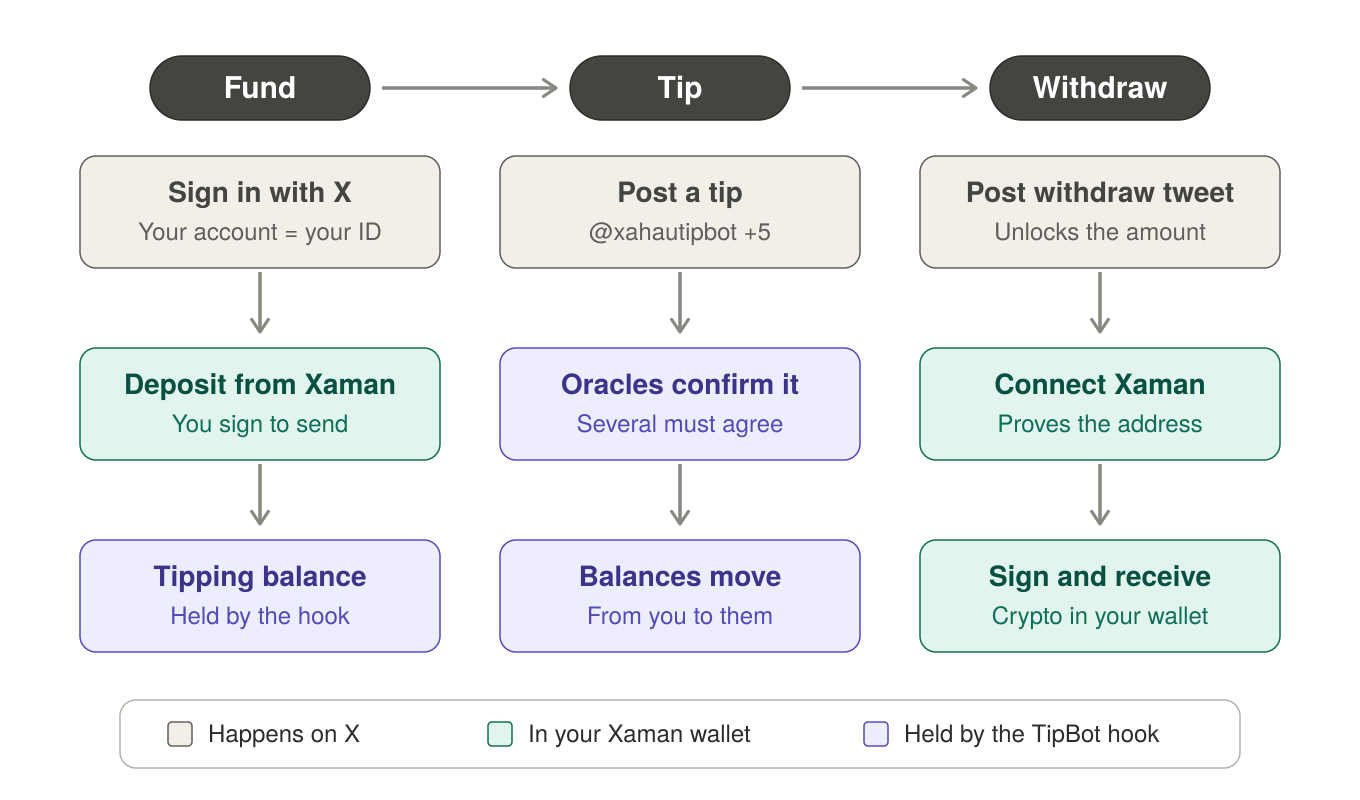 How The TipBot Works: Fund, Tip, Withdraw
- Fund: You sign in to the TipBot website with your X account, then deposit crypto from your Xaman wallet. The deposit becomes your tipping balance, held by the Hook. (You can also skip this step entirely if someone tips you first.)
- Tip: You post a command on X. Independent "oracle" operators spot the post, confirm it, and the Hook moves the amount from your balance to the recipient's.
- Withdraw: You post a withdraw command naming your Xahau address, connect Xaman on the TipBot dashboard to prove that address is yours, and sign the withdrawal. The crypto is sent to your wallet.
One important detail: your tipping balance is tied to your X account, not your @handle. Changing your username won't lose your funds. But it also means that, in practice, your X login acts like the key to your tipping balance.
Examples
Tipping is done entirely through posts on X. A few common patterns:
| What you want to do | What you post |
|---|---|
| Tip the author of a post (reply to it) | @xahautipbot +5 |
| Tip someone directly, without replying | @alice @xahautipbot +5 |
| Tip several people in one post | @alice +1 @xahautipbot @bob +2 @xahautipbot |
| Move funds so you can withdraw them | @xahautipbot withdraw 10 XAH to rYourAddress |
A few things to know:
- XAH is the default. A plain
+5sends 5 XAH, Xahau's native currency. - Up to 16 tips per post.
- The bot never replies. It doesn't like, reply, or DM. You confirm a tip by checking your balance on the dashboard. Tips typically settle within about 10 to 30 seconds.
- Mistakes are silent. A malformed command is ignored. The "How to tip" page includes a playground where you can test a post before sending it.
- Tips are final. Deleting or editing a post does not reverse a tip, and retweets never count.
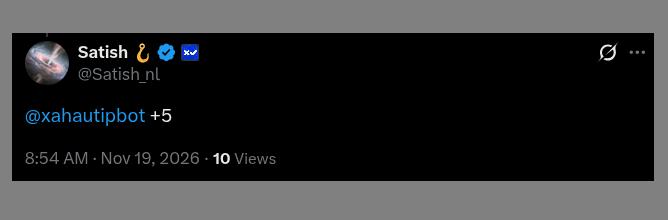 Basic 'Reply' Tip Denominated In XAH (Default Currency)
Convenient For Known Coins
Xahau supports many tokens beyond XAH, and each one is defined by two things: a currency code and an issuer, which is the account that created the token. Normally you'd need to include that issuer's long address in your tip so there's no ambiguity about which "USD" or "XRP" you mean.
For popular tokens, the TipBot removes that friction with shortcuts. Token creators can submit a request to the public TipBot-Shortcuts repository on GitHub. Once approved, everyone can tip that token by its ticker alone. At launch, shortcuts include XRP, USD, EUR, EVR, RVN, EURQ and several others.
The most common example will likely be XRP.
On Xahau, XRP exists as a token issued by GateHub. Thanks to the shortcut, these two posts do exactly the same thing:
@alice @xahautipbot +1 XRP
@alice @xahautipbot +1 XRP:rhub8VRN55s94qWKDv6jmDy1pUykJzF3wq
The first is the version most people will use. The second spells out GateHub's issuer address in full.
Two things to remember: you need to write the currency to send anything other than XAH (a plain +1 sends XAH, not XRP), and recipients who want to withdraw a token such as XRP to their own wallet will need a trustline for it in Xaman.
New Features
The new TipBot goes beyond the original. Its website includes a statistics page with badges, which Satish added prior to launch. It turns tipping into a visible record of community generosity.
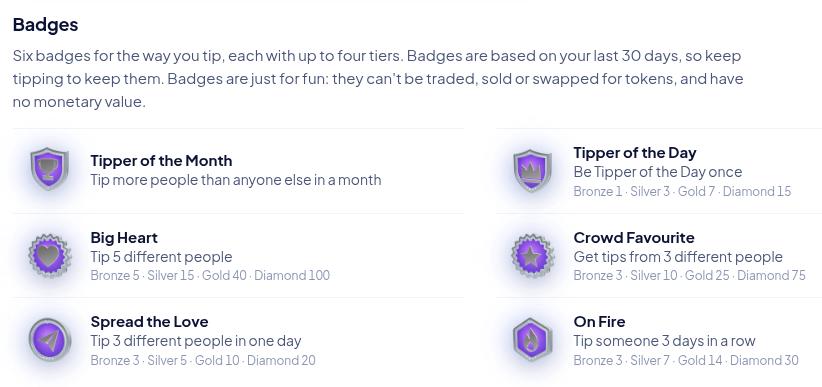 Badges
Satish also published developer documentation, so anyone can build their own dashboard, an app inside Xaman (an xApp), or other integrations on top of the TipBot.
Technical
Here is what the new Xahau TipBot really is, under the hood.
It's A Hybrid
It would be tempting to call the new TipBot a pure "Web 3.0" project, but it is more accurately a hybrid of Web 2.0 and Web 3.0. A useful way to think about it: the money side is Web3; the social side is Web2.
The Web3 side:
- Balances are stored on Xahau, inside the state of the TipBot's hook, not in a company database.
- There are two hooks. The main TipBot Hook handles tipping, while a Top-up Hook handles deposits and withdrawals.
- Every deposit and withdrawal requires a wallet's signature in Xaman.
- The hook itself enforces the rules, including checking that the sender's balance can cover a tip.
The Web2 side:
- Identity is your 'X' account, and every tip starts as a post on 'X'.
- A Hook can't read 'X' by itself. That job falls to oracles: independent servers, called Tipbot Oracle Nodes (TONs), watch 'X' through an API. Each oracle reads a post, checks the format, and submits a "vote" to the Hook. A tip is carried out only if more than half of the oracle group submits the same vote for the same post, so no single operator can create a tip on their own.
- The website and dashboard are a conventional web app, and the list of token shortcuts exists on GitHub.
The oracles are the bridge between these two worlds. Without them, the automated contract on Xahau would have no way of knowing that anyone had posted a tip. Wietse Wind is blunt about what this means:
"We still depend on X making those posts available and on the operators agreeing. If either stops, new tips can stall. The balances stay on Xahau."
That last sentence is the heart of the design.
The parts that could fail are the ones that make tipping convenient. The part that holds the money is designed to "keep going" ... independent of any person.
How Hooks Are Used
Two hooks were created by Richard Holland to be attached to the TipBot's account on Xahau. Each has a distinct job:
- The TipBot Hook handles tipping. It receives the "votes" sent by the oracle operators, counts them, and carries out a tip only once more than half of the oracles agree on the same post. It also checks that the sender has enough balance, ignores duplicate votes, and records the updated balances in its on-ledger memory (its "state").
- The Top-up Hook handles money moving in and out: deposits from users' Xaman wallets into their tipping balances, and withdrawals from those balances back to their own wallets.
Splitting the work this way keeps the tipping logic separate from the logic that moves funds on and off the network.
Back Story
The first version of the user interface was deliberately basic; the priority was proving that the core integration with the hooks worked. Once the functionality was solid, the team turned to the user-facing design.
Satish, the developer behind the TipBot's website and dashboard, was tasked with evaluating feedback from multiple reviewers, and merging it into the final creation:
"(The) second version of the UI is what we have now. Here the main focus was design, as the functionality was already covered early on."
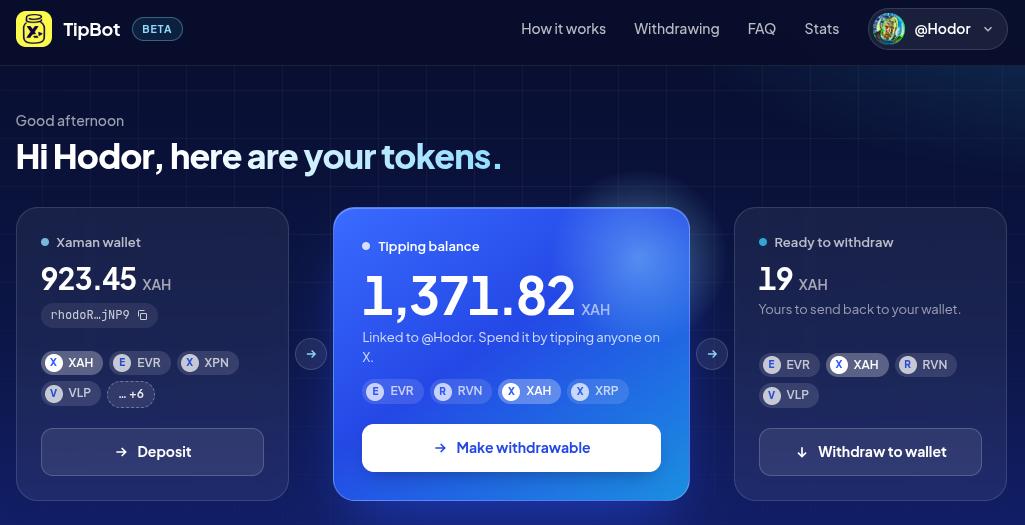 The TipBot Dashboard
The landing page - a dashboard that shows the intuitive separation between a user's wallet, their TipBot balance, and the amount that can be withdrawn - is a pleasant user experience.
Take A Look
Because the TipBot runs on a public ledger, anyone can look at its wallet.
Look up the TipBot's account, rtipboteEEZ6JkTNvcYgUZbiYyrV2W7DQ, on a Xahau explorer, and you'll see the total amount of each currency held by the TipBot, as well as the hooks attached to it.
What you won't see is who owns what. Individual balances and tipping activity are stored in the hook's state... its on-ledger memory. That data is still public, but it requires tools built on the developer documentation to read it in a friendly way.
A New TipBot For A Low-Trust World
The hooks that hold and move the TipBot's funds exist on the Xahau ledger. If the system works as designed, there is nothing for a business to manage by hand. Activity depends entirely on individual users choosing to fund, tip, and withdraw.
That also shifts responsibility to the user. There is no cap on how much of your balance you can tip, but Wietse Wind noted that the account protecting that balance is your 'X' account:
"Anyone who can post from your X account can spend your tipping balance. If you lose access to 'X', you need to get that account back to use the balance again. I can't reset it for you. Keep enough for the tips you want to send and withdraw the rest to your own wallet."
It is good advice for a low-trust world: treat your tipping balance like cash in your pocket ... not your savings account.
For Wietse, the relaunch is personal:
"The XRP TipBot is where my whole XRPL journey started. It led to Xaman and eventually to the inspiration that together with Richard Holland resulted in what became Xahau. … I'm pretty proud we've come full circle. I can tip someone who's never heard of it, and while I'm still explaining what it is, they can already tip somebody else. I missed that :)"
And his advice to anyone who receives their first tip:
"If someone just tipped you 1 XRP, find a post you like and reply with @xahautipbot +1 XRP. You've just passed it on. No registration, no wallet, no need to visit our site."
Frictionless onboarding - and fun - is back.
X | X>
Sources
- Cover Photo by: https://unsplash.com/@salivan_91?utm_source=unsplash&utm_medium=referral&utm_content=creditCopyText
- Wietse Wind and Satish, Q&A over 'X' DM
- Xahau TipBot, How to tip: https://xahautipbot.com/how-to-tip
- Xahau TipBot, FAQ: https://xahautipbot.com/faq
- Xahau TipBot, How to withdraw: https://xahautipbot.com/how-to-withdraw
- Xahau TipBot, For token issuers: https://xahautipbot.com/for-token-issuers
- Xahau TipBot, Stats and badges: https://xahautipbot.com/stats
- Xahau TipBot, Developer documentation: https://xahautipbot.com/developers
- Launch announcement on X: https://x.com/WietseWind/status/2123421890429534275
- Tipbot Oracle Node source code (Richard Holland): https://github.com/RichardAH/tipbot-oracle-node
- TipBot Hooks source code: https://github.com/RichardAH/tipbot-hooks
- TipBot token shortcut list: https://github.com/RichardAH/TipBot-Shortcuts
- TipBot account on a Xahau explorer: https://xahauwin.com/account/rtipboteEEZ6JkTNvcYgUZbiYyrV2W7DQ#hooks
- Original TipBot account count and Uphold partnership (The Daily Hodl): https://dailyhodl.com/2020/05/16/crypto-trading-network-uphold-revives-popular-xrp-payments-platform/
- Dutch AMLD5 rules and compliance costs (Cointelegraph): https://cointelegraph.com/news/xrp-tipbot-rescued-from-dutch-regulations-through-partnership-with-uphold